TrendForce has raised the capex forecast for major US and Chinese CSPs. With memory contract prices remaining elevated, memory spending is set to exceed half of total capex, while suppliers are prioritizing capacity for server products. CSPs are expected to balance total cost of ownership through architectural adjustments such as memory tiering and pooling.
TrendForce offers you a complete analysis on DRAM industry supply/demand sufficiency, cost analysis and price forecast.
CSP and Neocloud demand lifts the AI server outlook as NVIDIA shifts to VR200, AMD and ASICs gain, and cooling upgrades.
Suppliers and CSPs have signed multi-year server DRAM LTAs, placing many of its bit supply under price-band mechanisms while the rest are negotiated quarterly; spot trading remains quiet and flat. Micron beat expectations, but contract price momentum is easing as it expands SCAs and locks in HBM supply. TrendForce sees LTAs smoothing the memory cycle.
Robust AI demand has driven profitability in HBM and server products, squeezing consumer memory supply and sparking explosive growth in memory prices and industry revenue. DRAM vendors are substantially boosting capital expenditures for new fabs, with tight supply expected to persist into the year after next. Conversely, NAND Flash investment remains conservative due to space constraints and resource prioritization toward DRAM, relying primarily on node migrations for bit growth.
TrendForce combines its expertise in memory market and leverage it to provide a multi-faceted study of server market in this report. The content of it is as follows:
1. Server CPU Market: State of Competition and Market Shares
2. Server Procurement by Cloud Service Providers in North America and China
3. Projection on Shipments of Server Storage Products
4. Projection on Server Shipments for Current Year
5. Major ODM Partners of Critical Server Brands
6. Changes on Volumes in Server DRAM Procurement
7. Trends in SSD Procurement and Projections on Storage Form-Factors and Interfaces
8. Shares of Enterprise and Hyperscaler Servers in Memory Consumption.
This report leverages TrendForce’s expertise in the memory industry, as well as extends its in-depth research and analysis on the automotive sector
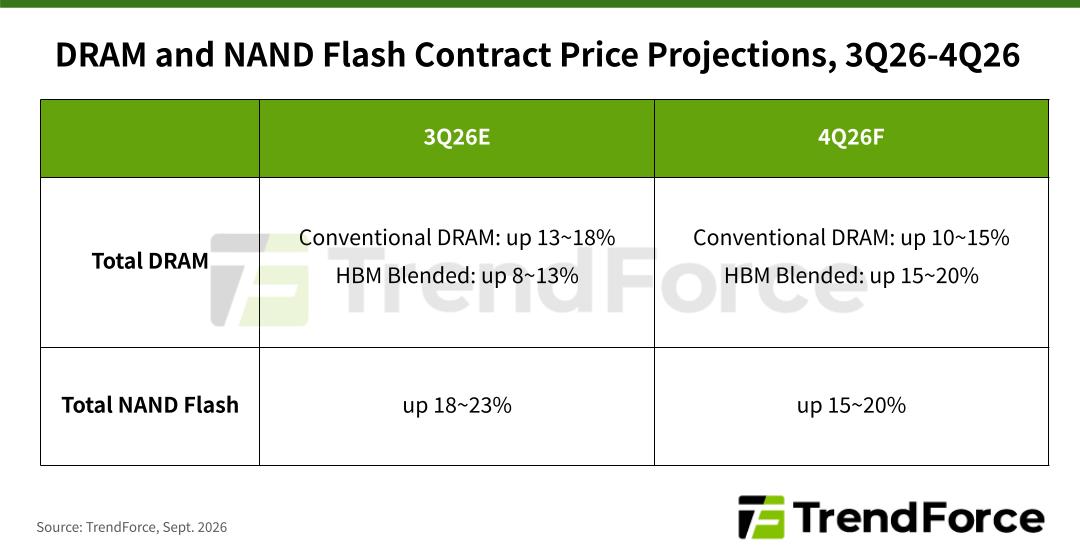
Robust add-on demand from US cloud service providers is pushing up long-term agreement price bands and driving server memory contract prices steadily higher. Conversely, Chinese providers are pivoting to lower-capacity products due to liquidity constraints. Suppliers are flexibly reallocating capacity toward higher-priced server products. Coupled with raised price ceilings on select long-term agreements and premiums on add-on orders, fourth-quarter contract prices are projected to rise by over 10% quarter-over-quarter.
Memory contract prices remained stable with expected growth momentum. On the supply side, major Korean and Taiwanese makers shifted capacity to server applications, causing severe PC DRAM shortages and tight secondary market supply. On the demand side, improved CPU availability and channel stocking boosted shipment performance, prompting PC OEMs to aggressively accumulate inventory and optimize costs.
Consumer DRAM prices are approaching the limit of buyer cost tolerance, with recent contract prices settling slightly higher and the spread between high and low pricing narrowing somewhat. Looking ahead, as major suppliers reallocate capacity to advanced products, the supply of mature node memory will continue to contract; combined with strengthening demand for server storage components, the market supply deficit will persist, keeping prices elevated.
Research Areas:
Industry News