TrendForce raised its 2026 global server shipment forecast, driven by surging AI server demand from CSPs and enterprises, with momentum expected through 2027.
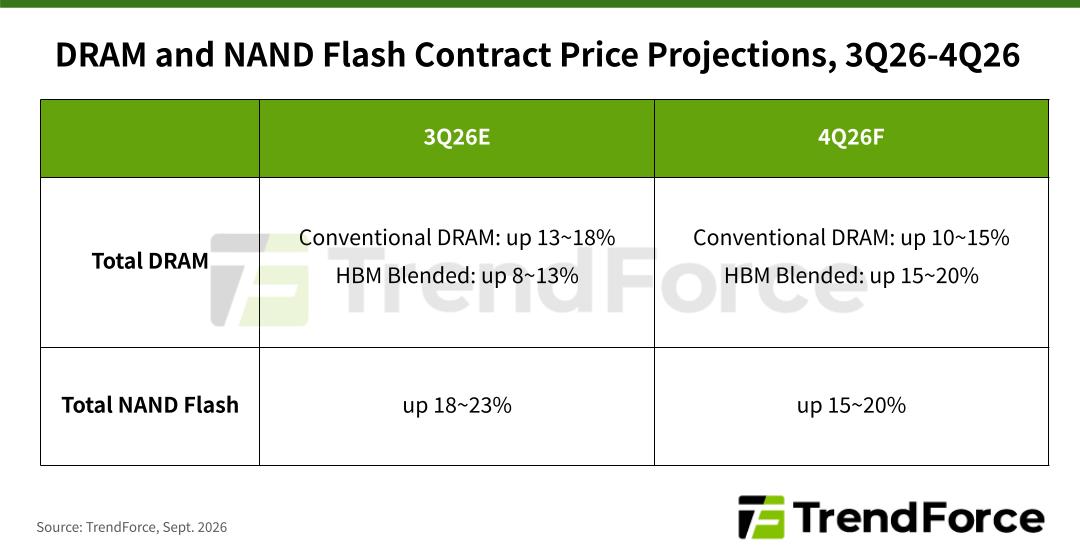
Server DRAM contract prices strengthen on supplier hikes, while spot markets show modest gains amid cautious buying. To overcome conventional capacity constraints caused by a focus on high-bandwidth memory, manufacturers are aggressively advancing node transitions to boost overall bit supply. Despite extensive expansion plans, new capacity will not significantly debut until the second half of the year after next, prolonging the current market undersupply.
Server DRAM contract prices continue to rise due to supply deficits and depleted manufacturer inventories. Although premium pricing on high-capacity modules and shifts in processor configurations have led cloud service providers to recalibrate their demand toward low-to-mid capacity options—temporarily halting the growth momentum of large-capacity shipments in the second half—overall server demand remains robust, keeping the market under-supplied.
The era of high-cost memory is unlikely to end anytime soon, and the global smartphone market is projected to enter an output adjustment period starting in 2Q26. Brands equipped with economies of scale, conglomerate resources, and premium product pricing power are well-positioned to stand out in this elimination race. Conversely, brands predominantly selling low-to-mid-range products must brace themselves for a battle for survival.
Driven by strong low-cost laptop sales and active server restocking, supplier inventories remain low, maintaining strong pricing power. PC DRAM contract prices grew significantly in Q2, with the upward trend projected to extend into Q3 and Q4.
Major manufacturers are shifting capacity to high-end chips, leaving mature niche DRAM severely undersupplied and reinforcing sellers' pricing dominance. To secure shipments amid high prices and shortages, buyers have resorted to downgrading capacities or process generations. Driven by robust AI and networking demand, this structural shortage is expected to persist long-term.
Propelled by substantial contract price increases, 1Q26 Mobile DRAM revenue reached an all-time high, with ASP appreciation serving as the core growth engine. From a supply perspective, vendors are channeling resources toward AI and server applications, resulting in a structurally constrained supply outlook for consumer Mobile DRAM over the long haul. Market concentration has intensified, with Samsung, SK hynix, Micron, and CXMT now dominating the landscape. Notably, CXMT has capitalized on its LPDDR4X supply strength to elevate its revenue contribution, cementing the "Big Four" formation. Meanwhile, Taiwan's Nanya and Winbond have reaped short-term gains by filling the void left by tier-1 players withdrawing from legacy nodes and low-density segments. That said, their overall footprint remains modest, with future trajectory highly dependent on pricing dynamics and the pace of new capacity ramp-ups.
The contract market sees seller-driven price hikes amid strong demand, while the spot market remains stagnant. Suppliers' focus on advanced and HBM causes legacy product shortages. Constrained by long expansion cycles, supply bottlenecks will persist for years, prompting buyers to secure long-term agreements and driving future price surges for HBM.
Driven by the expansion of AI inference demand into general servers, memory procurement has surged. With supplier inventories bottoming out and production capacities concentrated on high-margin products, tight supply has fueled soaring contract prices, leading to explosive growth in industry revenue and profits. Meanwhile, Taiwanese manufacturers are focusing on mature nodes to fill market gaps, while major suppliers will gradually expand output through node transitions.
Micron heavily invested in its US facility to launch advanced-node production of legacy memory, targeting long-lifecycle sectors like automotive and aerospace. Echoing US manufacturing policies, this internal capacity shift will contract global legacy memory output. Sustained by robust networking demand, market shortages are expected to persist.
Research Areas:
Industry News