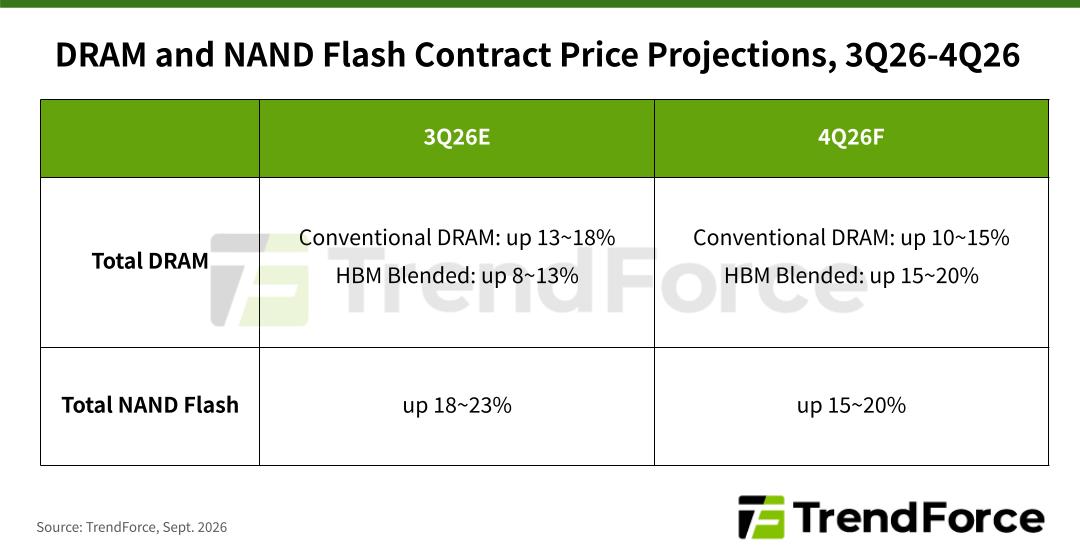
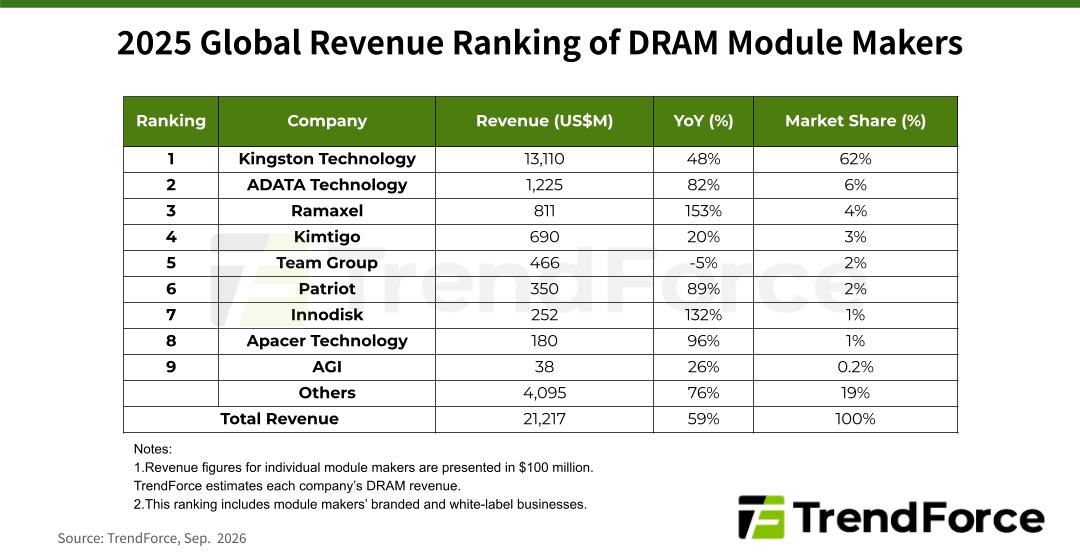
Some CSPs are actively buying additional server DRAM, driving supplier stocks to a lower level and pushing up contract prices. Meanwhile, the spot market continues to fluctuate within a narrow range due to holidays. As HBM squeezes production capacity, primary supply across various applications remains tight, prompting PC, smartphone, and module manufacturers to adjust specifications or raise inventory levels to address cost and supply challenges.
CSP demand keeps 4Q26 DRAM and NAND prices rising, led by AI, while weak consumer demand narrows other gains.
Tight supply and robust CSP demand keep DRAM undersupplied; TrendForce lifts its 4Q26 contract price outlook.
AI server demand stays firm as CSPs order NVIDIA racks, Tier-2 centers gain share, and hyperscalers expand ASIC plans.
AI infra demand tightens DRAM supply; PC and mobile brands cut output and adopt alternatives memory sources amid mounting cost pressure.
Driven by AI Agent computing expansion and third-party outsourcing demand, server shipments and CPU requirements have been revised upward. Memory suppliers face severe capacity constraints due to shifting production toward high-bandwidth memory, driving contract prices up significantly and increasing the share of high-capacity modules. As buyers actively build buffer inventory to prevent assembly bottlenecks, the structural supply shortage is expected to persist over the coming years.
Surging memory prices have triggered early purchasing, driving a short-term recovery in smartphone production this year; however, this pull-in effect will exacerbate market deterioration next year. Constrained by a high base and rising buyer inventory levels, the growth rate of Mobile DRAM contract prices is narrowing in the third quarter. As original manufacturers shift production capacity toward server DRAM and high-bandwidth memory (HBM), prices are projected to enter a period of high-level consolidation by year-end, with supply remaining tight into next year.
In 2Q26, Server DRAM revenue surged 53% QoQ to $75.58B. AI servers drove demand for high-capacity RDIMMs and DDR5. With rock-bottom supplier inventories, average prices rose 53–58%, pushing the supply shortage and price hikes through 2027.
RDIMM contract premium narrows on shifting demand, while spot market sees limited trades. Custom HBM (cHBM) optimizes AI chip area and performance via logical base dies, yet faces cooling, multi-sourcing, and high development cost hurdles, limiting early adoption to hyperscalers.
AI servers drive strong demand for conventional DRAM and HBM. Supply tightens, pushing contract prices higher and boosting memory suppliers' revenues. As server applications prioritize capacity, PC and smartphone demand slows due to cost pressures. Buyers pivot to lower-capacity modules to mitigate expenses, while major global suppliers expand through node upgrades.
Research Areas:
Industry News