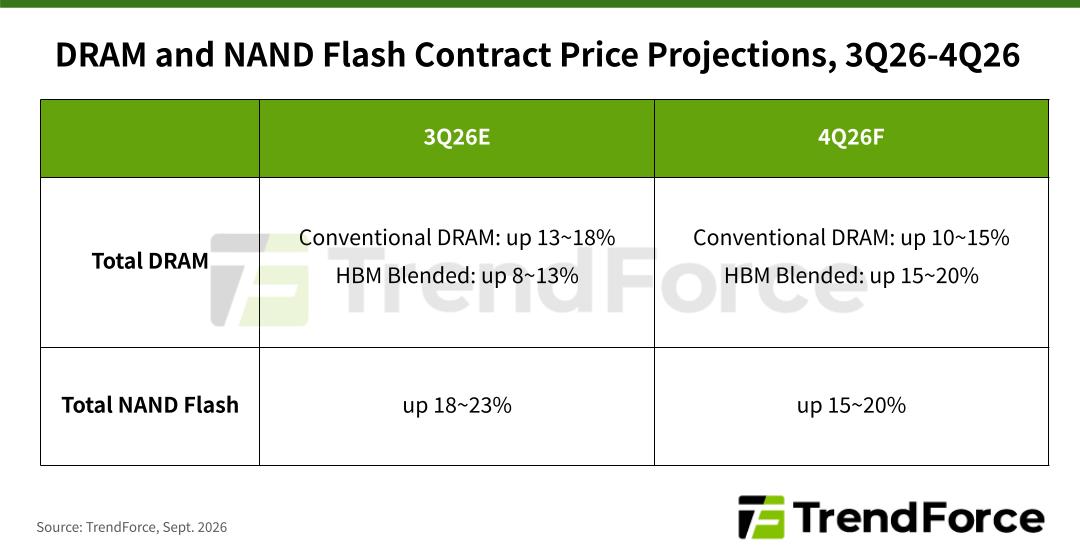
DRAM contract prices continue to rise. Driven by tight supply and expectations of negative production growth, manufacturers keep raising quotes. Despite pressure on passing costs to retail, low inventories and strong replenishment needs have pushed up future price forecasts, while the spot market increasingly relies on server demand.
2Q26 smartphone memory price negotiations have once again resulted in substantial price hikes. Multiple consecutive quarters of steep increases have left brands unable to absorb the costs, weighing on end-device production. As a result, 3Q26 is expected to see a muted peak season. On the spot market, elevated costs, buyer hesitation, and price expectation gaps have led to a sharp decline in transaction volumes. Brands have also slowed their procurement strategies to maintain cash flow stability.
Server DRAM contract prices are seeing upward momentum driven by robust server demand, whereas the spot market remains sluggish due to a lack of consensus between buyers and sellers. Regarding inventory dynamics, suppliers are maintaining extremely low levels thanks to aggressive client procurement. PC OEMs are experiencing accelerated inventory depletion, but module houses are facing inventory build-up amid weak channel demand. To preempt future supply constraints, hyperscalers and server OEMs are actively adjusting capacity configurations and securing additional orders. Meanwhile, smartphone brands have adopted conservative procurement strategies due to mounting cost pressures.
Global server growth accelerates in 2026 as CSPs expand AI infrastructure investment and custom silicon adoption reshapes procurement strategies.
DRAM contract and spot markets maintain upward trends. While CXMT's re-inclusion in the US military list inflicts no immediate sanctions, Entity List restrictions continue to hinder its advanced nodes. CXMT is boosting server DRAM for domestic clients and building new fabs, though foreign equipment limits cloud high-end progress.
Driven by AI infrastructure, major DRAM makers shift capacity to advanced nodes, tightening mature processes. To secure supply and control costs, brands downgrade to older generation consumer DRAM, shifting shortages from DDR4 down to DDR2 and boosting prices. Taiwanese suppliers pivot strategies accordingly, reflecting a persistent global structural DRAM shortage.
As AI shifts from training to inference and agentic workloads, Server CPU evolves from auxiliary to core orchestrator, lifting both ARM and x86 demand into a new growth cycle.
Contract negotiations extend as suppliers prioritize major American clients, while spot prices rise on strong demand. AI adoption reshapes memory specifications toward higher bandwidth and lower power. As computing demands surge, severe capacity shortages limit server configurations, making supplier allocation critical to industry growth.
AI demand and proprietary chip adoption drive upward revisions in global server shipments. Despite supply bottlenecks, memory face severe shortages and soaring prices. AMD and alternative architectures gain market share, putting pressure on the traditional market leader.
Soaring memory prices have triggered a chain reaction, leading to a significant downward revision in annual smartphone production. Faced with heavy cost pressures, brand strategies are diverging; tech giants with premium pricing power and deep resources are poised to expand their market share. Driven by surging contract prices, the mobile DRAM market revenue hit record highs, officially cementing a highly consolidated four-player oligopoly.
Research Areas:
Industry News