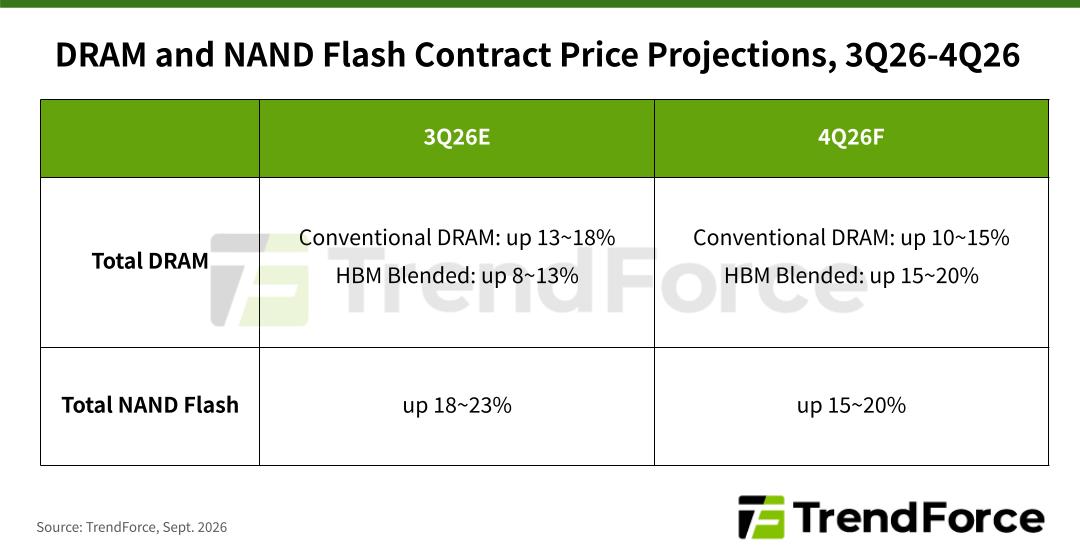
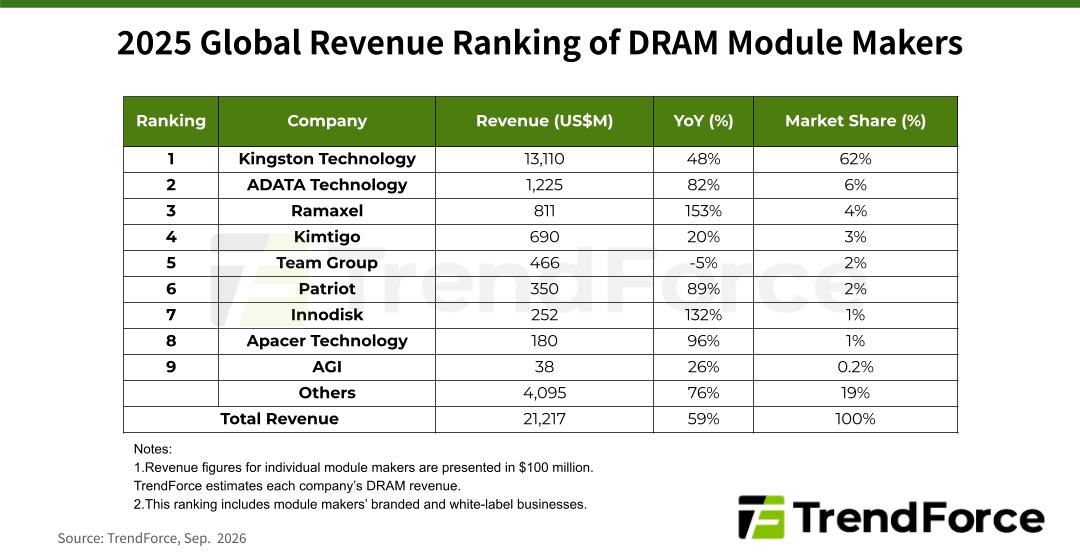
The contract market sees seller-driven price hikes amid strong demand, while the spot market remains stagnant. Suppliers' focus on advanced and HBM causes legacy product shortages. Constrained by long expansion cycles, supply bottlenecks will persist for years, prompting buyers to secure long-term agreements and driving future price surges for HBM.
Driven by the expansion of AI inference demand into general servers, memory procurement has surged. With supplier inventories bottoming out and production capacities concentrated on high-margin products, tight supply has fueled soaring contract prices, leading to explosive growth in industry revenue and profits. Meanwhile, Taiwanese manufacturers are focusing on mature nodes to fill market gaps, while major suppliers will gradually expand output through node transitions.
Micron heavily invested in its US facility to launch advanced-node production of legacy memory, targeting long-lifecycle sectors like automotive and aerospace. Echoing US manufacturing policies, this internal capacity shift will contract global legacy memory output. Sustained by robust networking demand, market shortages are expected to persist.
2026 server market accelerates on AI demand; CSPs expand CAPEX while OEMs compete via rack-scale and liquid cooling solutions.
Strong AI and server demand causes structural DRAM undersupply, driving contract and spot prices upward. Supplier inventories have bottomed out. Cloud and PC makers are aggressively securing long-term contracts, while smartphone brands adopt conservative procurement. Supply remains constrained.
Mobile DRAM contract hikes slowed due to costs, yet server demand stabilized overall prices; spot prices rose. Diverse AI applications boost demand across all server DRAM capacities. High-capacity leads, with future growth hinging on resolving CPU shortages.
CSP Capex fuels AI server growth; GPU and ASIC engines drive market upgrades as liquid cooling adoption accelerates.
Strong AI and server demand is driving upward revisions in memory contract prices, despite a sluggish spot market. Supplier inventories have bottomed out, with high-end applications driving profits. Next-gen HBM will soon enter mass production, becoming a key revenue driver. While RDIMM margins temporarily lead due to differing pricing mechanisms, HBM prices will eventually catch up.
Smartphone Mobile DRAM contract prices are maintaining their strong upward momentum in 2Q26. Samsung and Micron were the first to issue quotes, whereas SK hynix and CXMT have only provided tentative pricing so far, with final negotiations expected to conclude in May. Following steep price hikes for two consecutive quarters in 1H26, smartphone brands are finding these cost pressures increasingly difficult to absorb. Consequently, not only are 2026 smartphone production targets facing downward revisions, but brands may also fail to fulfill their previously negotiated LTA bit procurement volumes. Looking ahead, as AI servers continue to crowd out production capacity, smartphone brands must optimize their memory requirements at the software and system architecture levels. This approach is essential for maintaining operational resilience while caught between soaring costs and softening end-market demand.
Driven by supply shortages and bottoming supplier inventories, server memory makers now hold absolute pricing power, leading to continuous and substantial upward revisions in contract prices. Although suppliers are shifting mobile capacity to servers to boost supply, robust demand fueled by cloud providers' expanding capital expenditures on AI and data centers keeps the supply gap wide open. Consequently, the long-term price outlook remains bullish.
Research Areas:
Industry News