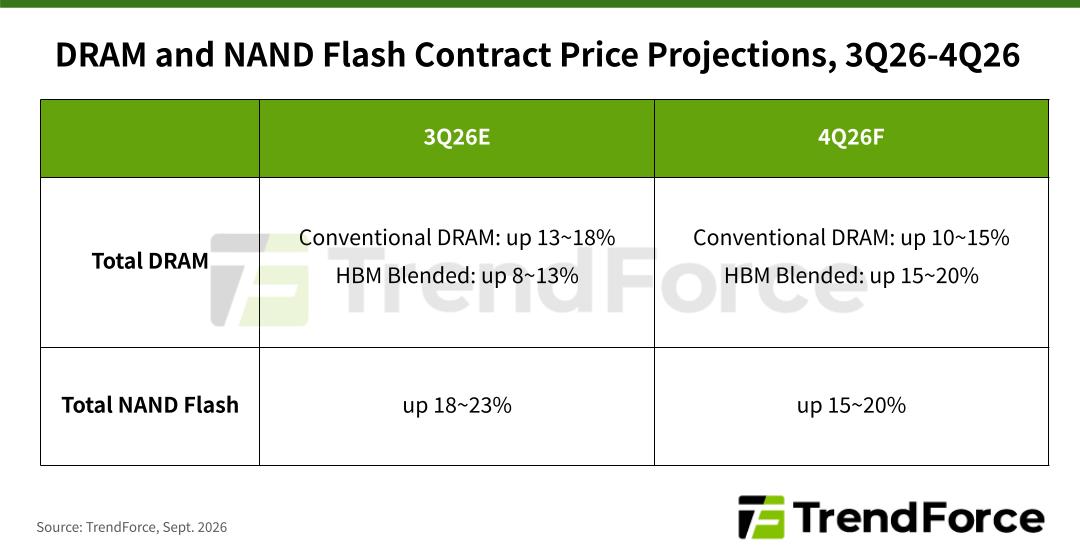
PC DRAM contract prices saw their quarterly increase revised upward, while spot transactions stayed subdued. HBM negotiations remain deadlocked with specifications still in flux, yet prices retain strong upside. Ahead, HBM shifts from a single-spec race toward customization, layering, and simplified packaging.
Server DRAM prices rise due to strong demand and HBM capacity crowding out. Buyers shift to mid-to-low capacity modules to optimize costs, while high-capacity stock flows to OEMs, helping suppliers maintain low inventory and strong pricing power. High-capacity premiums narrow as suppliers hike lower-capacity prices. Meanwhile, lower HBM stack specs may boost long-term bit supply.
The supply gap in consumer DRAM persists, keeping prices on a slight upward trend. However, as buyer cost tolerance reaches its limit, contract price growth is moderating. With suppliers locking in most capacity through long-term agreements (LTAs) and surging demand for enterprise SSDs crowding out standard consumer applications, this structural market tightness is expected to extend over the next couple of years.
Rising memory costs triggered premature purchases as consumers sought to beat price hikes, driving a short-term rebound in smartphone production and prompting TrendForce to revise its full-year output forecast upward. However, this momentum reflects front-loaded demand rather than a genuine market recovery. As persistent cost pressures trickle down to end-user pricing, entry-level models are set to disappear, leaving the market vulnerable to structural contraction risks ahead.
Rising chipmaker quotes and modest shipment recovery drive PC DRAM contract price increases. Facing future supply contraction, OEMs aggressively build inventory while adopting component downgrades to manage costs. Meanwhile, spot prices remain firm, prompting vendors to initiate long-term agreements for market visibility.
Mobile DRAM revenue surged sharply in 2Q26; four vendors dominate. Growth will moderate in 3Q26 as price gains slow.
Global DRAM manufacturers are accelerating new fab construction and capital expenditures, with new capacity set to release in phases starting two years from now. As cleanrooms and equipment installations advance across major suppliers, large-scale capacity is expected to online progressively over the coming years, driving a structural expansion in industry supply. However, actual bit output remains subject to construction variables and product qualification timelines.
Strong CSP capex fuels steady AI server growth as cloud giants expand GPU rack orders and self-developed chip programs.
DRAM contract prices remain firm while spot activity stays subdued. Major suppliers are expanding capacity via new facilities, driving strong multi-year bit supply growth while dynamically adjusting output to sustain industry balance.
Consumer DRAM remains undersupplied, with contract prices still rising but decelerating as buyer cost tolerance tightens, while spot trading stays subdued. On technology, focus centers on open software frameworks and zHBM architectures aimed at improving system efficiency and power. Cloud demand supports near-term contract prices, but accelerating capacity expansion points to longer-term pressure on pricing and industry revenue.
Research Areas:
Industry News