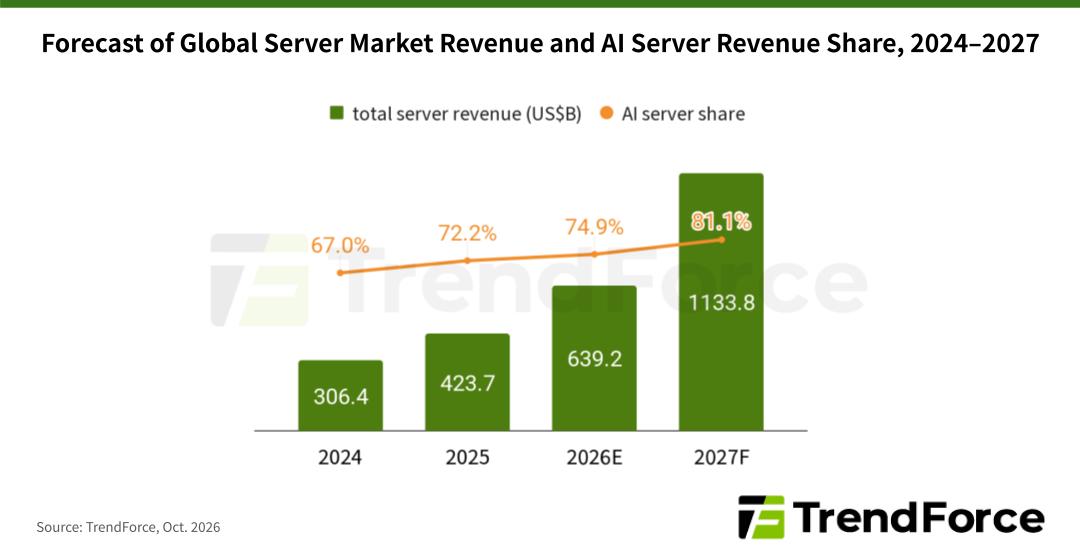
TrendForce raised its 2026 global server shipment forecast, driven by surging AI server demand from CSPs and enterprises, with momentum expected through 2027.
HBM remains irreplaceable in AI accelerators. HBM4 ramps, tight supply lifts prices, and ASIC demand diversifies the supplier base.
Server DRAM contract prices continue to rise due to supply deficits and depleted manufacturer inventories. Although premium pricing on high-capacity modules and shifts in processor configurations have led cloud service providers to recalibrate their demand toward low-to-mid capacity options—temporarily halting the growth momentum of large-capacity shipments in the second half—overall server demand remains robust, keeping the market under-supplied.
The explosion in global AI service demand has triggered a severe supply-demand imbalance in the enterprise SSD market, driving quarterly revenue and contract prices to historic highs. Major suppliers are aggressively adjusting their capacity, shifting resources from consumer-grade to enterprise-grade products, and accelerating the development of next-generation, high-speed storage solutions. Consequently, SSDs are gradually transitioning into a computing-assistive role, and the market is expected to sustain a long-term upward trend.
As AI server platforms advance, power architectures evolve into multi-track systems, and cooling accelerates toward full liquid solutions. Delta and LiteOn capture cloud service provider and new platform demands with diverse, high-power architectures, aggressively expanding localized capacity. AVC and Sunon accelerate into system-level liquid cooling integration, driving growth amid computing upgrades.
Since 2H25, accelerated AI infrastructure buildouts by CSPs have surged HBM demand and crowded out conventional DRAM capacity, pushing the broader DRAM market into shortage. Constrained by annual pricing mechanisms, HBM per-wafer output value and margins fell below DDR5 RDIMM in 1Q26. As 2027 HBM4 supply negotiations launch in 2Q26, TrendForce expects suppliers to push through substantial contract price hikes, reflecting acute supply-demand imbalance and rising next-generation manufacturing costs.
NVIDIA FY1Q27 hit a record high with Data Center share above 92%,with GB/VR Rack rollout boosting liquid cooling and HBM supply chains.
2026 server market accelerates on AI demand; CSPs expand CAPEX while OEMs compete via rack-scale and liquid cooling solutions.
AI server demand surges on hyperscale and inference workloads, lifting CSP rack-scale buildout amid grid constraints.
As NVIDIA and ASIC platforms expand, AI data center power and liquid cooling capacities face tightening supplies. Chinese firms Megmeet and Honor have successfully entered global supply chains, achieving breakthroughs in high-power sectors. In thermal management, liquid cooling is shifting toward system-level integration, with Vertiv and AVC benefiting from dual GPU/ASIC demand, driving significant long-term value growth.
Research Areas:
Industry News