AI chipmakers are adopting custom HBM as base dies move to advanced logic nodes, strengthening TSMC's role in the HBM supply chain.
US and China CSPs keep expanding AI infrastructure with GPU racks and in-house ASICs, lifting 2027 shipments despite supply risks.
HBM shortages push AI chipmakers to cut stack heights, making 8hi mainstream from 2H27 while 12hi share declines.
With our expertise in the memory market, this provides a comprehensive analysis and forecast on HBM market share, ASP, wafer capacity, demand consumption, etc.
TrendForce has raised the capex forecast for major US and Chinese CSPs. With memory contract prices remaining elevated, memory spending is set to exceed half of total capex, while suppliers are prioritizing capacity for server products. CSPs are expected to balance total cost of ownership through architectural adjustments such as memory tiering and pooling.
TrendForce offers you a complete analysis on DRAM industry supply/demand sufficiency, cost analysis and price forecast.
TrendForce offers you a complete analysis on DRAM industry supply/demand sufficiency, cost analysis and price forecast.
Driven by expanding AI clusters and surging bandwidth, the AI networking market will reach US$269.5B by 2027 (92% CAGR from 2024). Growth is extending from back-end networks to high-speed accelerator interconnects and NICs, with accelerator interconnects growing fastest. The chip platform mix will shape how market value is distributed, while 1.6T optical transceivers, CPO, and novel optical packaging reshape the industry.
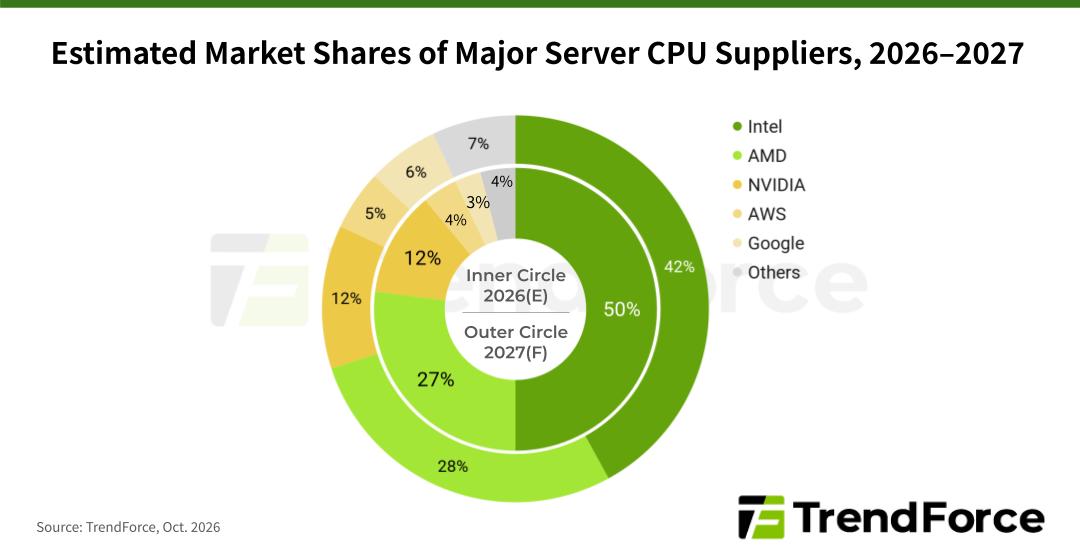
Agentic AI and inference reshape workloads, lifting server CPU demand. Shipments surge as CSP in-house Arm CPUs erode x86 share.
Inference demand drives CSP ASIC growth past GPUs; Google's next TPU adopts EMIB-T, with substrate yield key to cost.
Research Areas:
Industry News