AI chip makers weigh downgrading HBM capacity, hitting capacity for KV cache, lifting offload memory demand, as 8hi stays mainstream.
AI server demand stays firm as CSPs order NVIDIA racks, Tier-2 centers gain share, and hyperscalers expand ASIC plans.
AI compute surges in 2026 as ASICs rise, NVIDIA defends its ecosystem, and bandwidth becomes the bottleneck.
CSPs scale ASICs alongside GPUs, lifting packaging demand as CoWoS-L leads while EMIB-T and FOPLP emerge as new options.
CPO shifts to mass production, targeting test efficiency, lower costs, shared optical racks, and device gaps.
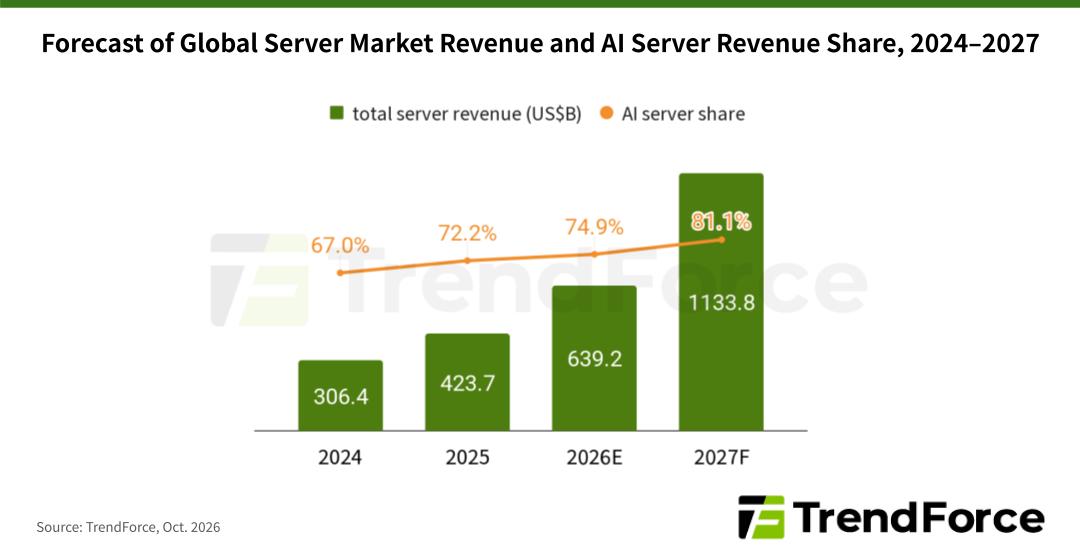
Driven by AI Agent computing expansion and third-party outsourcing demand, server shipments and CPU requirements have been revised upward. Memory suppliers face severe capacity constraints due to shifting production toward high-bandwidth memory, driving contract prices up significantly and increasing the share of high-capacity modules. As buyers actively build buffer inventory to prevent assembly bottlenecks, the structural supply shortage is expected to persist over the coming years.
In 2Q26, Server DRAM revenue surged 53% QoQ to $75.58B. AI servers drove demand for high-capacity RDIMMs and DDR5. With rock-bottom supplier inventories, average prices rose 53–58%, pushing the supply shortage and price hikes through 2027.
AI servers power surging demand, yet U.S. grid capacity trails shipments as midterm politics raise deferral risk.
Hyperscaler capex stays strong, lifting AI server growth, while tight supply now shapes shipment pace.
HBM 4hi samples emerge; low capacity curbs data center use; edge interest stays early, supplier uptake cautious.
Research Areas:
Industry News