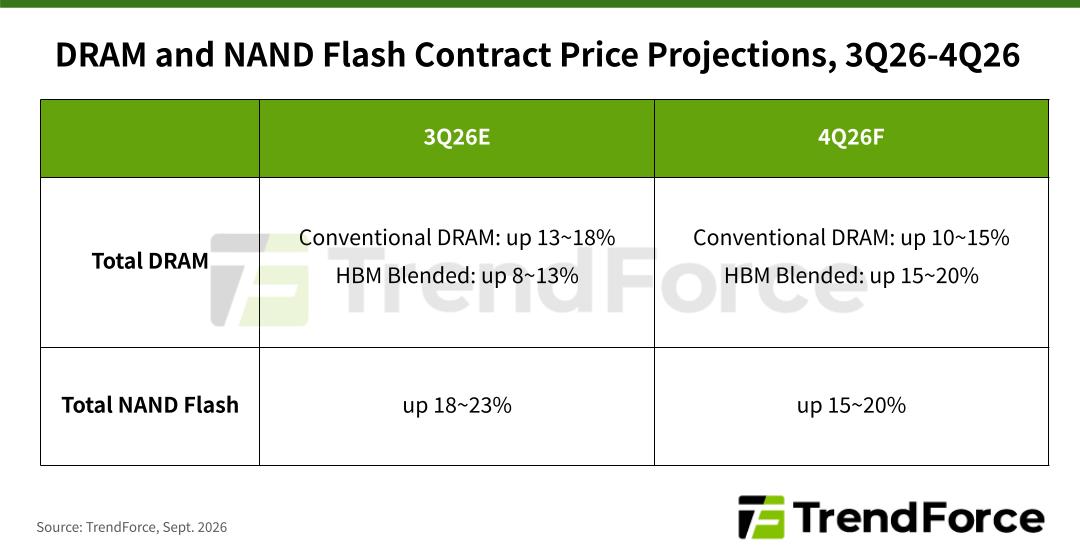
In 4Q26, buyer pushback at peak costs, high inventory and Chinese vendors’ rising share curb TLC eMMC/UFS gains, while MLC eMMC dips on substitution; 1Q27 off-season prices plateau as MLC faces heavier cuts.
Fourth-quarter contract price hikes are set to narrow as spot prices stay range-bound, while hybrid bonding replaces layer stacking as the key to NAND speed and cost.
TrendForce has raised the capex forecast for major US and Chinese CSPs. With memory contract prices remaining elevated, memory spending is set to exceed half of total capex, while suppliers are prioritizing capacity for server products. CSPs are expected to balance total cost of ownership through architectural adjustments such as memory tiering and pooling.
For the price chart of global end prices of SSD, TrendForce segments product categories in accordance with capacity (from 120GB to 2048GB and above) and user interface (SATA3, PCIe 3.0/4.0/5.0).
TrendForce offers you a complete analysis on NAND Flash industry supply/demand sufficiency, cost analysis and price forecast.
Toshiba is significantly expanding its HDD capacity in the Philippines, but given the lead time from investment to output, the benefits will materialize later, adding supply to the market without reshaping the competitive landscape. Areal density remains the key to HDD competition: Seagate leads with its fully in-house HAMR technology and is poised to overtake WD as the largest supplier, while Toshiba, still on MAMR, can only compete on volume.
Micron's strong results and upbeat outlook show AI data centers, edge AI and physical AI driving high-capacity storage demand, with data center SSDs as NAND's core profit engine. Disciplined supply and slow capacity expansion keep the market tight and suppliers in control of pricing, while long-term agreements and customer prepayments boost earnings visibility and could reshape the memory cycle.
Robust AI demand has driven profitability in HBM and server products, squeezing consumer memory supply and sparking explosive growth in memory prices and industry revenue. DRAM vendors are substantially boosting capital expenditures for new fabs, with tight supply expected to persist into the year after next. Conversely, NAND Flash investment remains conservative due to space constraints and resource prioritization toward DRAM, relying primarily on node migrations for bit growth.
TrendForce combines its expertise in memory market and leverage it to provide a multi-faceted study of server market in this report. The content of it is as follows:
1. Server CPU Market: State of Competition and Market Shares
2. Server Procurement by Cloud Service Providers in North America and China
3. Projection on Shipments of Server Storage Products
4. Projection on Server Shipments for Current Year
5. Major ODM Partners of Critical Server Brands
6. Changes on Volumes in Server DRAM Procurement
7. Trends in SSD Procurement and Projections on Storage Form-Factors and Interfaces
8. Shares of Enterprise and Hyperscaler Servers in Memory Consumption.
This report leverages TrendForce’s expertise in the memory industry, as well as extends its in-depth research and analysis on the automotive sector
Research Areas:
Industry News