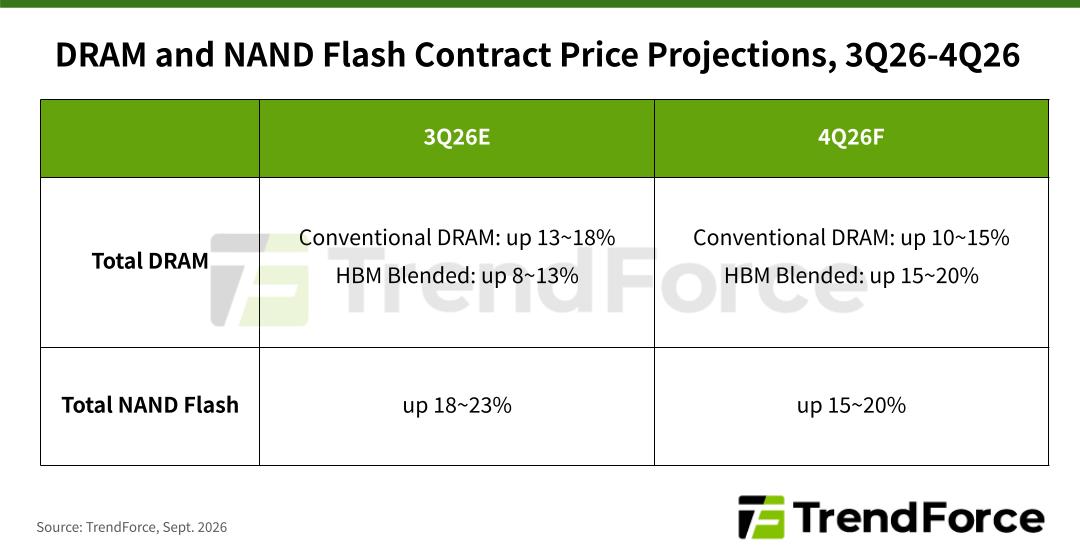
Driven by demand for artificial intelligence and cloud services, enterprise storage products are in short supply, driving significant growth in average memory selling prices and total industry revenue. In contrast, consumer electronics demand remains sluggish due to persistently high costs and increasingly conservative stocking strategies, creating a structural supply-demand divergence in the market, with future price increases expected to moderate gradually.
NOR Flash memory is facing a structural imbalance as major international manufacturers reallocate capacity to high-end AI products, contracting supply amid surging demand from servers and automotive applications. Delayed capacity expansions and resource diversion among vendors mean high-density supply shortages remain difficult to bridge, driving prices continuously upward. This profitable cycle is expected to persist through next year and beyond.
Price hikes suppress mobile demand, flattening contract prices while spot market stays weak. NAND controllers are evolving into AI compute layers. Driven by CMX architecture, customized NAND will integrate with AI processors across three phases to break memory bottlenecks.
3Q26 memory contract prices were finalized on strong server and AI demand, while the consumer segment reached a pricing compromise; meanwhile, the spot market remained flat due to weak end-user demand. The emerging HBF technology might bridges the gap between high bandwidth memory and solid-state drives, though cost and technical hurdles will limit its smartphone footprint to premium models and delay data center adoption until validation and standardization progress.
AI agents are driving up demand for KV cache and token storage, reshaping memory architecture. Cost considerations are pushing token storage down from expensive HBM and DRAM to SSDs. NAND suppliers are actively promoting next-generation solutions such as HBF, SCM, and SLC to address endurance and latency challenges, while wafer consumption climbs—making advance investment in leading-edge capacity a key competitive factor.
Driven by constrained capacity, niche NAND Flash supply shortages persist. SLC maintains moderate gains supported by rigid demand, though growth has slowed. MLC prices remain nearly flat as buyer cost limits are reached, entering a consolidation phase. Going forward, SLC will rise moderately while MLC stabilizes.
High prices of prime wafers are squeezing profits for module makers. Coupled with sluggish end-user demand, manufacturers are shifting to purchase downgraded materials to supply secondary markets and reduce costs—a move original suppliers welcome to clear inventory. The overall market is fluctuating at high levels. Aside from slight price increases in specific specs driven by supply constraints or rebound adjustments in high-capacity products, most items remain stable as buyers and sellers continue their price tug-of-war.
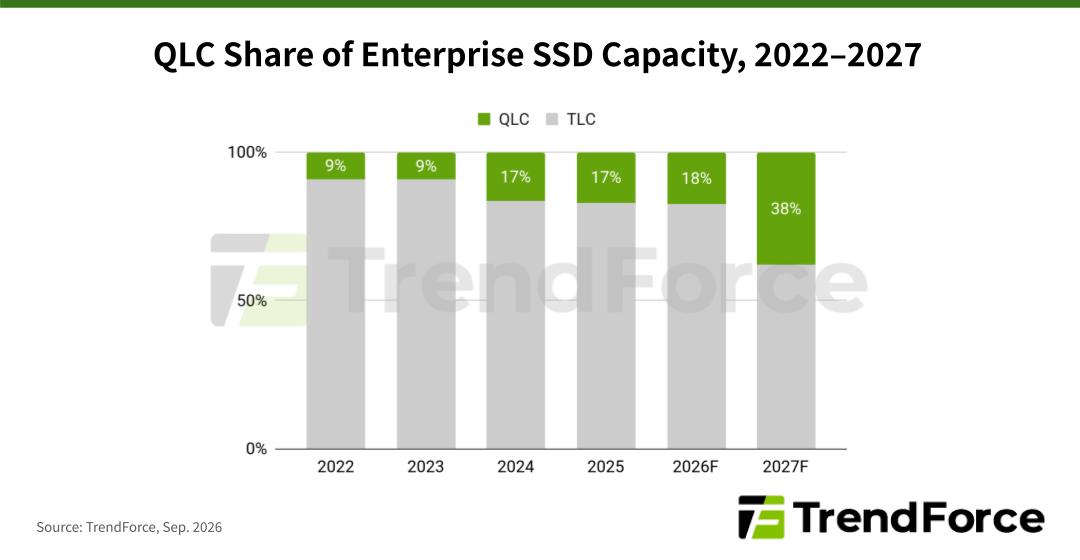
As NAND suppliers shifted capacity and compressed the consumer market, manufacturers fully expanded high-margin enterprise SSDs. Driven by generative AI and cloud infrastructure expansion, both shipment volumes and prices rose, pushing revenue to record highs. The top five giants are actively positioning in next-gen interfaces, high-layer stacking, and SLC/HBF technologies to build long-term competitive advantages.
Mobile DRAM and Mobile NAND Flash latest market supply/demand update.
NAND Flash capital expenditure is accelerating, yet manufacturers remain disciplined regarding capacity expansion. Supply growth is primarily driven by cleanroom filling at existing facilities and process technology transitions, yielding limited greenfield capacity. Overall facility expansion remains significantly smaller than that of DRAM, with substantial capacity additions deferred to later stages. Consequently, industry supply elasticity hinges heavily on technological upgrades rather than physical site expansions.
Research Areas:
Industry News