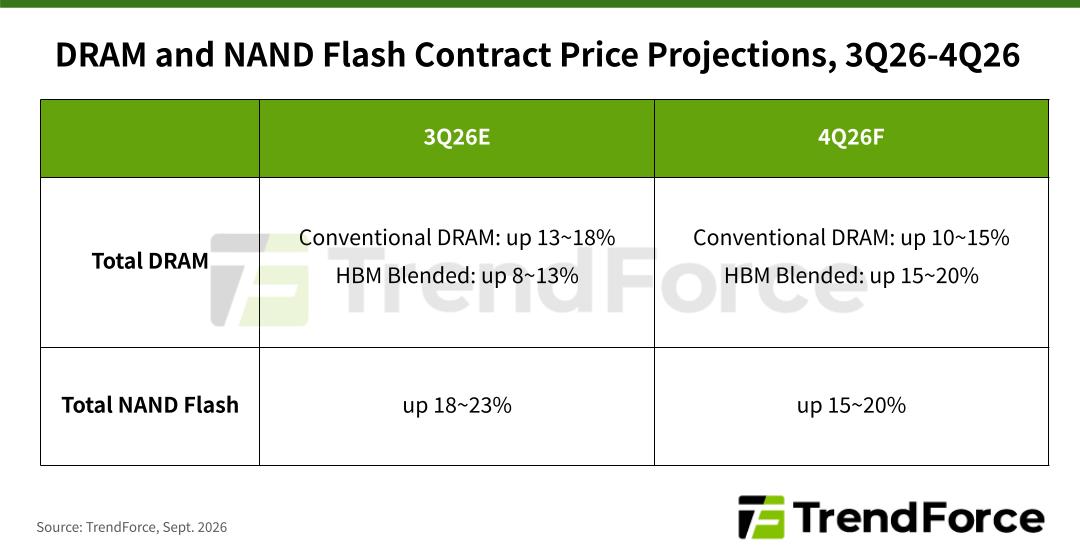
The memory market is exhibiting a clear two-tier divergence. Strong demand for high-performance storage, driven by cloud and artificial intelligence applications, is keeping supplier inventories at low levels and giving sellers significant pricing power, which continues to drive up enterprise market prices. In contrast, weak end-user consumer demand has fostered a cautious wait-and-see attitude among buyers, leaving spot prices in consolidation, while inventories at brand manufacturers and module houses have risen due to autumn restocking and resource allocation exchanges.
Driven by weak consumer end-market demand, NAND Flash wafer prices have stagnated at high levels. Although enterprise demand remains strong due to AI, inventory continues to pile up on the consumer side, leading suppliers to manage stock through bundled sales. Buyers show extremely low willingness to chase higher prices, with only select specifications seeing slight increases while overall prices consolidate sideways. If consumer inventory digestion continues to fall short of expectations, market prices face a heightened risk of a downward pull-back.
As original manufacturers shift production capacity to high-layer 3D processes, niche NAND Flash prices remain hovering at high levels. Influenced by buyers' cost pressures and supply discrepancies, price growth for low-capacity SLC has slowed significantly, whereas high-capacity SLC maintains its momentum, backed by rigid demand in automotive and networking applications. Meanwhile, due to extremely scarce supply and a hard price ceiling, MLC has entered a flat consolidation phase overall.
CSP demand keeps 4Q26 DRAM and NAND prices rising, led by AI, while weak consumer demand narrows other gains.
Driven by AGI and Agent AI, North American cloud providers' urgent orders for enterprise SSDs created a structural shortage in high-end storage. Suppliers prioritized capacity for high-margin products, taking strong pricing power and forcing overall contract prices up despite sluggish consumer demand.
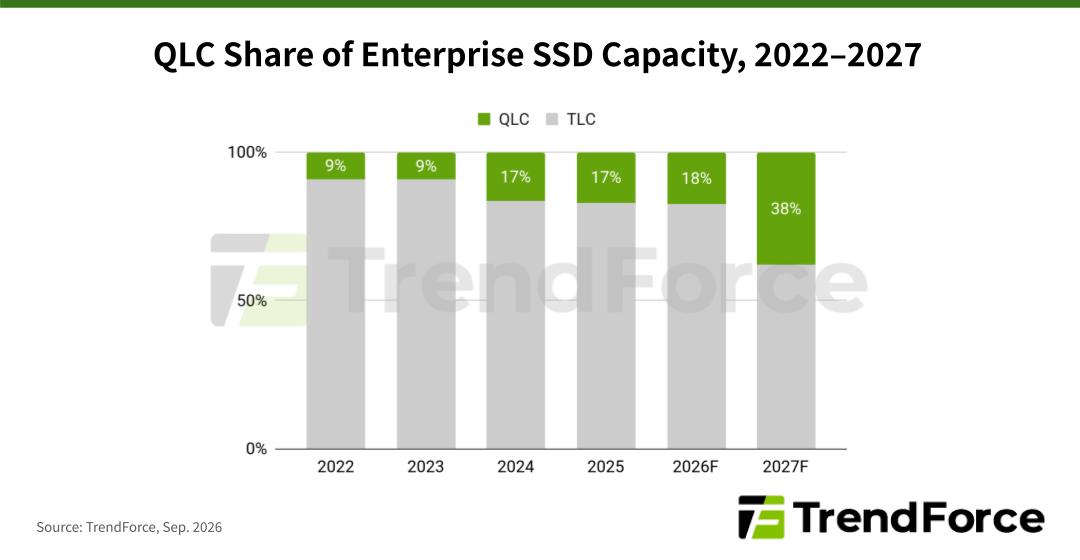
To address the surging KV cache demand driven by the development of agentic AI, cloud service providers are shifting their procurement toward high-performance QLC SSDs. By leveraging their high density and cost efficiency, combined with 'write-once, read-many' operating patterns and advanced attention compression techniques, QLC SSDs effectively overcome capacity bottlenecks while reducing hardware wear, making them the mainstream configuration for advanced storage units.
Winbond has agreed to acquire Infineon's NOR Flash and F-RAM businesses for more than US$1 billion, with closing targeted for 2H27. The deal brings automotive qualifications and high-density products, lifting Winbond's combined share to global No.1 with sharply expanded monthly capacity, turning the industry from a multi-player field into a single leader and strengthening its position in automotive and high-end AI markets.
Besides the mainstream market segments, TrendForce also provides price and supply/demand analyses for SLC solutions that belong to the more niche area of the NAND Flash market.
2027 NAND splits: enterprise SSDs surge on AI demand, while consumer products face price pressure from oversupply.
CSP QLC demand lifts ESSD contract prices; spot stays weak. Memory cost surge delays AI device capacity upgrades.
Research Areas:
Industry News