

Extended Component Lead Times Weigh on General Server Growth; 2026 Server Shipments Forecast to Grow 13% YoY, Says TrendForce
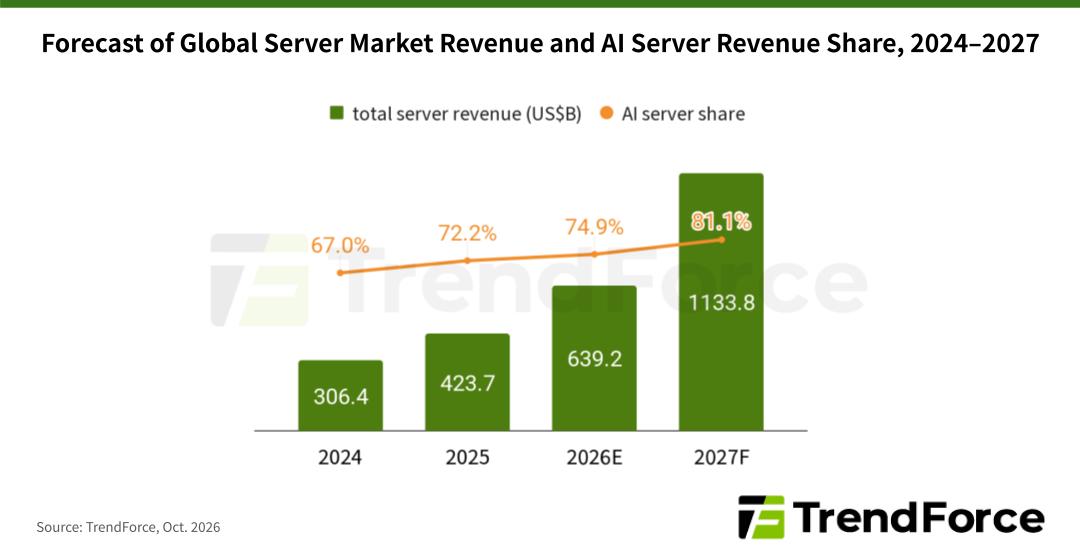
Although AI demand will continue to drive both general-purpose servers and AI servers in 2026, suppliers are prioritizing capacity allocation to higher-market AI server products, according to TrendForce’s latest server industry findings.
This has led to significantly extended lead times for multiple general server components. Consequently, full-year server shipment growth—previously expected to approach 20% YoY—is now projected to remain around 13%, falling short of fully reflecting underlying market demand.
TrendForce notes that demand for general servers remains steady. However, constraints in key components such as PCBs and CPUs are already evident, with lead times now extending to nearly one year. More recently, lead times for power ICs and BMC ICs have also lengthened considerably.
For PMICs, AI servers require substantially higher power density than general servers and are therefore prioritized by suppliers. As such, 8-inch wafer Bipolar-CMOS-DMOS (BCD) processes are increasingly allocated to AI-focused PMIC production. Compounding the issue, Samsung plans to shut down its S7 8-inch fab in Korea, further squeezing PMIC capacity for general servers. Lead times are therefore expected to extend from 21–26 weeks to 35–40 weeks.
BMC chips manufactured on mature nodes encounter similar constraints. Due to limited foundry capacity, suppliers are prioritizing higher-margin and urgent AI-specific chip orders, which reduces the availability for general-purpose BMCs. This has pushed lead times from 11–16 weeks to 21–26 weeks.
On the AI server side, strong demand from CSPs (cloud service providers) is expected to drive shipment growth of approximately 28% YoY in 2026, with ASIC-based AI servers likely to outpace GPU-based systems.
However, given the time required for chip validation and tuning by players such as Meta and Amazon Web Services, there is some risk of shipment delays. TrendForce has therefore slightly revised down the share of ASIC-based AI servers from nearly 28% to around 27%, with GPU-based systems still accounting for the majority.
TrendForce concludes that uneven global supply chain allocation and persistent lead-time bottlenecks for critical semiconductor components will continue to constrain general server shipment growth relative to AI servers, effectively capping overall server market expansion in 2026. Unmet demand and strong procurement momentum are expected to carry over into 2027, as capacity ramp-ups and component availability gradually catch up.
For more on the latest technology industry news and trends, please visit News.