

Rubin Faces Delay Risks Amid Ongoing Supply Chain Adjustments; Blackwell to Account for Over 70% of NVIDIA’s High-End GPU Shipments in 2026, Says TrendForce
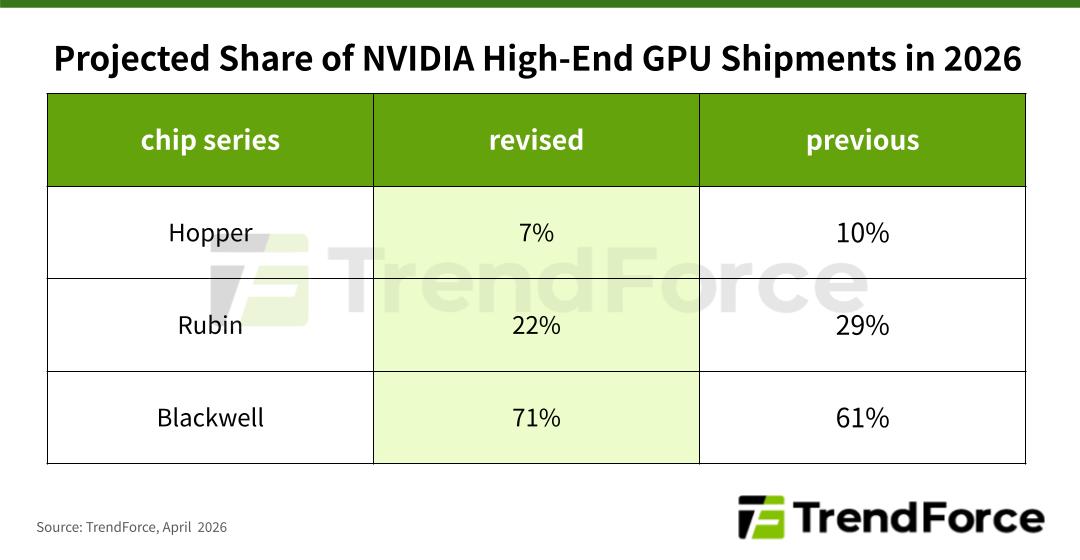
According to TrendForce’s latest findings on AI servers, NVIDIA’s high-end AI chip shipment mix is expected to change in 2026. The combined share of Hopper and Rubin series in overall high-end GPU shipments is anticipated to decrease due to geopolitical issues and ongoing supply chain changes. Meanwhile, the Blackwell series is projected to grow markedly from 61% to 71%, solidifying its leading position in the market.
TrendForce notes that strong AI demand, along with NVIDIA’s push for integrated GB/VR rack solutions that require higher chip content, will drive a notable increase in high-end GPU shipments in 2026. However, the annual growth rate is slightly revised downward from the previously estimated 26.8% to around 26%.
This downward revision is primarily due to shipment delays facing the Rubin series. In addition to the time required for HBM4 validation, challenges include transitioning network interconnects from CX8 to CX9, managing significantly higher power consumption, and optimizing performance under more advanced liquid cooling solutions. As a result, Rubin’s share of NVIDIA’s high-end GPU shipments is expected to decline from 29% to 22%.
Geopolitical factors also add uncertainty to the shipment timeline of H200, with actual deliveries dependent on future developments to U.S.-China policies. Consequently, the Hopper series’ share is forecast to drop from 10% to 7%.
By comparison, the more mature Blackwell platform is estimated to account for over 70% of shipments, led by the GB300/B300 series. Although shipment volumes of GB200/B200 will be relatively lower, continued fulfillment of existing orders and demand from more cost-sensitive customers may support shipments of the series through the second half of 2026.
Notably, in addition to reinforcing its leadership in high-end AI training, NVIDIA is actively expanding into AI inference applications. Demand for its new LPU solutions is expected to reach several hundred thousand units in 2026, with a target to double in 2027. NVIDIA is also promoting solutions such as the RTX PRO 4500/6000 series to address mid-range, entry-level, and edge AI markets, which are expected to lift the share of mid- to low-end products to over 32% of total shipments in 2026.
Amid generational transitions and a complex geopolitical environment, NVIDIA is strengthening its leadership in the AI compute market through a diversified product portfolio and continued expansion into new applications.
For more on the latest technology industry news and trends, please visit News.