


China’s Humanoid Robot Output to Surge 94% in 2026; Unitree and AgiBot to Capture Nearly 80% Market Share, Says TrendForce
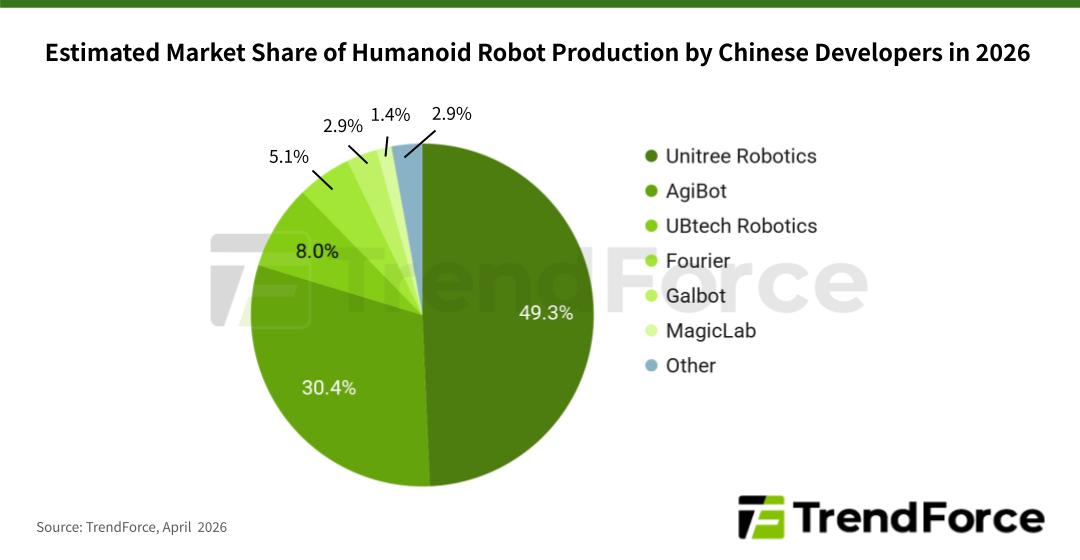
TrendForce’s latest in-depth report on humanoid robots reveals that the global industry is set to enter a critical phase of commercialization in the second half of 2026. In China, vendors are rapidly clarifying commercial use cases and scaling up production, which is expected to drive annual output growth up to 94% in 2026.
Among them, Unitree Robotics and AgiBot are emerging as clear leaders, supported by strong monetization capabilities and progress in mass production. Together, these two companies are projected to account for nearly 80% of total shipments.
TrendForce notes that while most humanoid robot developers are historically focused on foundational capabilities—perception, dynamic balance, and semantic understanding—the industry’s focus will shift in the second half of 2026 toward delivering tangible user value. In China, the world’s largest market, key trends include the convergence of application scenarios, deep integration of LLMs into general-purpose robots, and continued investment momentum.
Unitree recently had its IPO application accepted on China’s STAR market. Its prospectus shows that in 2025, revenue from humanoid robots surpassed that of quadruped robots for the first time, accounting for over 51% of total revenue. Combined gross margin across both segments reached 60%, which challenges the perception that robotics is a purely cash-burning industry.
If successfully listed, Unitree could help reset industry valuations and improve financing conditions across the supply chain. The company has also committed to expanding capacity to 75,000 humanoid robots and 115,000 quadruped robots annually, which is expected to drive upstream expansion in key components such as joint modules, dexterous hands, and sensors.
AgiBot reached a milestone in late March with the rollout of its 10,000th general-purpose embodied robot (Expedition A3). Its production scale increased from 1,000 units in 2025 to 5,000 units, and then doubled to 10,000 units within just three months.
TrendForce attributes this to its standardized supply chain for embodied AI robots, supported by flexible, order-driven manufacturing, collaborative development, and dedicated supply arrangements, which enable supply chain control and high-quality output. Growing orders from industries such as automotive manufacturing, consumer electronics, and logistics also indicate a shift from trial adoption to real demand.
U.S.-based companies are also speeding up commercialization. Boston Dynamics’ Atlas has begun commercial deployment, and 1X’s home robot is progressing toward household use, emphasizing key issues in safety, usability, and system integration. If Tesla’s Optimus Gen 3 reaches mass production as scheduled, it could greatly impact the global supply chain and capital markets in the second half of 2026, creating a robot manufacturing model similar to the automotive industry.
For more on the latest technology industry news and trends, please visit News.