

AI Server Demand to Drive Memory Contract Price Increases in 2Q26 as CSPs Secure Supply via Long-Term Agreements
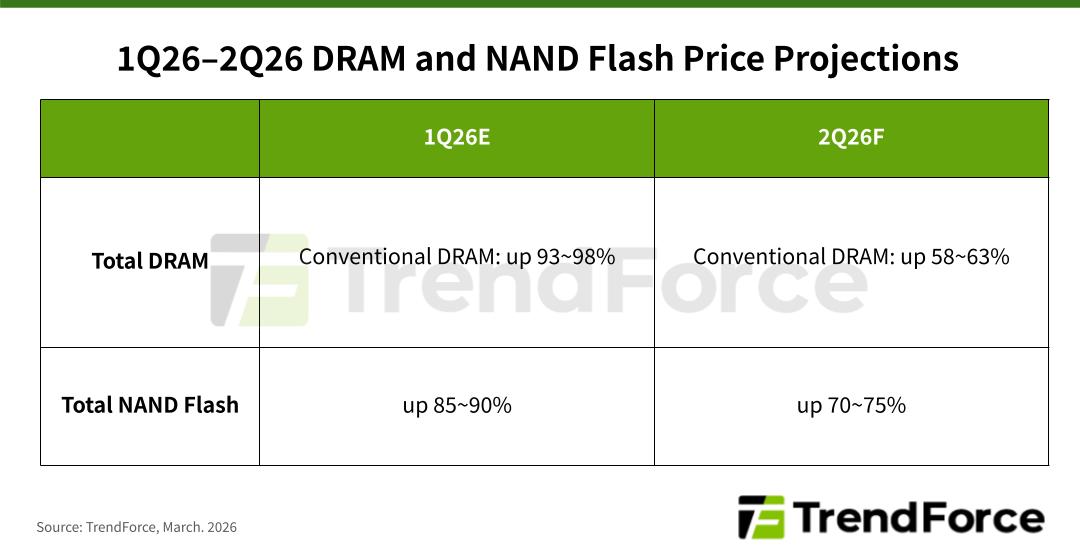
- Conventional DRAM contract prices expected to rise 58–63% QoQ in 2Q26; NAND Flash contract prices up 70–75% QoQ
- DRAM suppliers keep reallocating capacity toward server-related applications. Despite downside risks in certain end-market demand, overall supply remains tight, and prices continue to trend upward
- NAND capacity is increasingly allocated to enterprise SSDs, while consumer applications scale back amid cost pressures
TrendForce’s latest memory pricing survey reveals that DRAM suppliers are reallocating capacity toward HBM and server applications in 2Q26, while implementing catch-up pricing to narrow price gaps across product segments. Conventional DRAM contract prices are projected to rise by 58–63% QoQ despite downside risks to end-market shipments.
Meanwhile, the NAND Flash market continues to be driven by demand from AI and data centers, with price increases spreading across the entire product portfolio. Overall, NAND Flash contract prices are expected to rise by 70–75% QoQ in 2Q26.
Breaking down price trends across DRAM segments reveals that prices are expected to remain supported by tight supply. Although overall system demand in the PC DRAM market has been revised downward, suppliers have simultaneously reduced shipments to PC OEMs and module makers. As a result, OEMs with lower allocation fulfillment rates are forced to procure at higher prices from suppliers or module vendors, thereby supporting price increases.
North American CSPs are accelerating AI inference deployments, which in turn is driving demand for AI and general-purpose servers. High-capacity RDIMMs have become the primary procurement target. On the supply side, suppliers continue prioritizing server DRAM due to its superior profitability and are negotiating long-term agreements (LTAs) with key customers to support future capacity expansion. However, it is noted that near-term supply remains tight.
In the smartphone segment, brands continue to face mounting pressure from rising memory costs and may adjust production plans starting from 2Q26. However, demand for mobile DRAM is not expected to contract significantly in the first half of the year. As suppliers finalize 2Q pricing with key customers and establish a baseline for price increases—while also seeking to narrow price gaps across applications through catch-up pricing—mobile DRAM contract prices are expected to continue rising from the previous quarter.
For graphics DRAM, rising memory costs are weighing on demand for notebooks and gaming devices, while limited capacity allocation to GDDR continues to constrain supply. Prices are therefore expected to increase further in 2Q26.
As for consumer DRAM, customers are primarily focused on low-cost, high-volume products with thin margins. The ongoing price increases since early 2025 have pushed memory costs above selling prices for some products, leading to a slight slowdown in procurement demand. However, the gradual withdrawal of major suppliers from the consumer DRAM segment remains the key driver of market imbalance, and supply shortages have yet to ease.
AI computing arms race intensifies, and capacity crowding continues to drive NAND Flash prices higher
In 2Q26, the magnitude of growth remains limited despite NAND Flash suppliers increasing bit output through process upgrades and higher QLC adoption. Demand from AI servers remains strong, while PC and smartphone vendors are forced to reduce product capacities to curb demand for NAND Flash.
Anticipation is growing among buyers that client SSD prices will rise further, even though the demand for PCs has yet to bounce back. There's also concern that server demand could take up all the available capacity, prompting buyers to restock their inventory. Meanwhile, suppliers are focused on maximizing their profits by maintaining prices through the second quarter, which they aim to achieve by continuing to limit supply to client SSDs.
Demand for high-performance SSDs has grown significantly as generative AI enters a phase of large-scale adoption—with enterprise SSD orders showing no signs of slowing. A clear shortage is expected in 2026, with meaningful capacity expansion unlikely until late 2027 or 2028. CSPs are willing to accept higher prices and sign LTAs to secure a stable supply, further reinforcing suppliers’ pricing power.
For eMMC/UFS, despite a weak smartphone market, demand for high-speed transmission driven by AI features in flagship devices remains rigid, while automotive and industrial demand has also seen modest recovery. From a supply perspective, eMMC/UFS shares overlapping process capacity with enterprise SSD, but offers significantly lower margins. This has led to the tightest supply gap across all product segments, with prices expected to rise sharply in 2Q26.
As demand in the retail market, as well as for memory cards and USB drives, continues to contract under pricing pressure, module makers are facing dual challenges in costs and sales, leading to reduced demand for NAND Flash wafers. Considering inventory adjustments and profitability, wafers have become the lowest priority for supplier shipments. Wafers are expected to remain on an upward trend in the second quarter, driven by extremely limited market availability.
For more on the latest technology industry news and trends, please visit News.