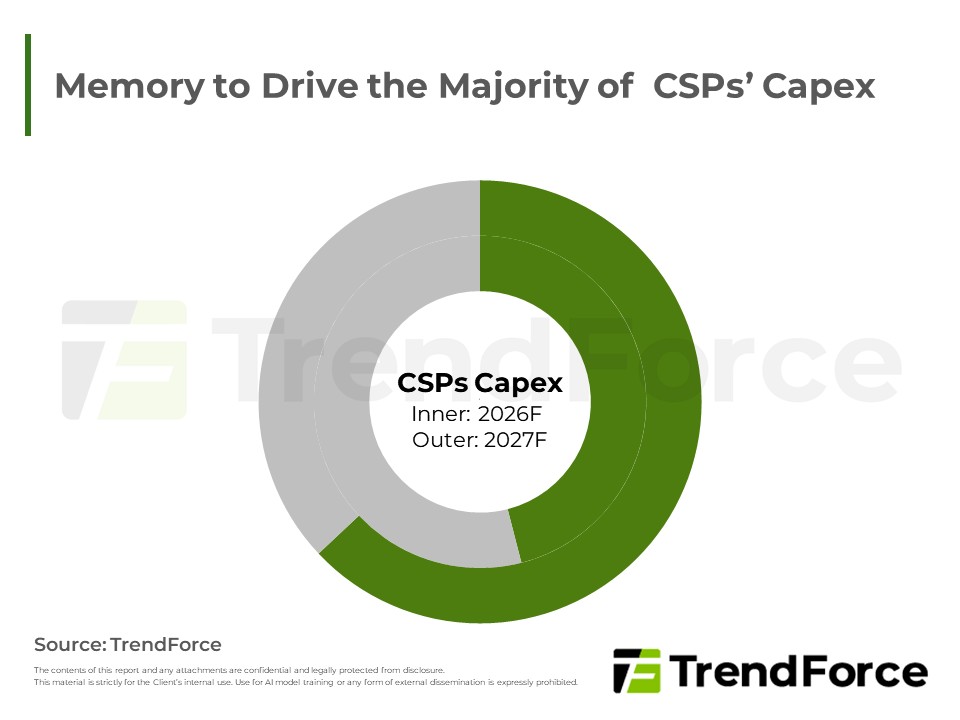
TrendForce has raised the capex forecast for major US and Chinese CSPs. With memory contract prices remaining elevated, memory spending is set to exceed half of total capex, while suppliers are priori...

TrendForce offers you a complete analysis on DRAM industry supply/demand sufficiency, cost analysis and price forecast.

Suppliers and CSPs have signed multi-year server DRAM LTAs, placing many of its bit supply under price-band mechanisms while the rest are negotiated quarterly; spot trading remains quiet and flat. Mic...
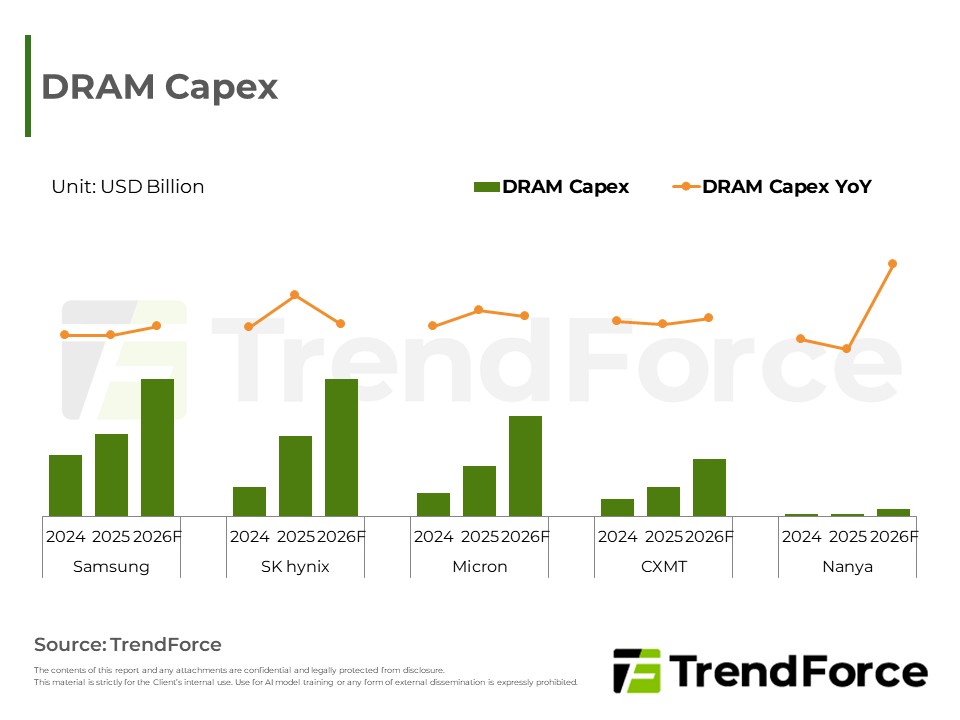
Robust AI demand has driven profitability in HBM and server products, squeezing consumer memory supply and sparking explosive growth in memory prices and industry revenue. DRAM vendors are substantial...
TrendForce combines its expertise in memory market and leverage it to provide a multi-faceted study of server market in this report. The content of it is as follows: 1. Server CPU Market: State of Co...
This report leverages TrendForce’s expertise in the memory industry, as well as extends its in-depth research and analysis on the automotive sector
Robust add-on demand from US cloud service providers is pushing up long-term agreement price bands and driving server memory contract prices steadily higher. Conversely, Chinese providers are pivoting...
Memory contract prices remained stable with expected growth momentum. On the supply side, major Korean and Taiwanese makers shifted capacity to server applications, causing severe PC DRAM shortages an...
Consumer DRAM prices are approaching the limit of buyer cost tolerance, with recent contract prices settling slightly higher and the spread between high and low pricing narrowing somewhat. Looking ahe...
Some CSPs are actively buying additional server DRAM, driving supplier stocks to a lower level and pushing up contract prices. Meanwhile, the spot market continues to fluctuate within a narrow range d...
CSP demand keeps 4Q26 DRAM and NAND prices rising, led by AI, while weak consumer demand narrows other gains.
Tight supply and robust CSP demand keep DRAM undersupplied; TrendForce lifts its 4Q26 contract price outlook.
AI infra demand tightens DRAM supply; PC and mobile brands cut output and adopt alternatives memory sources amid mounting cost pressure.

AI servers continue to crowd out DRAM capacity, driving a supply-demand imbalance and price hikes that will persist into 2027. Impacted by skyrocketing component costs, global smartphone shipments are...

Driven by AI Agent computing expansion and third-party outsourcing demand, server shipments and CPU requirements have been revised upward. Memory suppliers face severe capacity constraints due to shif...