

Supply Chain Control Enables Apple to Launch Lower-Priced Notebooks Amid Industry Downturn to Fill Pricing Gap, Says TrendForce
- MacBook Neo signals Apple’s formal expansion into lower price tiers, cultivating future brand loyalty earlier
- Pricing aligns with mainstream Windows notebooks, strengthening competitiveness in education procurement markets
- Apple’s superior supply chain control allows it to introduce a lower-priced device despite industry headwinds
TrendForce’s latest projections estimate that global notebook shipments will decline 9.2% YoY in 2026, with the possibility of deeper contraction should demand remain weak. Amid simultaneous shortages and price increases in memory and CPUs—factors prompting most notebook brands to streamline product lines and adopt cautious inventory strategies—Apple has taken the opposite approach by introducing an entry-level notebook, the MacBook Neo, at a starting price of US$599.
The new model targets the $500–800 mainstream segment, which is commonly associated with education and general productivity notebooks. This highlights Apple’s clear ambition to broaden its product lineup and expand its ecosystem reach.
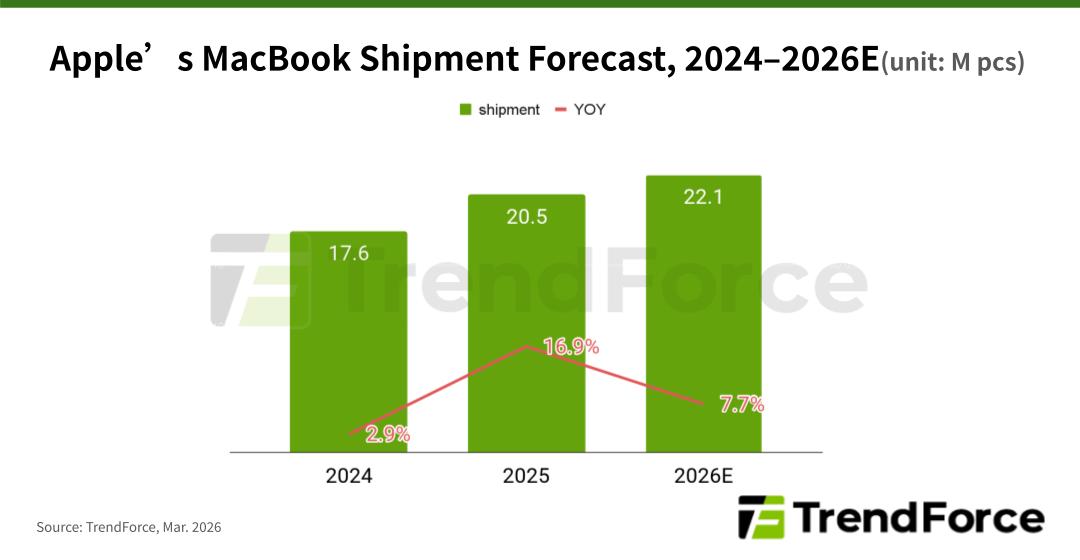
TrendForce forecasts Apple’s notebook shipments will grow 7.7% YoY in 2026, pushing macOS market share to 13.2%, fueled by the company’s downward extension of price tiers, proactive pricing strategy, and strong supply chain control when compared to peers. Shipments of the MacBook Neo alone could reach 4–5 million units, depending on consumer acceptance of its 8 GB memory configuration.
If the MacBook Neo successfully penetrates the entry-level segment, it could not only offset the broader industry downturn but also reshape the pricing structure and competitive landscape of the global notebook market.
TrendForce notes that Apple’s ability to launch a lower-priced device despite rising component costs largely stems from its strong supply chain control. First, its in-house Apple Silicon processors reduce reliance on external CPU suppliers, giving Apple greater flexibility in capacity allocation and cost negotiations. Second, Apple’s highly standardized product specifications, streamlined development pipeline, and concentrated memory configurations enable larger purchasing volumes and stronger long-term contract bargaining power.
In contrast, Windows ecosystem brands typically maintain more fragmented product portfolios with diverse memory and processor configurations, making it more difficult to manage inventory and cost risks during periods of component price volatility.
Historically, Apple has focused on the mid-to-high-end notebook segment, with most MacBook models priced above $999. The introduction of the MacBook Neo marks Apple’s official move to expand its product pyramid downward. By entering the entry-level segment, Apple can not only fill a key pricing gap but also establish brand loyalty among students and early-career professionals at an earlier stage.
Beyond boosting hardware sales, the new model is expected to expand the macOS user base, which in turn supports long-term growth in services such as the App Store, iCloud, and Apple Music, reinforcing Apple’s broader monetization strategy through its ecosystem.
The MacBook Neo’s starting price is significantly lower than previous MacBook models and directly targets mainstream Windows notebooks. As competitors are forced to raise prices due to rising component costs, Apple is opting to sacrifice some margin in exchange for greater market share and user growth. The competitively priced device could attract more price-sensitive consumers and potentially give Apple an advantage in education procurement tenders.
For more information on reports and market data from TrendForce’s Department of Display Research, please click here, or email the Sales Department at DR_MI@trendforce.com
For additional insights from TrendForce analysts on the latest tech industry news, trends, and forecasts, please visit https://www.trendforce.com/news/