[News] Samsung, SK hynix’s HBM4 Push Puts HBM, General Memory Pricing in the Spotlight for 2H Earnings
With Samsung reportedly lifting HBM4 yields to around 80%, the race between South Korea’s two memory giants is set to intensify in the second half. While NVIDIA’s Vera Rubin remains a major HBM demand driver, MoneyToday Broadcasting (MTN) reports that customer diversification and rising general-purpose memory prices are making ASP growth an increasingly important earnings lever.
As highlighted by the report, memory competitiveness could no longer be assessed solely by supply share to NVIDIA. HBM demand is now coming from diverse players such as AMD and Google, while server DDR5, SOCAM combining low-power memory (LPDDR), and NAND-based enterprise SSDs (eSSDs) are also having a significant impact on earnings growth, the report adds.
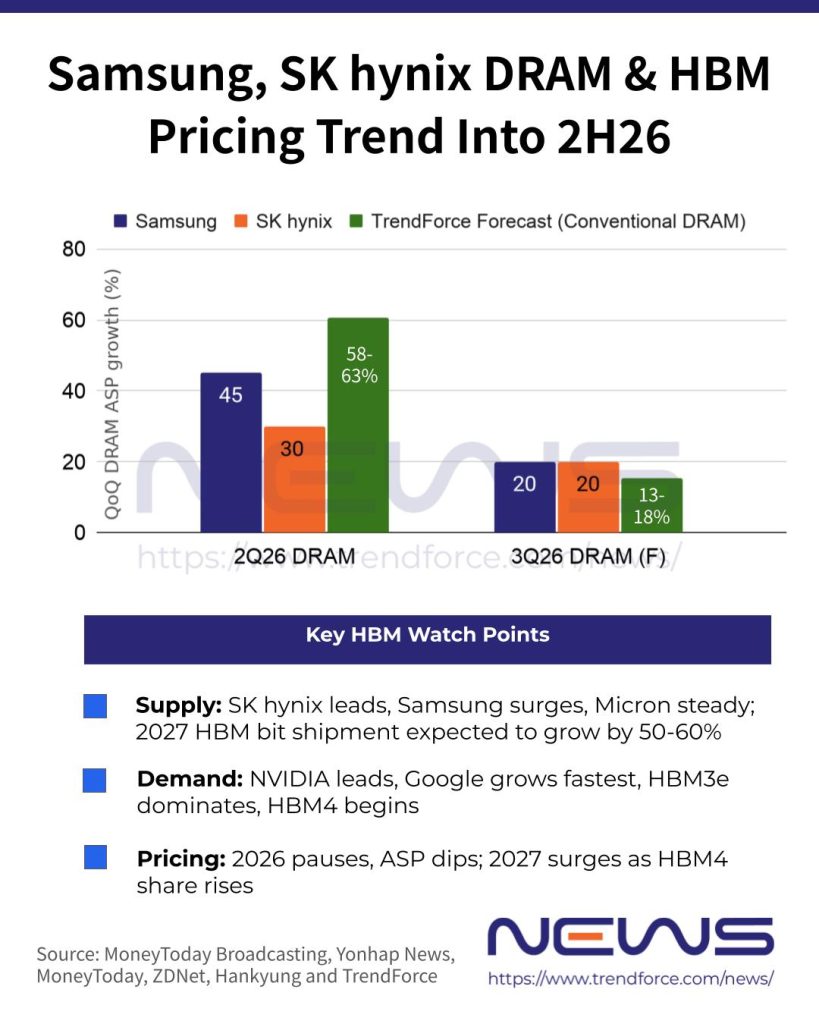
Samsung, SK hynix’s HBM Pricing Trend
Still, HBM4 ramp-up is set to be a key earnings driver in 2H26, with HBM ASPs adding another variable to watch. Citing Samsung, Yonhap News reports that the company expects Q3 HBM4 revenue to more than triple QoQ and H2 HBM4 revenue to account for over 60% of total HBM sales. Meanwhile, MTN reports that SK hynix also expects stronger 2H performance as it significantly ramps HBM4 shipments.
The pricing backdrop looks equally favorable. Citing Fubon Research, MoneyToday reports that HBM4 costs for NVIDIA GPUs could reach $31–32/GB, nearly double HBM3e’s $17–18/GB. Costs for other GPU makers and custom ASICs, according to the report, could climb even higher, to $35–36/GB, further supporting the earnings outlook for Samsung and SK hynix.
Still, HBM4 is only part of the pricing equation, with HBM3e pricing remaining another key watchpoint. MTN notes that although HBM3e remained the mainstream product through 1H26, SK hynix’s earnings growth lagged Samsung despite commanding an estimated HBM3e 50%–60% market share and leading the high-value segment.
This has fueled speculation that SK hynix may be selling HBM3e at lower prices under existing Long-term agreements (LTAs). The company, cited by the report, pushed back, saying it is not selling HBM3e at particularly low prices, while declining to disclose specific contract terms.
Overall Memory ASPs Add Another Layer
Against this HBM pricing backdrop, broader memory ASP trends will be another key earnings driver to watch. MTN notes that Samsung’s DRAM and NAND ASPs rose by mid-40% and high-60% QoQ, respectively, in 2Q26. Over the same period, SK hynix reported ASP gains of around 30% for DRAM and mid-50% for NAND.
That momentum is expected to carry into 3Q26, albeit at a more moderate pace. TrendForce forecasts conventional DRAM contract prices to rise 13–18% QoQ, while NAND Flash prices are seen increasing 10–15%.
Samsung and SK hynix could also see stronger DRAM pricing in the current quarter. ZDNet reported in early July that Samsung was pushing for up to a 20% QoQ increase in 3Q DRAM ASPs, while analysts cited by Hankyung expect SK hynix’s DRAM prices to rise around 20% in 3Q, above the previously estimated 10% gain.
Hankyung also notes that SK hynix’s DRAM bit growth is expected to reach the mid-20% range in 2026, above its previous 20% forecast, driven in part by rising shipments of 1c-based SOCAMM2.
Taken together, the combination of rising HBM ASPs, resilient conventional memory pricing, and accelerating bit growth suggests both Samsung and SK hynix are entering 2H26 with multiple, overlapping earnings levers — though the market will be watching closely whether actual contract prices land at the higher end of these projections, or whether cooling consumer demand tempers the pace of gains.
Read more
- [News] Samsung’s HBM4 Yield Reportedly Hits 80% as HBM Race Heats Up, SK hynix Labor Talks Add a Twist
- [News] Samsung’s DS Unit Delivers 99.7% of Q2 Profit amid Memory Boom; HBM4 Revenue Reportedly to Triple in Q3
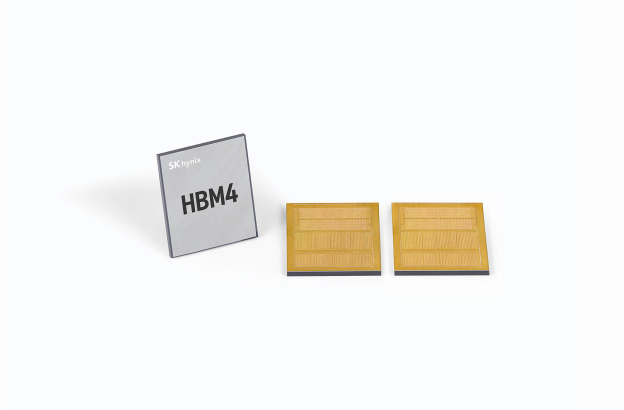
(Photo credit: SK hynix)