[News] NVIDIA’s DLSS 5 Could Boost Graphics DRAM Demand, With GDDR6 Prices Reportedly Already Triple
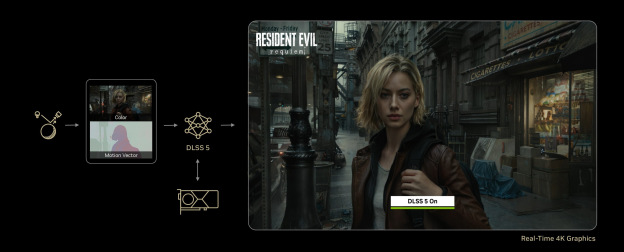
NVIDIA, already a major memory buyer through its AI accelerators, is tightening memory supply and extending its impact beyond HBM. According to Chosun Biz, the chip giant’s latest neural rendering technology, DLSS 5, is raising the performance bar for PC gaming hardware and emerging as a new demand driver for graphics DRAM (GDDR).
It is also worth noting that against a structurally tight supply backdrop, GDDR6 prices have already tripled from $2.80 to $8.40 per 8Gb (1GB) module since late October last year, adding to graphics card cost pressures, Chosun Biz reports, citing data from DRAMeXchange.
DLSS 5’s AI Rendering Raises VRAM, GDDR Demand
As reported, officially launched on September 3 with NBA 2K27, NVIDIA’s DLSS 5 is a 3D-guided neural rendering technology that adds AI processing to real-time rendering, enhancing lighting, materials, and character details for more photorealistic graphics. NVIDIA initially supports the technology on RTX 50-series GPUs powered by Blackwell, with plans to extend it to RTX 40-series cards once optimization for the architecture is complete, according to Wccftech.
The technology could add further pressure to an already tight graphics memory market. Chosun Biz reports that Samsung Electronics and SK hynix are upgrading graphics DRAM specifications and performance to support DLSS 5, while NVIDIA has raised graphics card supply prices for the third time this year to reflect higher costs.
More importantly, DLSS 5’s added AI workload could drive demand toward higher-capacity GPUs. NVIDIA’s technical materials, cited by Chosun Biz, show that running DLSS 5 at 4K on the flagship RTX 5090 requires about 731MB of additional GPU memory and comes with some frame-rate loss from the added computational load. This could encourage demand for higher-end graphics cards with 16GB or more of VRAM, the report adds.
With GDDR memory already accounting for a significant portion of graphics card costs, the industry expects the sharp increase in memory prices to inevitably translate into higher supply prices for finished graphics cards.
As reported by Chosun Biz, recent price increases for selected graphics card models in the Chinese market by manufacturers such as ASUS, GALAXY, and Gigabyte are already seen as reflecting mounting cost pressures. Wccftech adds that for GeForce RTX 5070, ASUS is reportedly hiking prices by RMB 150–300 (US$22–44) and Galax by RMB 200 (US$30).
This aligns with TrendForce’s observation, which notes that conventional DRAM contract price growth is expected to moderate to 13–18% QoQ in the third quarter. Consumer DRAM, however, is expected to see the strongest price growth, as suppliers have significantly curtailed supply.
Read more
(Photo credit: NVIDIA)