[News] Samsung’s DS Unit Delivers 99.7% of Q2 Profit amid Memory Boom; HBM4 Revenue Reportedly to Triple in Q3
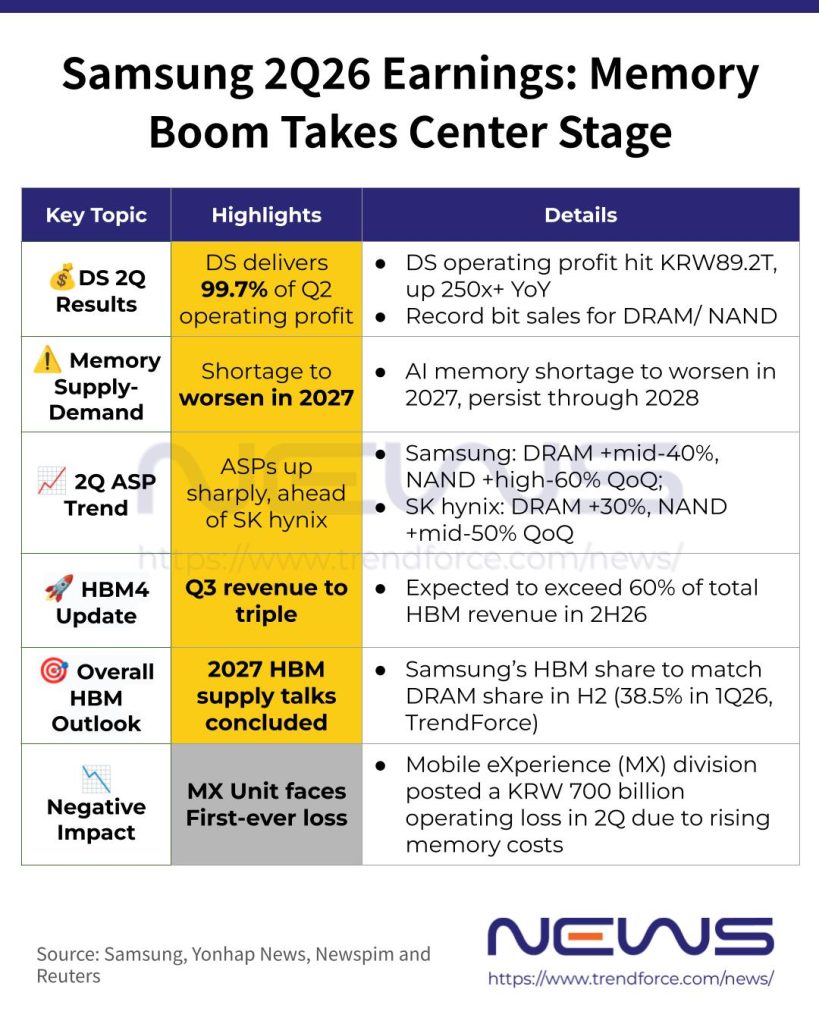
Samsung Electronics delivered another record second quarter, with operating profit jumping 19-fold year over year to KRW 89.5 trillion. While memory’s role as the key earnings driver came as little surprise, the scale of its contribution was striking: the DS division accounted for a 99.7% of Samsung’s total operating profit in Q2, with operating profit soaring more than 250-fold YoY, as highlighted by The Elec and Reuters.
Samsung posted record Q2 revenue of KRW 171.5 trillion, up 28% QoQ, driven primarily by the Device Solutions (DS) division, which saw sales rise 56% QoQ. The DS unit, encompassing Memory, System LSI, and Foundry, generated KRW 89.2 trillion in operating profit, with its operating margin expanding to nearly 70% from 65.7% in Q1 2026.
However, the memory boom came with a downside for Samsung’s smartphone business. As soaring memory prices drove up component costs, the company’s Mobile eXperience (MX) division posted a KRW 700 billion operating loss, marking its first quarterly loss on record, according to Reuters.
Samsung Expects Memory Shortage to Worsen in 2027
Notably, Samsung expects the memory supply crunch to intensify in H2, as surging demand for AI server DRAM, enterprise SSDs, and HBM far outpaces weakening mobile and PC demand, according to Newspim. The company also forecast that the supply shortage in AI memory will worsen next year as demand continues to far exceed supply capacity, with the imbalance expected to persist through 2028, Yonhap News notes.
HBM4 Progress and ASP Trend in Focus
Samsung has already entered HBM4 mass production and begun shipments to major customers, including NVIDIA, while further expanding its AI memory push with HBM4E sample shipments to key clients. Underscoring its aggressive HBM ambitions, Samsung expects HBM4 revenue to more than triple QoQ in Q3 and account for more than 60% of total HBM revenue in H2, Yonhap News reports.
The company plans to further expand HBM4 supply capacity alongside the ramp-up of 1c-class DRAM production. Samsung also aims to secure an HBM market share comparable to its overall DRAM share, helping create a more balanced DRAM portfolio, the report notes.
Meanwhile, in its earnings release yesterday, SK hynix revealed that DRAM ASPs rose 30% QoQ, while NAND ASPs increased by the mid-50% range in Q2. In comparison, Newspim reports that Samsung’s ASPs climbed by the mid-40% range for DRAM and the high-60% range for NAND compared with the previous quarter. On the other hand, DRAM shipments in Q2 reportedly increased by more than 10% from the previous quarter, while NAND shipments rose by low-single digit.
System LSI, Foundry Stay in the Red but Momentum Builds
Despite the memory boom, Samsung’s Foundry and System LSI units are believed to have remained loss-making in Q2, according to Chosun Ilbo. Still, signs of improvement emerged: System LSI maintained quarterly revenue through stronger mobile SoC and image sensor sales, while Foundry earnings improved on rising HBM base-die demand and U.S. customer orders, with new 2nm HPC design wins expanding, the company said.
In H2 2026, Samsung noted that its Foundry Business aims to scale up 2nm mobile chip production and accelerate growth in 4nm-based LPU and base-die products.
Read more
- [News] Q2 Memory Earnings Preview: What to Watch From Samsung, SK hynix, and Kioxia
- [News] SK hynix Posts Record 2Q Results but Misses Estimates Reportedly Due to Conservative Pricing; Completes 10 LTAs
(Photo credit: Samsung)