[News] NAND’s 2026 Playbook: Samsung, SK hynix Chase Upgrades and SSD Mix Over Volume
Ahead of Kioxia’s earnings call today, Samsung and SK hynix’s 2Q26 results, released earlier this week, both point to NAND Flash’s return as a key growth driver. Crucially, ASP gains, rather than shipment growth, are driving the recovery. With major capacity expansion not expected until 2028–29, memory makers appear to be prioritizing supply discipline and process/product upgrades to support pricing power instead of aggressively chasing demand growth.
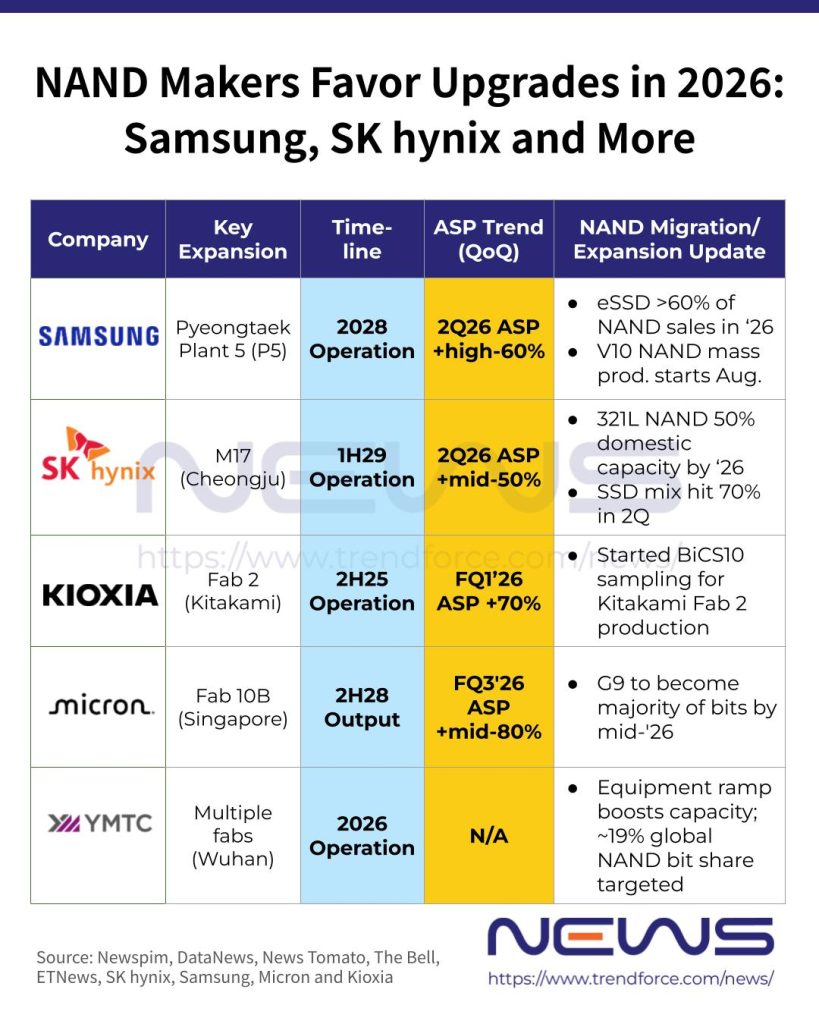
The trend is evident in both companies’ NAND results. According to SK hynix, NAND bit shipments grew around 15% QoQ in 2Q26, while ASPs surged by the mid-50% range. Samsung saw an even stronger pricing impact, with NAND shipments rising only low-single digits QoQ while ASPs jumped by the high-60% range, Newspim reports.
SK hynix Expands NAND Migration Across Korea and China
According to DataNews, SK hynix’s NAND revenue is estimated to have soared 358.7% YoY to KRW 21.4161 trillion in 2Q26, while operating profit more than doubled QoQ to KRW 13.52 trillion from KRW 5.67 trillion, based on brokerage estimates.
Despite the sharp earnings rebound, SK hynix remains cautious on NAND bit demand, projecting third-quarter bit shipments to rise only in the low-single digits QoQ. For full-year 2026, the company expects NAND demand growth to remain in the high-teens YoY range.
The outlook suggests the recovery is being driven less by volume than by stronger pricing and technology upgrades. To reinforce profitability, SK hynix is accelerating process migration, with 321-layer NAND now accounting for the largest share of its output. The company aims to expand the node to 50% of its domestic NAND production capacity by the end of 2026.
The strategy extends beyond Korea. According to News Tomato, SK hynix has completed the transition to 192-layer NAND and replaced legacy equipment at its first Dalian fab in China. Meanwhile, The Bell reports the company has begun preparations for mass production of mid-200-layer Floating Gate (FG) NAND at Dalian Fab 2, with a pilot “One Path” line scheduled for the third quarter to validate process stability and yields.
Beyond process migration, product mix optimization is also supporting SK hynix’s NAND profitability. SSDs are taking a larger share of NAND revenue, rising from around 50% in 2Q25 to the 60% range in 1Q26 and roughly 70% in 2Q26, DataNews adds.
Samsung Shifts NAND Strategy Toward AI SSDs and Next-Gen V-NAND
Similarly, Samsung Electronics is shifting its NAND strategy toward AI-driven enterprise SSDs. According to ETNews, fueled by surging demand for dedicated KV cache storage amid the rise of agentic AI, the company expects eSSDs to account for more than 60% of NAND revenue in 2026, up over 20 percentage points YoY.
Meanwhile, Samsung is advancing both performance and capacity upgrades across its SSD portfolio. ETNews reports that it aims to target early AI platform adoption with ultra-high-speed PCIe Gen6 SSDs, while expanding shipments of 256TB high-capacity eSSDs based on V9 1Tb QLC NAND. The company’s QLC-based SSD shipments are expected to more than double in 2H26 compared with 1H26, the report adds.
Notably, Samsung is also preparing its next-generation NAND technology. The company plans to begin mass production of V10 NAND in August, introducing new bonding technology and a three-step process for the first time, according to ETNews.
This shift toward process migration and product optimization reflects a broader industry strategy. According to TrendForce, NAND suppliers are boosting bit output primarily through technology migration rather than major capacity expansion in 2026. However, supply growth is expected to accelerate in 2027 as higher-layer NAND migration and new fabs ramp up, potentially pushing the market toward oversupply in 2H27 amid weak consumer demand and renewed pricing pressure, TrendForce notes.
Read more
- [News] SK hynix Reportedly Revives Dalian Plant 2 Expansion in 2H26, Adding New V8 NAND Capacity
- [News] Kioxia Begins BiCS 10 NAND Sampling, Reportedly Targets 2027 Mass Production at Kitakami Fab
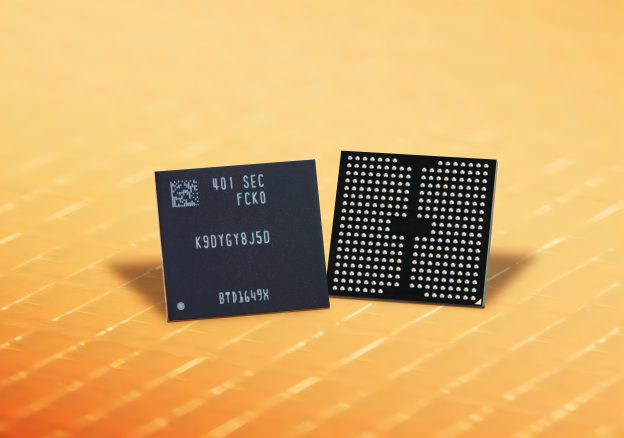
(Photo credit: Samsung)