Global Foundry Revenue Approaches US$53.49 Billion in 2Q26 as SMIC Narrows Market Share Gap with Samsung, Says TrendForce
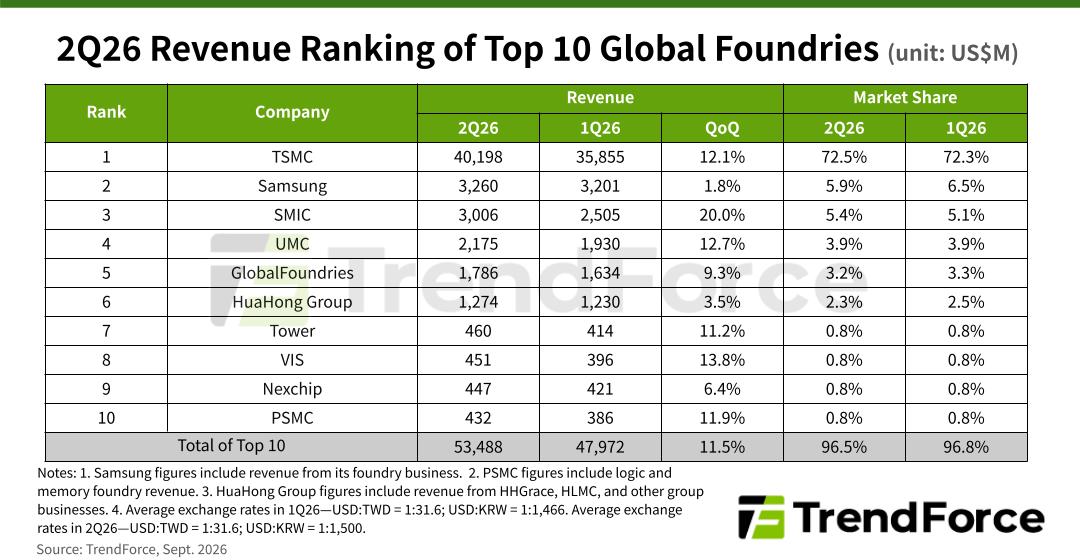
TrendForce’s latest foundry industry research reveals that the combined revenue of the world’s top 10 foundries rose 11.5% QoQ to nearly US$53.49 billion in 2Q26, setting another record high. Growth was driven by continued supply constraints for advanced processes used in AI and HPC processors, alongside rising demand for peripheral AI chips such as PMICs and power discretes. Continued advance procurement across consumer supply chains, including TVs, PCs, and notebooks, also tightened capacity for some mature processes.
Looking ahead to the third quarter, consumer IC design customers are expected to maintain steady wafer starts amid concerns that mature-process capacity could remain constrained and wafer prices may rise. The seasonal ramp-up of flagship smartphones and growing production of next-generation AI and HPC platforms are also expected to lift foundry revenue further.
Among the top 10 foundries, TSMC maintained its lead with 2Q26 revenue nearing $40.2 billion, a 12.1% increase QoQ, capturing a 72.5% market share. Strong demand for AI server GPUs and XPUs kept its 5/4nm and 3nm capacities fully booked. Additionally, the initial inventory buildup for new iPhones supported sales, and 2nm contributed revenue for the first time. These combined factors resulted in quarter-over-quarter growth in both wafer shipments and ASPs.
Samsung Foundry ranked second. New advanced-process orders, including HBM base dies, gradually ramped up during the quarter, while foundry prices for 5/4nm and more advanced nodes increased. Revenue edged up 1.8% QoQ to $3.26 billion. However, Samsung’s market share declined to 5.9% as competitors grew at a faster pace.
SMIC ranked third, with revenue surging 20% QoQ to more than $3 billion. Its market share edged up to 5.4%, narrowing the gap with Samsung. Growth was supported by advance procurement across consumer supply chains, particularly PCs and notebooks, as well as steadily increasing orders for AI peripheral ICs and server networking products. Widespread memory shortages also drove stronger foundry demand and pricing for NAND and NOR Flash.
UMC maintained fourth place with a 3.9% market share. The company benefited from advance procurement of PCs, notebooks, and certain consumer electronics in 1H26, as well as increased orders for server-related products such as FPGAs. A significant recovery in 8-inch capacity utilization also provided support. As a result, 2Q26 revenue rose 12.7% QoQ to nearly $2.18 billion.
GlobalFoundries ranked fifth, supported by renewed procurement from consumer customers and growing demand for AI and server peripheral components, including power ICs and TIAs/drivers. Both wafer shipments and ASP increased during the quarter, lifting revenue 9.3% QoQ to approximately $1.79 billion. Its market share stood at 3.2%.
Strong PMIC demand and foundry pricing lift VIS back to eighth place
HuaHong Group ranked sixth, with 2Q26 revenue rising 3.5% QoQ to more than $1.27 billion. Stable orders for NOR Flash and AI-related PMICs provided support, while previous wafer price increases began to contribute more meaningfully to revenue and ASP. The gradual ramp-up of new capacity at subsidiary HHGrace also supported the group’s growth.
Tower took seventh place with revenue of $460 million, up 11.2% QoQ. Growth was driven by higher shipments and production of ICs used in AI optical transceiver modules, including TIAs/drivers, and photonic ICs.
VIS moved back into eighth place as advance procurement and rising orders for AI peripheral ICs and smartphone PMIC/power products boosted wafer shipments and ASP. Revenue increased 13.8% QoQ to $451 million.
Nexchip slipped to ninth place despite a 6.4% QoQ increase in revenue to $447 million. Orders for its core display driver IC (DDIC) products returned as capacity at other foundries was increasingly allocated elsewhere. Advance procurement of consumer products also lifted capacity utilization and shipments. However, its growth remained weaker than that of AI-related power products, resulting in a decline in ranking.
PSMC ranked tenth, with revenue rising 11.9% QoQ to $432 million. Although overall shipments increased only modestly, deliveries of memory and logic wafers reflecting previous price increases helped drive revenue growth.
For more on the latest technology industry news and trends, please visit News.