

Early Purchases Lift 2026 Smartphone Production Above Expectations; Full-Year Forecast Raised to 1.07 Billion Units, Says TrendForce
Global smartphone production reached 275 million units in 2Q26, down 8% YoY, according to TrendForce’s latest smartphone industry research. The decline was narrower than previously forecast, resulting in better-than-expected overall performance.
TrendForce attributes the stronger-than-expected results primarily to two factors: First, some consumers have brought forward smartphone purchases amid concerns that continued memory price increases could further drive up device costs and lead to another round of price hikes for new models in 2027.
Second, some brands had previously cut their production plans too aggressively in response to surging memory costs and are now restoring some of those volumes as market conditions stabilize.
Against this backdrop, TrendForce has raised its forecast for global smartphone production in 2026 from 1.05 billion to 1.07 billion units, with the projected YoY decline narrowing from 16% to 14%.
TrendForce stresses that the near-term improvement does not signal a genuine market recovery, but rather reflects a temporary boost from purchases being brought forward. As this effect fades and memory contract prices continue to rise in 2027, global smartphone production could face greater downward pressure.
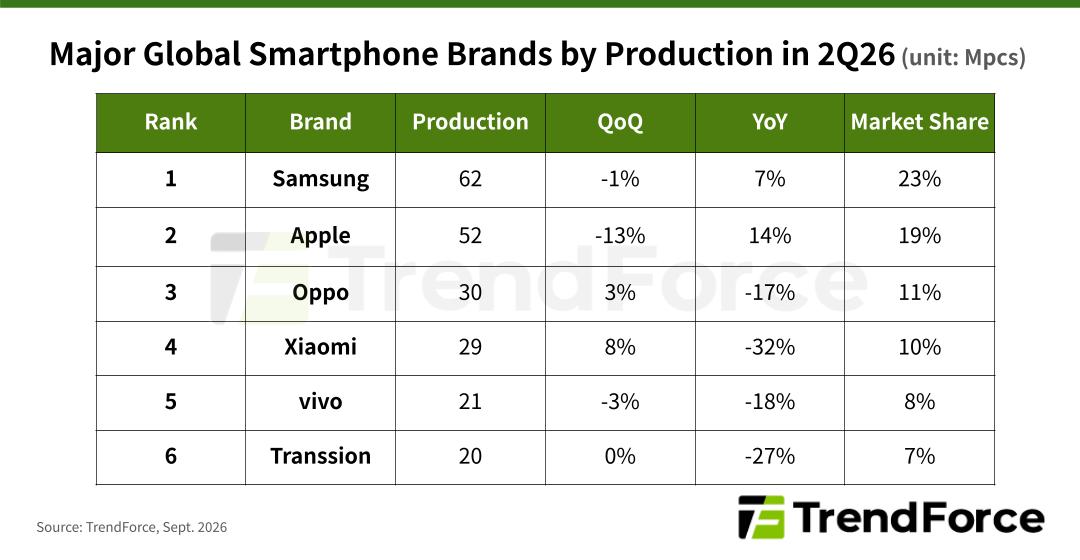
Samsung ranked first in 2Q26 with production of 62 million units, up approximately 7% YoY, supported by the later launch timing of its new flagship models. The company has significantly increased its reliance on ODM production for entry-level and mid-range models to offset high memory costs, leveraging ODM suppliers’ design flexibility and manufacturing cost advantages to maintain price competitiveness.
Apple ranked second with production of approximately 52 million units, up around 14% YoY. Growth was primarily driven by the effective pricing strategy of the iPhone 17 series, which supported strong sales performance through the first three quarters. However, price increases for the upcoming iPhone 18 series appear inevitable, making their potential impact on sales momentum a key factor to watch.
OPPO, Xiaomi, and vivo ranked third through fifth, with production of approximately 30 million, 29 million, and 21 million units, respectively. The three brands have shifted away from aggressive strategies aimed at gaining market share and are instead focusing on maintaining their existing positions while preventing further deterioration in profitability. OPPO and vivo, in particular, derive a substantial share of their sales from China, where Huawei’s aggressive market share expansion is creating mounting competitive pressure.
Transsion ranked sixth with production of nearly 20 million units in 2Q26, down approximately 27% YoY. With its portfolio concentrated primarily on entry-level and low-end smartphones, and with lower inventories of lower-cost memory than its competitors, the company has been more heavily affected by the current surge in memory prices.
Near-term rebound does not signal a market turnaround; Outlook remains uncertain
Overall, TrendForce notes that the upward revision to its full-year production forecast primarily reflects the temporary effects of purchases being brought forward and brands restoring previously reduced production plans, rather than a fundamental improvement in market conditions. The outlook for the global smartphone industry will require close monitoring as this demand fades and memory cost pressures persist into 2027.
For more on the latest technology industry news and trends, please visit News.