

Improved CPU Supply Narrows 2026 Global Notebook Shipment Decline to 9.4%, but Brands Still Face Heavy Cost Pressure, Says TrendForce
TrendForce’s recent research into the notebook industry shows that CPU supply has markedly improved since 2Q26, enabling brands to gradually normalize their procurement and manufacturing processes. Meanwhile, persistent increases in DRAM and SSD costs have led brands to accelerate their procurement strategies to secure components earlier, resulting in shipment volumes exceeding expectations in the first half of the year. Nonetheless, the ongoing rise in memory prices, along with increased CPU costs, has further amplified cost pressures on notebook brands.
TrendForce notes that as CPU shortages ease in 2H26, continued advance procurement by brands, earlier replacement purchases by consumers, and stable commercial demand are expected to support an upward revision to shipment forecasts. As a result, the decline in global notebook shipments for full-year 2026 is expected to narrow to 9.4% YoY.
The shipment pattern in 2026 will also differ markedly from previous years, when the second half typically accounted for the peak season. With some demand originally expected in 2H26 already pulled forward into the first half, shipments are projected to be split approximately 53:47 between 1H26 and 2H26. Volumes are therefore still expected to decline beginning in the third quarter.
Core components rise to 68% of BOM costs; Cost pass-through becomes key as lower-cost inventory is depleted
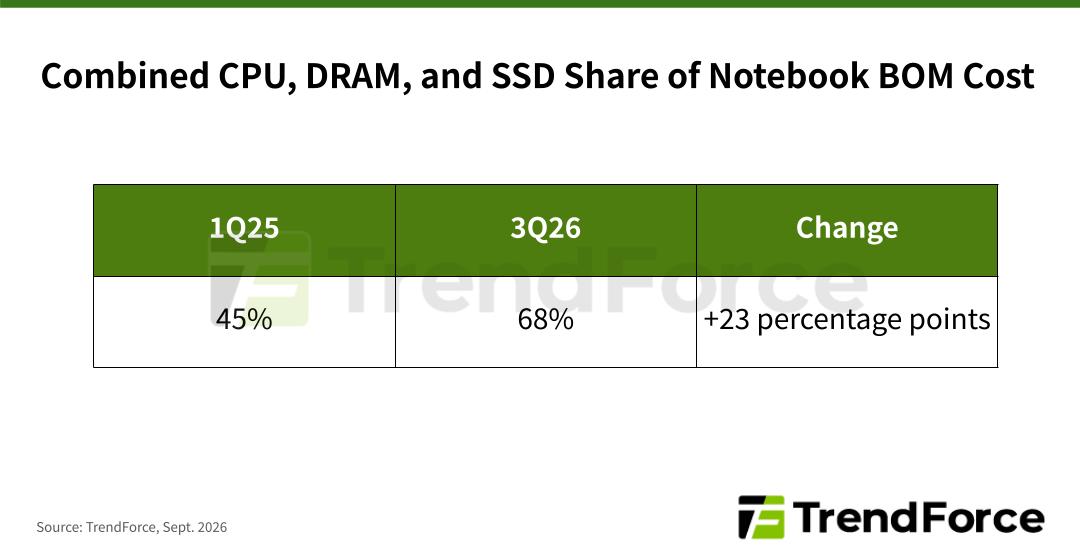
TrendForce uses a mainstream model with an MSRP of US$900 in 1Q25—when memory supply was still stable—as its benchmark to assess the impact of component price increases on notebook cost structures. At the time, core components including the CPU, DRAM, and SSD accounted for approximately 45% of the system’s total BOM cost. Following more than a year of price increases, this share had risen to 68% by 3Q26, underscoring how rapidly higher memory and CPU prices are reshaping notebook cost structures.
From a gross-margin perspective, the continued quarterly increases in CPU, DRAM, and SSD prices have placed even greater pressure on brands. TrendForce estimates that by 3Q26, brands would need to raise the price of a comparable 1Q25 product by approximately 80% to maintain the same gross margin as in 1Q25. This suggests that the impact of component inflation on notebook retail prices is shifting from simply increasing the cost burden to creating mounting pressure for more substantial price hikes.
TrendForce observes that brands are likely to maintain relatively aggressive shipment strategies in the near term, supported by competition for market share, new product launches, stable commercial demand, and existing inventories procured at lower costs. Advance procurement and these lower-cost inventories can also temporarily cushion the impact of rising component costs on retail prices and gross margins.
However, as lower-cost inventories across regions are gradually depleted, this cost buffer will diminish. Future products are likely to reflect current CPU, DRAM, and SSD prices to a greater extent, forcing brands to confront the trade-off between passing higher costs on to consumers and preserving demand more directly. The magnitude of retail price increases, changes in consumer replacement cycles, and brands’ willingness to sacrifice margins will therefore be key factors shaping market demand going forward.
For more on the latest technology industry news and trends, please visit News.