


Global TV Shipments Rise 1.3% YoY in 1H26 as Brand Polarization Intensifies and RGB Mini LED Commercialization Advances, Says TrendForce
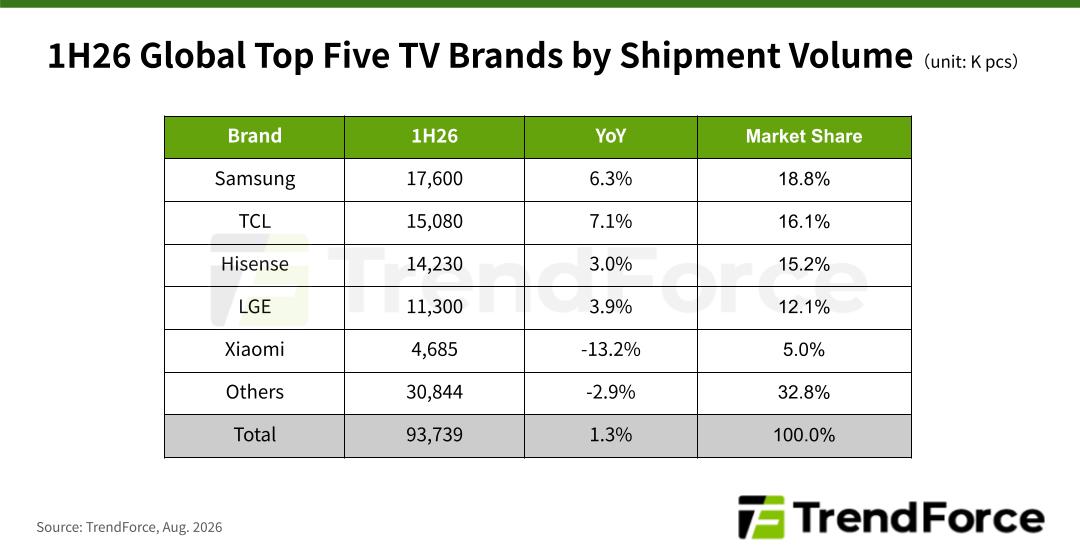
TrendForce’s latest TV industry research reveals that the global TV market in 2Q26 was still influenced by increasing memory prices and brands’ early efforts to prepare for demand in the second half of the year. This led to a 1.1% QoQ decrease in shipments. Nonetheless, total shipments for the first half of the year increased by 1.3% YoY to 93.74 million units, reaching the highest for this period since the COVID-19 pandemic began.
Brand performance has begun to show growing polarization: rising memory costs reduced profitability for second-tier brands and white-box TV makers, while leading brands sustained their market share through cost advantages.
TrendForce forecasts global TV shipments to decline 0.8% in 2026 to 194.65 million units as demand growth slows. In the near term, brands will continue to enhance product value by expanding the adoption of QLED and Mini LED while introducing RGB Mini LED.
Over the longer term, smart TV platforms, advertising services, and content ecosystems will become increasingly important to brand competitiveness. Industry competition will therefore extend beyond hardware specifications toward an integrated hardware, platform, and content business model.
Leading brands maintain shipment growth through scale and cost advantages
Samsung remained the market leader in 1H26, with shipments rising 6.3% YoY to 17.6 million units. The company maintained its competitiveness in the premium market with Neo QLED, OLED, and RGB Mini LED models. Its M70 and M80 Mini LED TVs feature quantum-dot-film-free design to target the mainstream market at more competitive price points. Better-than-expected sales helped drive Samsung’s overall Mini LED TV shipments up more than 200% YoY.
TCL shipped 15.08 million units in 1H26, up 7.1% YoY, the highest growth rate among the top four brands. The company expanded its global reach through regionalized product strategies while moving further into the mid-to-high-end market with technologies such as SQD Mini LED and QLED. It also introduced smaller and mid-sized FHD QLED models in select markets. The bargaining power generated by its large procurement scale has helped TCL balance product upgrades with price competitiveness.
Hisense focused on large-screen and premium products while using RGB Mini LED to differentiate its technology. TV shipments rose 3% YoY to 14.23 million units in 1H26. In addition to maintaining its leading market share in TVs of 100 inches and above, Hisense has expanded its RGB Mini LED lineup beyond flagship models into a broader range of premium products. Marketing around sporting events such as the FIFA World Cup is also helping strengthen its presence in the premium large-screen market.
LGE’s shipments increased 3.9% YoY to 11.3 million units in 1H26. The company is expanding its Mini LED lineup this year as it moves beyond its previous reliance on OLED models for the premium segment. Its Mini LED TV shipments in 2026 are expected to triple from 2025, as LGE increasingly pursues a dual-track OLED and Mini LED strategy to broaden its coverage of the premium display market.
RGB Mini LED TV shipments expected to exceed 1.7 million units in 2026
TrendForce notes that 2026 marks an important turning point for RGB Mini LED TVs1 as the technology moves toward broader commercialization. Previously positioned primarily as a flagship showcase, RGB Mini LED is now being adopted across expanding product lineups from Samsung, TCL, Hisense, and Sony. Improving price competitiveness is also helping the technology expand beyond the ultra-premium segment into the broader premium market.
RGB Mini LED also offers advantages over conventional Mini LED in color gamut, brightness, and energy efficiency. Brands continue to emphasize these specifications to increase consumer awareness of the next-generation display technology.
TrendForce has therefore raised its forecast for global RGB Mini LED TV shipments in 2026 to 1.7 million units, with shipments potentially approaching 2 million units. This reflects a shift in brand strategies from pursuing technological leadership toward expanding market scale and building a broader product ecosystem.
1RGB Mini LED TVs include Samsung’s Micro RGB series, Sony’s BRAVIA RGB series, Hisense’s RGB Mini series, TCL’s RGB Mini series, as well as RGB Mini LED TVs from other brands.
For more on the latest technology industry news and trends, please visit News.