Strong AI Momentum to Drive 24.8% Growth in Foundry Revenue in 2026; Selective Price Increases Emerging, Says TrendForce
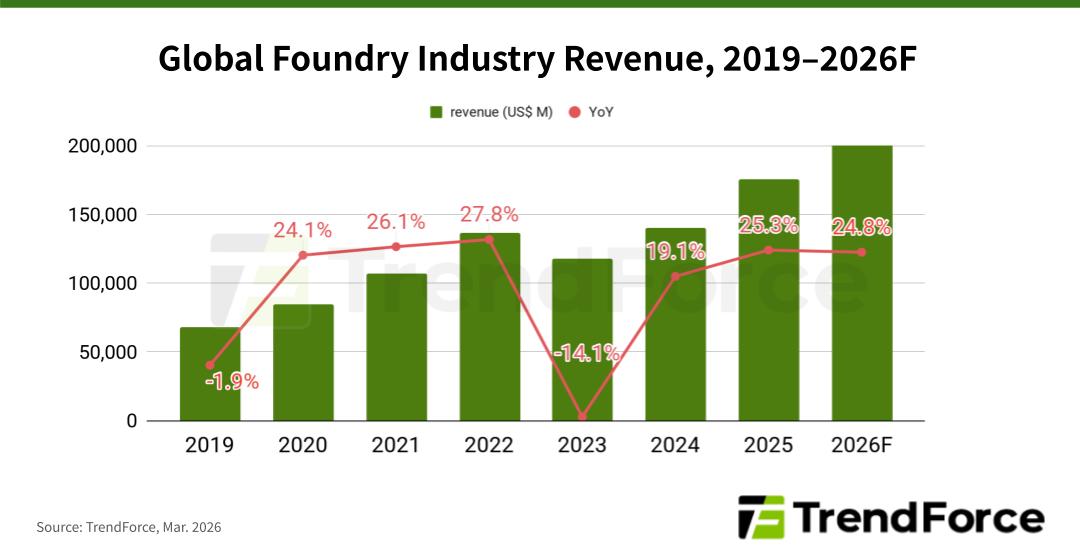
TrendForce’s latest research on the foundry industry reveals that continued investment in the AI arms race by North American CSPs and AI startups will keep demand for AI processors and supporting ICs strong in 2026. Global foundry revenue is projected to grow 24.8% YoY to approximately US$218.8 billion, with TSMC expected to post the largest increase of around 32% YoY.
Demand for advanced nodes will continue to be driven by AI GPUs from companies such as NVIDIA and AMD. Meanwhile, North American CSPs, including Google, AWS, and Meta, and AI startups such as OpenAI and Groq, are accelerating the development of their own AI chips. Many of these designs are expected to enter volume production and begin shipping in 2026, becoming key drivers for 5/4 nm and more advanced process technologies.
TrendForce observed that TSMC’s 5/4 nm and below capacity is expected to remain fully utilized through the end of the year, while Samsung Foundry has also seen a notable increase in orders for its 5/4 nm-class modes. TSMC has therefore raised foundry prices across all nodes at 5/4 nm and below for 2026, and with order visibility extending into 2027, further price increases in subsequent years cannot be ruled out. Samsung similarly informed customers in 4Q25 that it would raise prices for its 5/4 nm foundry services.
In the mature-node segment, both TSMC and Samsung have accelerated reductions in 8-inch wafer capacity, and demand for AI power-management components remains solid, helping lift overall utilization rates. As a result, foundries have already begun signaling potential price increases for 2026.
Demand for 8-inch capacity is primarily driven by AI power-management components and domestic demand in China. Additionally, PC and notebook ODMs began building inventory in early 2026 in response to memory shortages and concerns over higher IC costs later in the year. Demand for DDI and CIS has also performed slightly better than in previous industry cycles, providing additional support to market momentum.
However, despite some improvement, 8-inch fabs are not expected to reach full utilization across the board. At the same time, uncertainties surrounding consumer electronics demand in the second half of the year may lead to downward shipment revisions in the supply chain. Consequently, utilization rates across 8-inch lines are likely to diverge among different foundries, making broad-based price increases unlikely.
For 12-inch wafers, capacity expansion for 28 nm and larger nodes will continue in 2026. Demand for consumer electronics remains uncertain as high memory prices have led to lower shipment expectations for end devices. Although new product upgrades and process migrations may improve product mix and ASPs, overall utilization rates for mature 12-inch nodes are still expected to remain below full capacity, with strong momentum concentrated mainly in advanced nodes.
For more on the latest technology industry news and trends, please visit News.