


Humanoid Robots Move Toward Commercialization; Solid-State Batteries Set to Break Through Power Bottlenecks, Says TrendForce
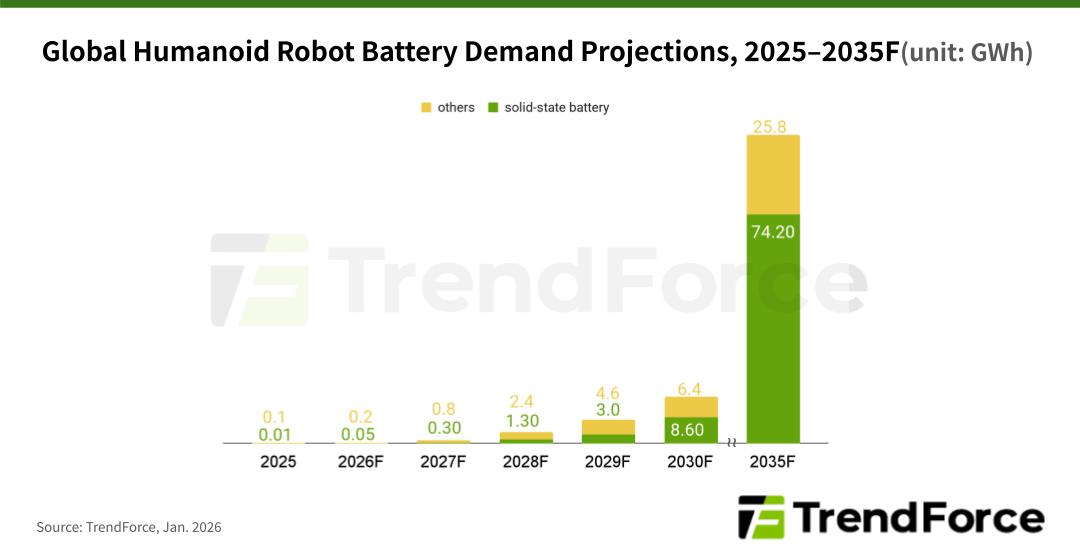
- The demand for solid-state batteries driven by humanoid robots is expected to hit 74 GWh by 2035, which is over 1,000 times higher than in 2026
- Most humanoid robots today have a runtime of 2 to 4 hours; increasing their operating time depends on hot-swappable batteries or higher-energy-density batteries (e.g., solid-state batteries)
TrendForce’s latest research on solid-state batteries suggests that the commercialization of humanoid robots around 2026 is expected to significantly accelerate demand for next-generation batteries, elevating energy storage—particularly solid-state batteries—to a critical enabling role.
Although most current humanoid robots use liquid Li-ion batteries, increasing demands for longer operational periods and high-load capability are likely to drive wider adoption of solid-state lithium batteries, which provide notably higher energy density and safety. By 2035, demand for these batteries in humanoid robots may surpass 74 GWh, a more than 1,000-fold increase from 2026.
TrendForce forecasts indicate that global shipments of humanoid robots will exceed 50,000 units by 2026, with a YoY growth of over 700%. The dominant power source for these robots is high-nickel ternary lithium batteries (NMC/NCA), thanks to their higher energy density. Meanwhile, lithium iron phosphate (LFP) batteries, being more affordable, are mainly used in service robots that do not require high endurance.
Most products currently deliver only two to four hours of runtime, with battery capacities generally under 2 kWh. This limitation is due to the energy density of standard Li-ion batteries and the restricted space and weight within humanoid robots. For instance, the Unitree H1 has a 0.864 kWh battery, delivering less than four hours of static operation. In comparison, Tesla Optimus Gen2, with a 2.3 kWh high-nickel battery system, only manages around two hours of dynamic runtime.
TrendForce highlights two primary methods to exceed the five- to eight-hour battery life threshold. One approach involves a battery-swapping strategy, exemplified by Agility Robotics’ Digit and Apptronik’s Apollo with hot-swappable designs that permit battery replacement without rebooting, thus enabling near-continuous 24/7 operation. The other method involves boosting capacity through higher energy-density battery technologies. Robots like the Xpeng IRON, GAC GoMate, and EngineAI T800 have adopted solid-state batteries, which extend their runtimes to over 4 hours.
Humanoid robot battery development has encountered two main challenges: Firstly, core technologies like joint design, mechanical architecture, and on-device AI computing are still rapidly evolving, leading to uncertainty in designing customized batteries, especially regarding installation space and power needs. Secondly, since humanoid robots are still in the early phase of commercialization, the industry mainly concentrates on finding scalable application scenarios instead of optimizing endurance. This focus reduces immediate motivation for significant advancements in battery technology.
However, the high energy density, high-rate discharge, and safety requirements of humanoid robots make them excellent candidates for testing solid-state batteries, enabling these technologies to showcase their progress. As solid-state batteries become more efficient and affordable, they are projected to be crucial in helping humanoid robots resolve power and endurance challenges.
For more information on reports and market data from TrendForce’s Department of Green Energy Research, please click here, or email the Sales Department at GER_MI@trendforce.com
For additional insights from TrendForce analysts on the latest tech industry news, trends, and forecasts, please visit our blog at https://www.trendforce.com/news/