[Insights] As COMPUTEX Nears, Has x86 Already Won the PC Battle Against Arm?
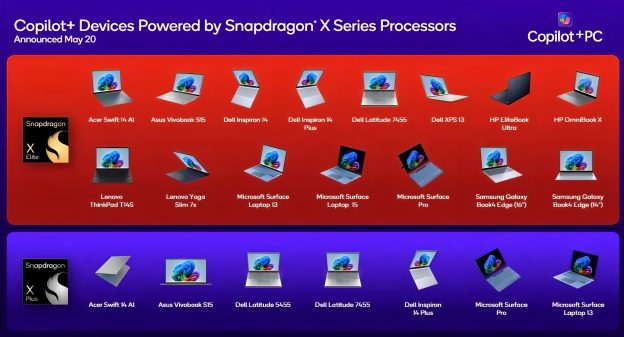
With COMPUTEX approaching, it also marks nearly two years since Windows on Arm (WoA), which once entered the market amid expectations tied to Copilot+ PCs. According to Zhu Shi’s column on TechNews, although software support for Windows on Arm has not performed too poorly over the past two years, its market share has failed to achieve sustained growth. The following analysis explores the factors behind its limited adoption and examines the strategies WoA is pursuing to compete with the long-established x86 ecosystem.
To add some context, the launch of WoA alongside Copilot+ PCs once saw Snapdragon X Elite devices deliver exceptional battery life and performance comparable to similarly positioned x86 chips, prompting Microsoft to view WoA as an opportunity to challenge Apple and prioritize Copilot optimization on Arm over x86. Qualcomm CEO Cristiano Amon even projected WoA could capture 50% market share by 2029. Yet two years later, progress appears to have fallen short of expectations.
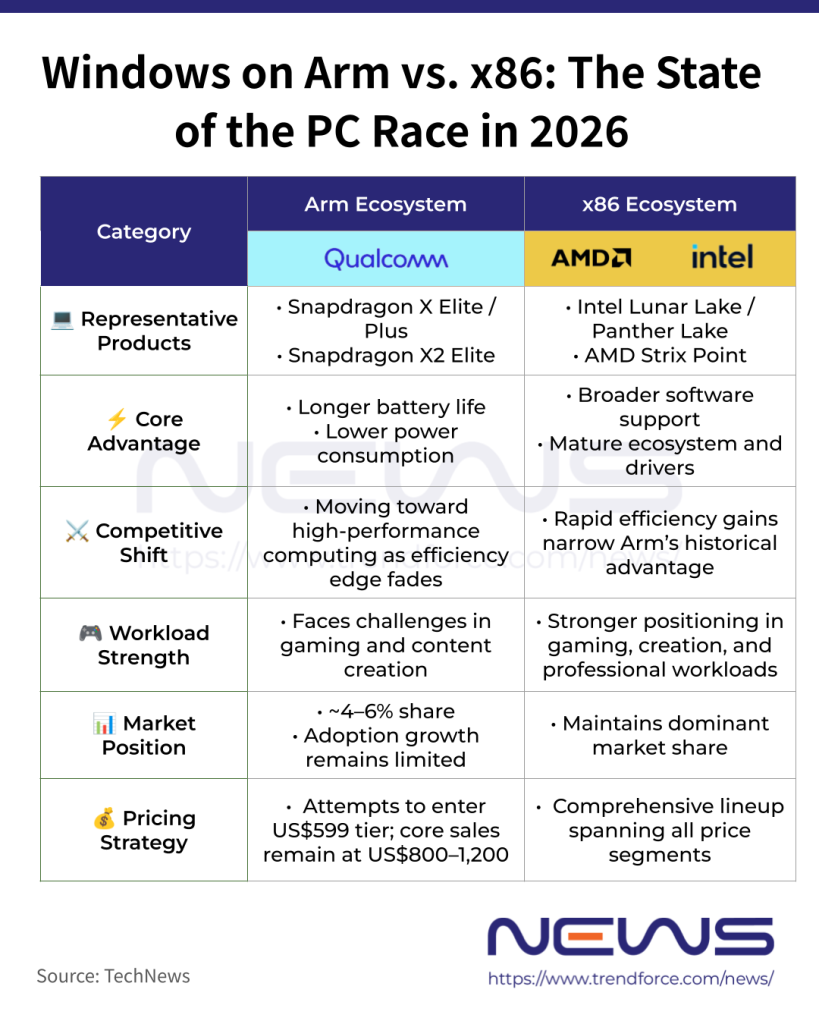
WoA’s market share has yet to see meaningful growth. While it appears to have established a foothold in the PC market at around 4%–6%, it is clearly far from achieving the rapid adoption Qualcomm once projected, let alone taking share from MoA (Mac on Arm).
Qualcomm later introduced lower-end Snapdragon X Plus chips targeting the US$599 laptop segment to quickly expand market share. However, WoA devices have largely remained concentrated in the US$800–1,200 mainstream range, limiting broader adoption.
In addition, the response from the x86 camp on the product side has also been a factor limiting WoA’s market share growth. While Snapdragon X Elite delivered impressive power efficiency, Intel soon responded with Lunar Lake, described as the most power-efficient x86 platform in its history. AMD’s Strix Point, although slightly behind Snapdragon in efficiency, has maintained an advantage in performance through its Zen 5 large-core architecture, helping keep x86 in a leading position.
Has x86 Already Won? The Final Variable May Be NVIDIA’s N1X
Meanwhile, Snapdragon X2 Elite appears to signal a shift toward high-performance computing, a reasonable move as Intel’s Panther Lake is expected to further improve x86 power efficiency, weakening one of Arm’s key historical advantages. As a result, performance may be one of the few remaining areas where Arm can compete more aggressively.
However, moving into the high-performance segment presents challenges, as gaming and content creation — two of the most common PC use cases — remain WoA’s biggest weaknesses. In gaming, NVIDIA continues to dominate through strong performance, while Intel is targeting portable gaming laptops with Panther Lake’s integrated graphics, leaving little room for WoA to gain an edge. In content creation and professional workloads, software compatibility remains a persistent concern, with recent Snapdragon X2 testing showing some applications still lack support or exhibit abnormal behavior.
So, has the outcome of x86 versus Arm already been decided? For now, it appears so. One remaining variable is the long-awaited N1X, which may determine whether Arm can once again challenge x86 by leveraging NVIDIA’s in-house GPU advantages.
Read more
- [Insights] What to Watch at COMPUTEX: Intel Gaming Handheld Chip, NVIDIA First Consumer PC SoC in Focus
- [News] NVIDIA Reportedly Plans Arm-Based SoCs, with Lenovo and Dell Among Early Adopters
(Photo credit: Qualcomm)