[News] Micron More Upbeat on Outlook, Reportedly Sets 2027 HBM4E Ramp with TSMC for Standard, Custom Logic Dies

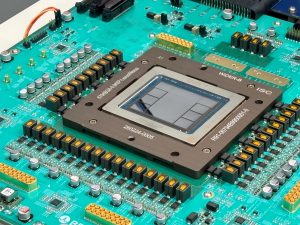
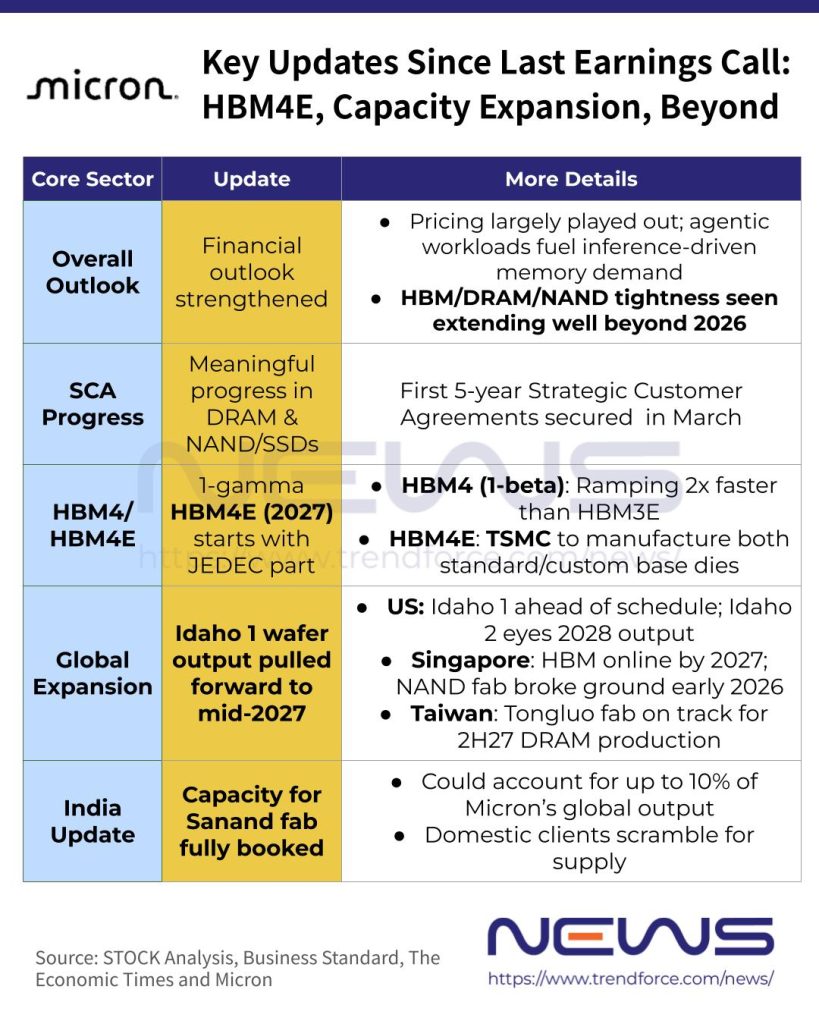
Two months after its March earnings call, Micron is turning more upbeat on its outlook, while providing additional details on its custom HBM development progress. At the J.P. Morgan 54th Annual Global Technology, Media and Communications Conference, Micron’s Global Operations EVP Manish Bhatia, via STOCK Analysis transcript, said the company’s first HBM4E will be a JEDEC-standard product, with ramp-up scheduled for 2027.
While Micron is still using 1-beta DRAM for HBM4, Bhatia said the company is expected to transition to 1-gamma DRAM in the HBM4E era. He also confirmed that the logic dies for both standard and custom HBM4E are expected to be manufactured by TSMC.
When asked about the margin profile of customized products, Bhatia, according to STOCK Analysis, highlighted that value creation stems from multiple proprietary layers: design innovation, robust core DRAM development, and advanced packaging.
He emphasized that customization represents the next evolution of this value expansion, and as the value increases, customers are expected to be willing to pay for the added customization.
Improving Outlook vs. Previous Earnings Call
According to Bhatia, Micron now expects tight conditions across HBM, DRAM, and NAND to persist well beyond 2026. Thus, he noted that the financial outlook has strengthened since the company’s last earnings call, and it is on track for another substantial record free cash flow in fiscal Q3.
Notably, Bhatia pointed out that while pricing has largely played out as expected, demand remains very strong. He added that the AI ecosystem is shifting from human interactions to agentic and even machine-to-machine workflows, with these agentic workloads increasingly driving inference demand. As inference takes up a larger share of workloads, memory is increasingly seen as a strategic asset for customers, he said.
Against this backdrop, Micron said in March that it had secured its first strategic customer agreement—a five-year deal with a large customer. Since then, the company has made meaningful progress on additional SCAs, with other customers also showing strong interest in establishing similar strategic relationships with Micron, including in NAND, Bhatia said.
India Capacity Reported Booked up
Amid tight demand, Bhatia also said Micron’s global expansion is accelerating. He noted that its Idaho 1 site is progressing well, with the company pulling forward its wafer output timeline from the second half of 2027 to mid-2027.
Surging memory demand is also driving ramp-up at Micron’s new semiconductor assembly and test facility in Sanand, Gujarat, which began operations in late February. In a separate report by Business Standard, Micron’s entire memory production capacity in India has been fully booked amid strong demand.
According to a previous Business Standard report, at full capacity, the facility could account for up to 10% of Micron’s global output, supplying both domestic and international markets.
Sumit Sadana, executive vice-president and chief business officer at Micron, reportedly told Indian media outlet The Economic Times that the global semiconductor memory shortage triggered by the AI boom is proving far more severe than many companies currently anticipate, with the crunch potentially extending well beyond 2028 despite aggressive capacity expansion across the industry.
Read more
- [News] Micron Says AI Still in Early Stage as Memory Demand Reportedly Seen Exceeding 50% of Total Market This Year
- [News] Micron Ramps FY26 Capex to $25B, Signs First 5-Year Customer Deal
(Photo credit: Micron)