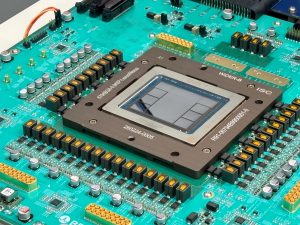
[News] Intel Says EMIB Customers Back Substrate Prepayments; 4 Taiwan, 2 Japan Suppliers Seek Commitments
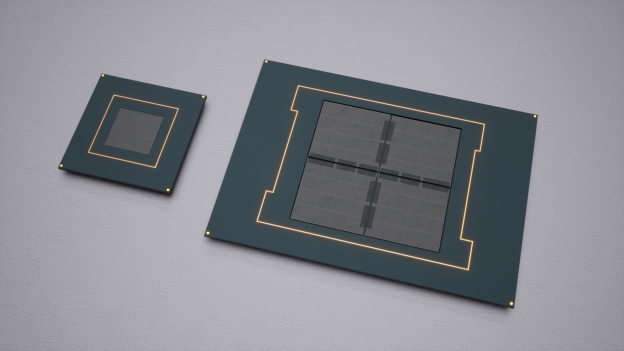
As Intel gains traction with its 18A and 14A nodes, its advanced packaging business — particularly EMIB (Embedded Multi-die Interconnect Bridge) — is also drawing customer support amid tight substrate supply. Speaking at the J.P. Morgan Global Technology Conference, Intel CEO Lip-Bu Tan said several customers have shown strong interest in EMIB-T and are willing to help prepay Taiwanese and Japanese suppliers to secure substrate capacity, according to a Seeking Alpha transcript.
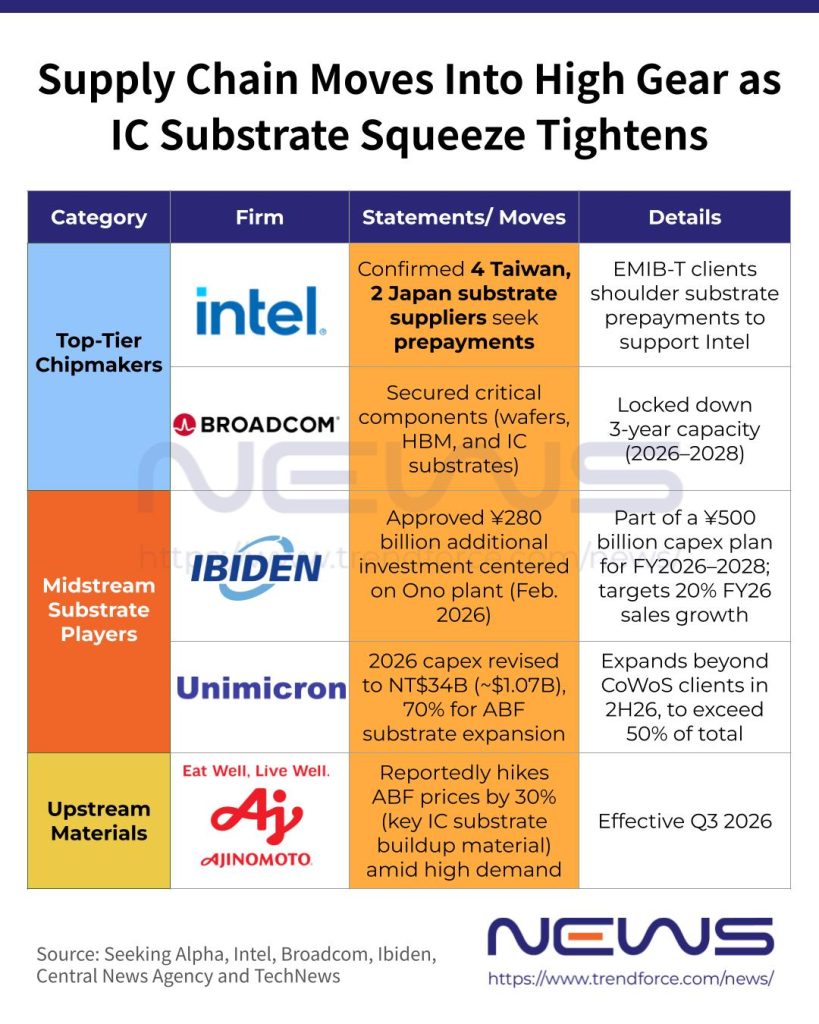
Notably, Lip-Bu Tan revealed that substrate supply remains extremely tight, with four suppliers from Taiwan and two from Japan requesting upfront commitments to secure capacity.
Against this backdrop, Intel has also asked customers planning to adopt EMIB-T to participate in substrate prepayments, according to Seeking Alpha. “If you are serious to use our EMIB-T, can you help me on the substrate prepay? They jump on it,” Tan said.
While TSMC has reportedly achieved a 98% yield rate for CoWoS, Wccftech, citing analyst Jeff Pu, reports Intel’s EMIB yields have reached 90%. The report further notes that Google’s TPU v8e, slated for 2H27, and Meta’s in-house CPU targeted for 2H28 are both expected to adopt Intel’s EMIB.
Separately, TrendForce notes that TSMC’s CoWoS has remained structurally tight since 2023, with spillover demand benefiting OSAT players such as SPIL and Amkor. Alternative architectures like Intel’s EMIB and SPIL’s FOEB (Fan-Out Embedded Bridge) are also gaining traction, supported by Intel’s expanding U.S. manufacturing footprint, TrendForce adds.
According to TrendForce, Intel’s EMIB offers several advantages over TSMC’s CoWoS, including eliminating the need for a large interposer by using embedded silicon bridges. This design improves yield, reduces warpage risk, and enhances long-term reliability.
EMIB also enables larger effective reticle scaling. EMIB-M has already reached 6× and is projected to expand to 8–12× by 2026–2027, compared with CoWoS-S at about 3.3× and CoWoS-L at around 3.5× today, as per TrendForce.
EMIB Substrate Suppliers in Focus
Notably, at the 2025 Intel Foundry Direct Connect event held last April, the company further advanced its push into advanced packaging by outlining key EMIB substrate partners. According to a previous Economic Daily News report, the list includes Japan’s Ibiden and Shinko Electric Industries, Taiwan’s Unimicron, and Austria-based AT&S.
Central News Agency reports that Unimicron has maintained a long-standing partnership with Intel. Citing company chairman T.J. Tseng, the report adds Unimicron will increase its customer base beyond CoWoS-related clients in the second half of 2026, with such business expected to account for more than half of its total.
Meanwhile, another key supplier, Japan’s Ibiden, expects fiscal 2026 (Apr 2026–Mar 2027) sales to grow about 20% YoY, with a stronger second half, as noted by ZDNet.
The IC substrate leader also reasserts its expansion plan going smoothly. According to a Feb. press release, Ibiden has approved an additional ~¥280 billion investment, mainly centered on its Ono plant as well as existing domestic and overseas sites, to expand capacity for high-performance IC package substrates used in advanced servers.
The expansion is part of a broader three-year capital spending plan of about ¥500 billion for fiscal 2026–2028. Mass production is set to roll out in stages from fiscal 2027, the company said.
Read more
- [News] SK hynix Reportedly Tests Intel EMIB 2.5D Packaging With HBM Amid TSMC CoWoS Tightness
- [News] Intel’s EMIB Reportedly Gains Traction at Google, Meta; Yields Said to Reach ~90% Milestone
(Photo credit: Ibiden)