[News] Under Qatar’s Shadow: Helium Crunch Hits South Korea Harder, Putting Samsung, SK hynix, TSMC in Spotlight

The Middle East war, widely known for driving oil prices up, is also threatening the semiconductor industry by hitting a critical yet little-known resource: helium. As reported by CNBC, Qatar, which supplies over a third of the world’s helium, has seen production at its Ras Laffan LNG plant stall after attacks on QatarEnergy. The impact on major chipmakers in Taiwan and South Korea—TSMC, Samsung, and SK hynix—is now under close watch.
Helium’s Critical Role and Rising Risks
According to Liberty Times, helium, a rare inert gas essential for semiconductor manufacturing, is used in smaller quantities compared with bulk gases like nitrogen, oxygen, or argon. Yet, it plays a critical role in specific processes.
As TechNews explains, during etching, helium is injected between the wafer and the carrier to quickly dissipate heat generated by the process, preventing the wafer from overheating or warping. CNBC adds that helium is also crucial in photolithography, the process that precisely prints the intricate circuitry on each chip.
Amid Middle East turmoil, Maeil Business reports that spot helium prices have surged up to 40% in just a week. Analysts cited by the report also warn that if the supply squeeze continues, helium could soar to $2,000 per 1,000 cubic feet (MCF), up from about $500 before the Iran conflict. According to the report, QatarEnergy said recent attacks damaged 17% of its LNG export capacity, with full recovery expected to take three to five years.
Should Chip Giants Worry?
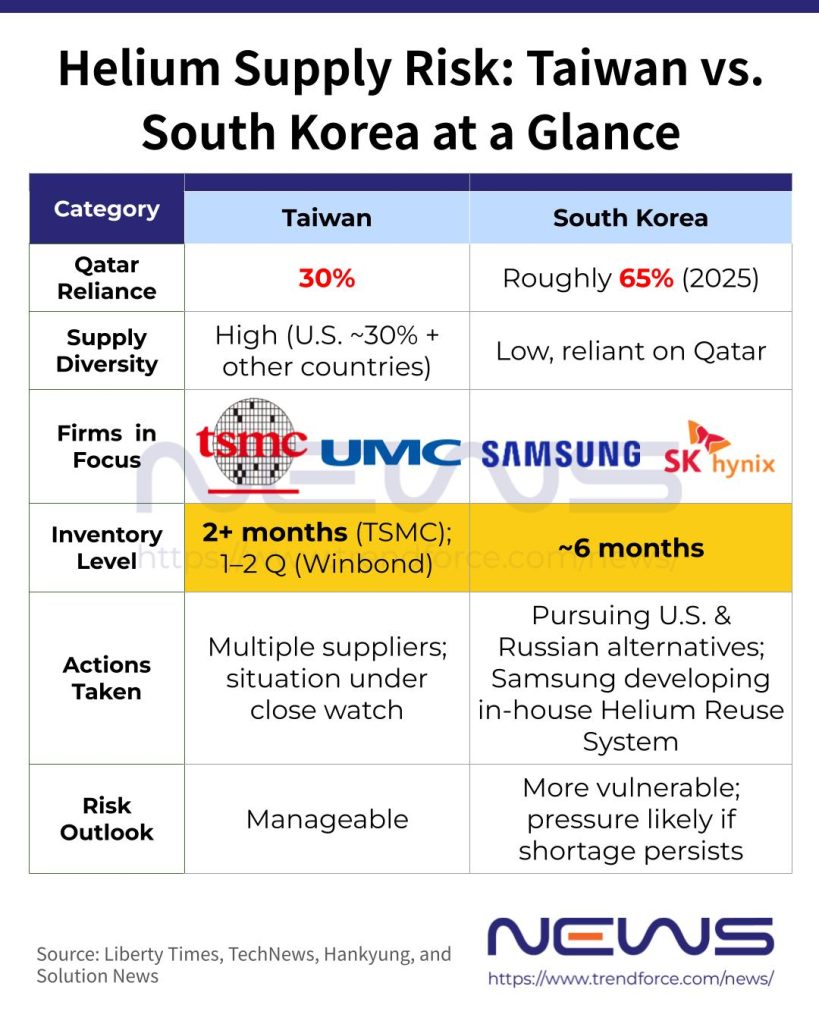
However, TechNews notes that Taiwan’s helium supply is far more diversified than South Korea’s. Only about 30% reportedly comes from Qatar, another 30% from the U.S., and the rest from other countries and domestic sources. This spread gives Taiwan more flexibility to navigate potential disruptions in the Middle East, while South Korea—heavily reliant on Qatari helium—could face tighter constraints.
Liberty Times reports that TSMC, making AI chips for global clients like NVIDIA, keeps helium and other materials sourced from multiple suppliers, with over two months’ stock on hand. Production risks are seen as manageable, though the situation remains under close watch.
UMC, Taiwan’s second-largest foundry, confirms ample helium from multiple suppliers, while memory maker Winbond says critical gases and materials usually carry one to two quarters of safety stock, keeping short-term production largely unaffected, the report adds.
In contrast, Hankyung reports that South Korea sourced 64.7% of its helium from Qatar in 2025, leaving local chipmakers vulnerable if the supply crunch continues. Thus, Samsung and SK hynix are actively seeking alternatives, tapping U.S. suppliers—the world’s second-largest source—and even exploring potential deals with Russian firms, while maintaining roughly six months of helium stock, the report adds.
Samsung Taking Action
Big techs are moving fast. According to Solution News, Samsung has rolled out its in-house Helium Reuse System (HeRS) on select production lines since April last year, capturing and purifying used helium for reuse in semiconductor processes. Early results suggest an annual reduction of roughly 4.7 tons of helium, with projections indicating that expanding HeRS across all lines could cut total helium use by about 18.6% per year, the report notes.
However, given that helium production is tightly linked to LNG output, securing new sources quickly is challenging, the report cautions, adding that building new helium facilities takes months, and much of the supply is already tied up in long-term contracts.
Read more
(Photo credit: TSMC)