[News] The Race to 2028: Samsung, SK hynix Set High-NA EUV Timelines for DRAM as Micron Stays Tight-Lipped
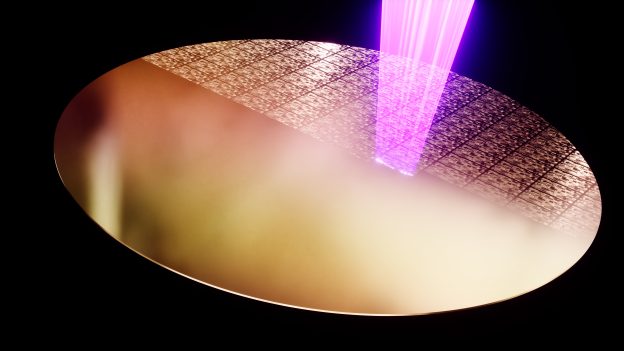
As ASML unveils a series of collaborations with leading chipmakers, including TSMC, Intel, and Samsung, to drive the transition from today’s 6-inch photomasks to larger 12-inch masks for High-NA EUV systems, adoption roadmaps among major semiconductor players are also coming into focus.
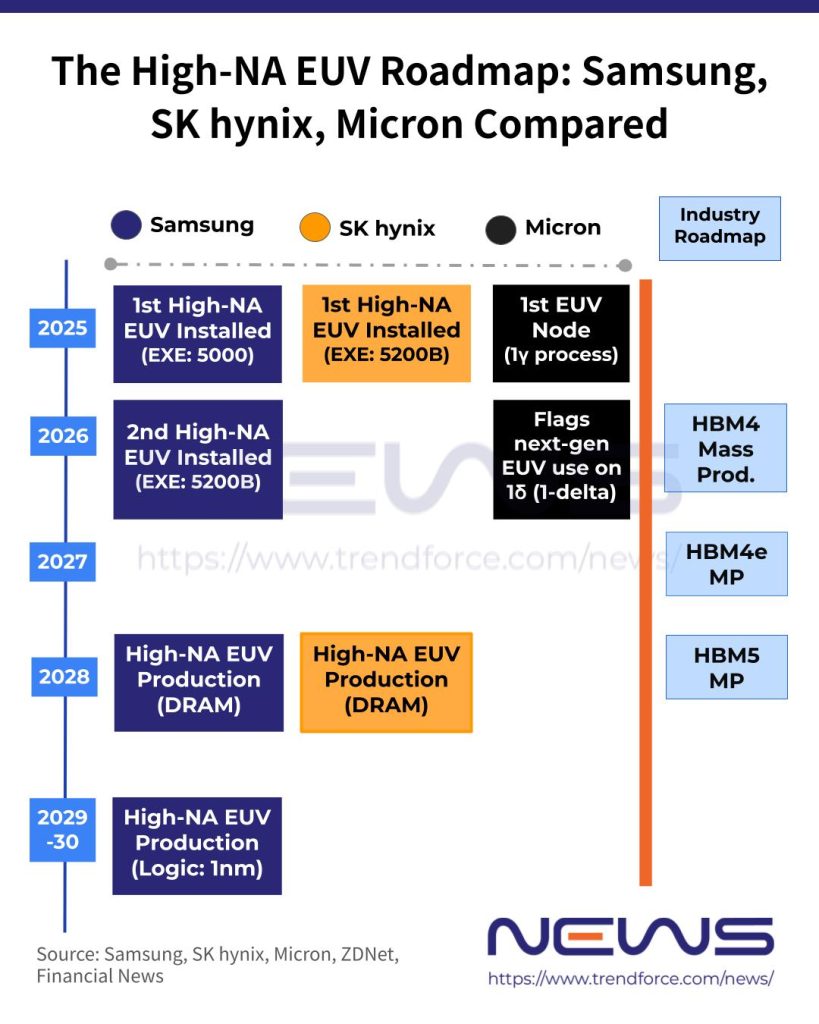
Notably, 2028 could mark a critical milestone for memory makers, with both Samsung and SK hynix targeting the technology’s adoption in DRAM production by then, according to South Korean media outlet M Today.
High-NA EUV to Boost DRAM Efficiency, HBM Edge
As explained by M Today, High-NA EUV uses a higher numerical aperture (NA) than conventional EUV to improve resolution. While ASML’s existing NXE EUV systems have an NA of 0.33, its latest EXE systems raise it to 0.55.
As noted by Financial Times, a key advantage of the system is its ability to reduce the number of multipatterning steps. While conventional EUV requires four multipatterning steps to achieve 2nm-class features, High-NA EUV could theoretically cut the number of process steps in half, significantly lowering manufacturing costs, the report adds.
Notably, Samsung’s planned adoption could also have more implications. Citing industry sources, Financial News reports that applying High-NA EUV systems to advanced DRAM production could help Samsung further enhance HBM performance and strengthen its position against rivals. As noted by the report, Samsung set performance targets above international standards from the outset of HBM4 development and moved early to adopt its most advanced 1c-class (10nm-class sixth-generation) DRAM process.
According to Yonhap News, Samsung has been working closely with ASML on next-generation lithography, including bringing in South Korea’s first High-NA EUV system in March 2025.
On the other hand, Financial News points out that the move could become increasingly critical as China rapidly advances its memory capabilities, with the country reportedly beginning limited production of HBM3E. As China’s memory ambitions accelerate despite EUV restrictions, Samsung and SK hynix’s push to adopt High-NA EUV could be crucial to maintaining a significant technology lead in advanced DRAM and HBM, the report adds.
SK hynix Steps Up High-NA EUV Push
Meanwhile, News1 reports that, like Samsung, SK hynix is planning to introduce High-NA EUV equipment into its DRAM process and begin mass production applications by 2028. The company is also considering joining the Large Size Mask Consortium led by TSMC, the report adds.
The move builds on SK hynix’s continued expansion of EUV in advanced DRAM manufacturing since its first adoption in fourth-generation 10nm-class DRAM in 2021. The company is now rapidly ramping up production of its sixth-generation 10nm-class (1c) DRAM, which is set to serve as the core memory die for its next-generation HBM4E targeted for mass production in 2027, according to Chosun Biz.
The 1c ramp is already gaining momentum. Sources cited by Chosun Biz said 1c DRAM accounted for around 13% of SK hynix’s DRAM production in 2Q26, with the share projected to rise to 34% in 4Q26.
A Hiring Clue Points to Micron’s High-NA Plans
Meanwhile, Micron has been relatively quiet on its High-NA EUV progress, but introduced its first EUV-based 16Gb DDR5 devices in 2025, built on its new 1γ (1-gamma) process, according to Tom’s Hardware.
Notably, at its 2QFY26 earnings call, Micron said 1γ is expected to account for the majority of its DRAM bit mix by mid-2026. More importantly, the company has offered subtle clues about its next-generation EUV strategy. According to Micron, it plans to expand EUV adoption at its 1δ (1-delta) DRAM node using “the latest-generation EUV tools,” which it says will improve cleanroom space efficiency and optimize patterning as it scales to 1δ and beyond.
A recent job posting offers a further signal that preparations may already be underway. Micron is currently recruiting for a “High NA EUV Track – Equipment Engineer” role based at the NY Creates site in Albany, New York — home to the High NA EUV Center that Micron helped establish alongside IBM, Applied Materials, and Tokyo Electron through a $10 billion partnership with New York State.
Read more
- [News] ASML Expands High-NA EUV Push with TSMC, Samsung and Intel; 12-inch Photomask Pilot Line Set for 2031
- [News] ASML Advances High-NA EUV Toward HVM as 10 Systems Reportedly Go Live at 4 Customers
(Photo credit: ASML)