[News] NVIDIA Vera Rubin Spillover from HBM to NAND: CMX Fuels TLC Spot Price Rebound from June Dip
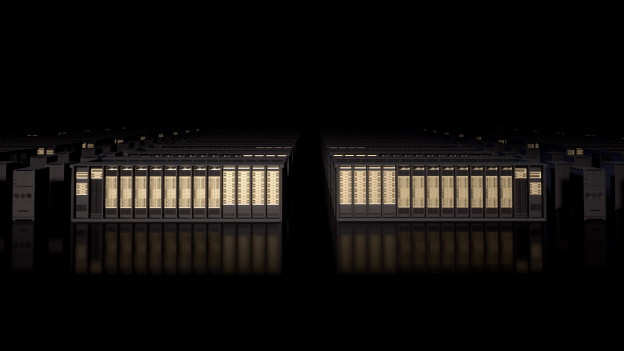
As NVIDIA’s Vera Rubin ramps up, its memory impact is extending beyond HBM into NAND. Alpha Economy reports that stronger Rubin production is tightening TLC NAND supply-demand, with the 512Gb TLC NAND spot price rebounding from its June dip to $21.125 on Aug. 17.
Citing DRAMeXchange, the report suggests the price jumped 4.97% from the previous week and 11.6% in just three weeks.
CMX: A New NAND Demand Driver
Economy Tribune points to NVIDIA’s rollout of Context Memory eXtension (CMX) in the Vera Rubin platform as a key catalyst behind the TLC NAND price surge. As generative AI and AI agents handle longer contexts, KV caches storing previous-token computation results are expanding rapidly, making it costly and capacity-intensive to keep them entirely in expensive HBM.
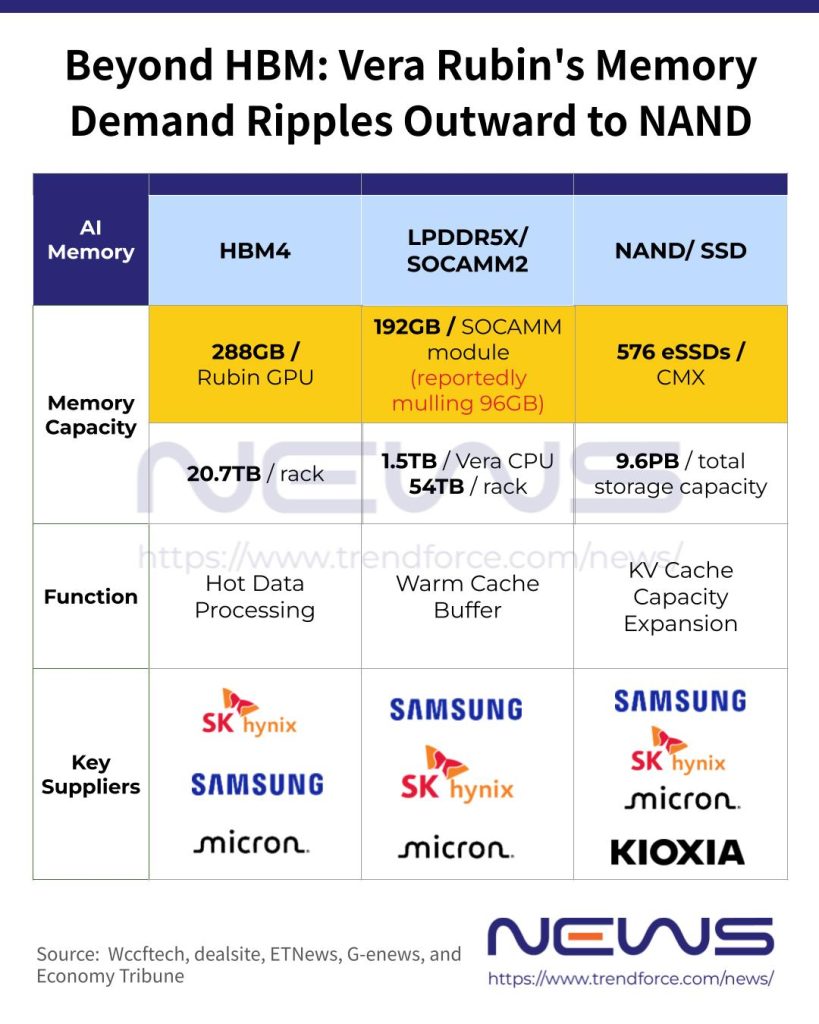
Built on BlueField-4, CMX addresses this bottleneck by inserting a flash-based memory layer between HBM and network storage, allowing KV caches and other data pushed out of HBM to be stored in flash and retrieved when needed. Wccftech highlights that CMX uses TLC flash connected to Rubin GPU clusters via BlueField-4 DPUs and Spectrum-X Ethernet to handle KV cache in real time.
The scale of CMX could translate into a significant new NAND pull. Citing industry observers, Economy Tribune estimates that a single CMX configuration could use around 576 enterprise SSDs, delivering a massive 9,600TB (9.6PB) of total storage capacity.
While much of NVIDIA’s TLC NAND supply is likely secured through long-term contracts, Wccftech notes that the sheer scale of Rubin-related demand is already putting pressure on the spot market, raising the question of how far the price rally could go.
Samsung, SK hynix and Kioxia in Focus
As Economy Tribune notes, major NAND players including Samsung, SK hynix and Kioxia stand to benefit. Kioxia unveiled its CM10 enterprise SSDs in July, built on 10th-generation BiCS FLASH™ TLC NAND and optimized for AI inference and context caching.
Designed to support NVIDIA’s CMX™ architecture, the CM10 delivers higher performance, better power efficiency and greater cooling flexibility than the CM9, Kioxia said, adding that samples are now shipping to select customers.
SK hynix, meanwhile, is doubling down on high-capacity QLC enterprise SSDs through its subsidiary Solidigm. The company began mass-producing the world’s first 321-layer 2Tb QLC NAND in August last year and started shipping 321-layer QLC-based SSDs in April, Economy Tribune reports.
On the other hand, Economy Tribune notes that Samsung, in its semi-annual report on Aug. 14, noted that both DRAM and NAND posted record-high bit shipments in Q2, while the share of bit shipments to servers also reached an all-time high.
In July, Samsung also began mass production of the PM1763 enterprise SSD for NVIDIA’s Vera Rubin platform. Built with 9th-generation V-NAND and a 4nm controller, the 16TB model delivers up to 28,400MB/s read and 21,900MB/s write speeds, roughly twice those of its predecessor, according to the Chosun Daily.
Read more
- [News] NVIDIA Reportedly Halves Vera Rubin SOCAMM Capacity as Memory Costs Near 29% of System BOM
- [News] Vera Rubin Buildout: NVIDIA Reportedly Pushes TSMC Above 20% Revenue Share, Power, Cooling Suppliers Benefit
(Photo credit: NVIDIA)