





 Download Report
 Contact Us
2026 Outlook: Global Semiconductor Supply Chain Diversification and Materials Strategy

Last Modified
2026-06-18

Update Frequency
Not

Format
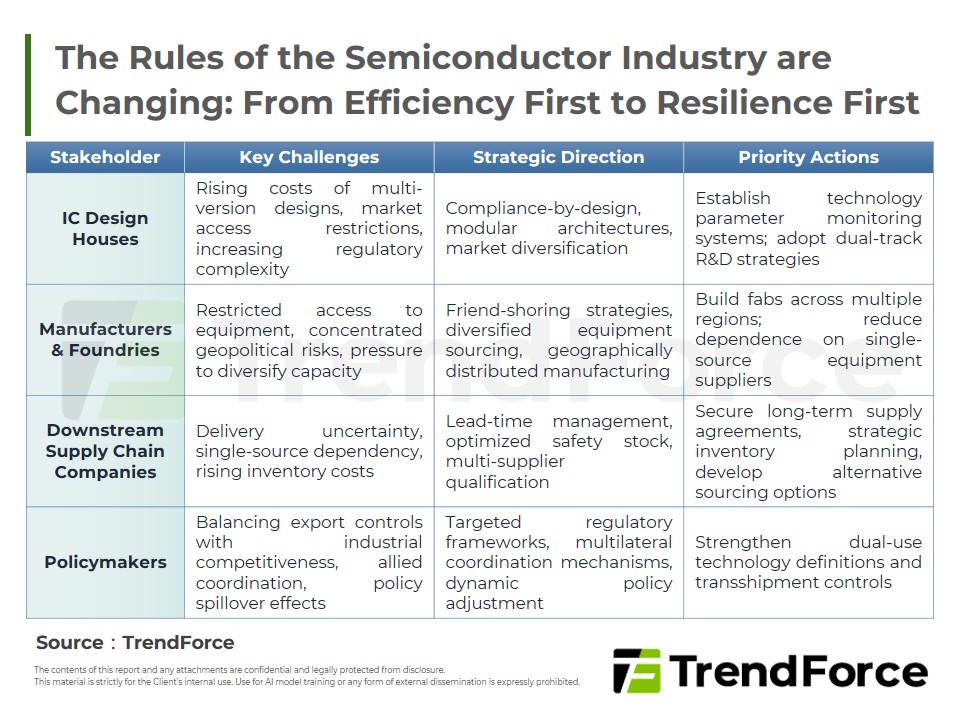
Global semiconductor supply chains are shifting from efficiency to resilience amid escalating export controls, driving manufacturing diversification. Governments race to subsidize domestic ecosystems, while China pursues dual-track strategies; material self-sufficiency remains a lasting challenge.
Key Highlights
- Paradigm shift: The industry moves from efficiency-first to resilience-first, prioritizing security and self-sufficiency.
- Expanding controls: U.S. export restrictions now cover hardware, software, cloud services, and AI models, reinforced via multilateral alliances.
- Subsidy race: The U.S., EU, Japan, and China deploy large-scale subsidies to accelerate domestic manufacturing and technology independence.
- China's dual-track response: Sustaining compute development through mature nodes and software optimization while pursuing alternative technology paths.
- Materials challenge: Critical materials remain heavily concentrated in China, requiring long-term diversification and lengthy qualification processes.
Table of Contents
- 2026 Semiconductor Realignment: The Era of Manufacturing Diversification
- Supply Chain Resilience Becomes a Strategic Imperative
- Governments Deploy Multi-Pronged Strategies to Reshape the Semiconductor Materials Landscape
- TRI’s View
<Total Pages: 27>

Spotlight Report
-

AI Wave & DRAM Deficits: 2027 Global DRAM Outlook
2026/07/28
Selected Topics
PDF
-

AI Surge Drives NOR Flash Deficit: 2026 Industry Outlook
2026/09/10
Selected Topics
PDF
-

AI Server Boom Outpaces U.S. Grid Buildout
2026/09/07
Selected Topics
PDF
-

iPhone 18: Modest Hardware Gains, Pricing and AI Drive Sales
2026/09/02
Selected Topics
PDF
-

US Data Center Buildout Faces Midterm Risks
2026/10/07
Selected Topics
PDF
-

AI Server Value Surges on Pricing and Capex Boom
2026/10/08
Selected Topics
PDF
Selected TopicsRelated Reports

Download Report
2,500

Membership
- Selected Topics
- Selected Topics-197_Global Semiconductor Supply Chain Restructuring and Strategic Policies (Presentation)
Spotlight Report
-
AI Wave & DRAM Deficits: 2027 Global DRAM Outlook
2026/07/28
Selected Topics
PDF
-
AI Surge Drives NOR Flash Deficit: 2026 Industry Outlook
2026/09/10
Selected Topics
PDF
-
AI Server Boom Outpaces U.S. Grid Buildout
2026/09/07
Selected Topics
PDF
-
iPhone 18: Modest Hardware Gains, Pricing and AI Drive Sales
2026/09/02
Selected Topics
PDF
-
US Data Center Buildout Faces Midterm Risks
2026/10/07
Selected Topics
PDF
-
AI Server Value Surges on Pricing and Capex Boom
2026/10/08
Selected Topics
PDF