





 Download Report
 Contact Us
AI Infra Market Bulletin – Jun. 11, 2026

Last Modified
2026-06-11

Update Frequency
Biweekly

Format
The year 2026 marks the watershed transition of AI data center optical interconnects from adoption to mass production. The actual volume driver is not scale-out CPO switches, but GPU scale-up networks. Competition is also elevating from pure PIC foundries to integrated optical engine platforms that combine PICs, EICs, packaging, lasers, and optical coupling. Success in mass production will depend on yield, field-serviceable connectors, InP/CW laser supply, and strategic ecosystem positioning.
Key Highlights
- Primary driver: The AI data center bottleneck is shifting from compute to data movement. The transition to 200G/400G lanes means copper interconnects have higher requirements for SerDes and FEC, and optical interconnects move closer to the package through a progression of pluggable, LPO/LRO, NPO, and CPO architectures.
- Demand inflection point: CPO will initially be deployed in scale-out switches, but the actual volume growth will come from GPU-to-GPU and cross-rack scale-up networks. Volume production is expected to begin in 2027-2028, with a more meaningful production ramp starting in 2028-2029.
- PIC market segmentation: The market is dividing into pure PIC foundries and integrated optical engine platforms. The former simply provide SiPh wafers, whereas the latter combine PICs, EICs, 3D packaging, testing, and lasers, resulting in higher ASPs and stronger customer lock-in.
- Technology roadmap: SiPh remains the mainstream platform, while TFLN targets 400G/lane and long-reach DWDM applications. GeSi EAM is a key technology to watch for scale-up optical I/O after 2028.
- Mass-production bottlenecks: The challenge is no longer whether CPO can be built, but whether it can be delivered reliably at scale. Yield, thermal control, electro-optical testing, coupling accuracy, and field-serviceable connectors are now decisive.
- Supply-chain positioning: InP/CW lasers, ELSFP modules, FAUs/coupling processes, and connector standards are becoming new strategic assets, prompting hyperscalers to secure production capacity through long-term contracts and investments.
Table of Contents
- TrendForce’s View
- Demand Related to AI Data Centers Is Driving the Evolution of Optical Interconnects
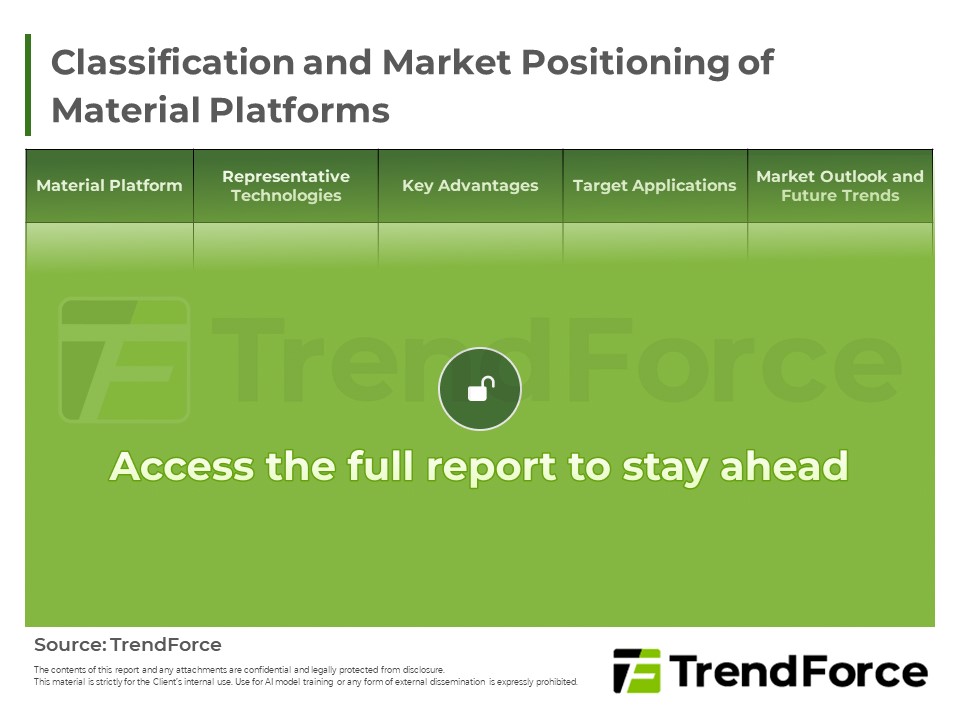
- Basic Definition of the PIC Industry and the Material Technology Landscape
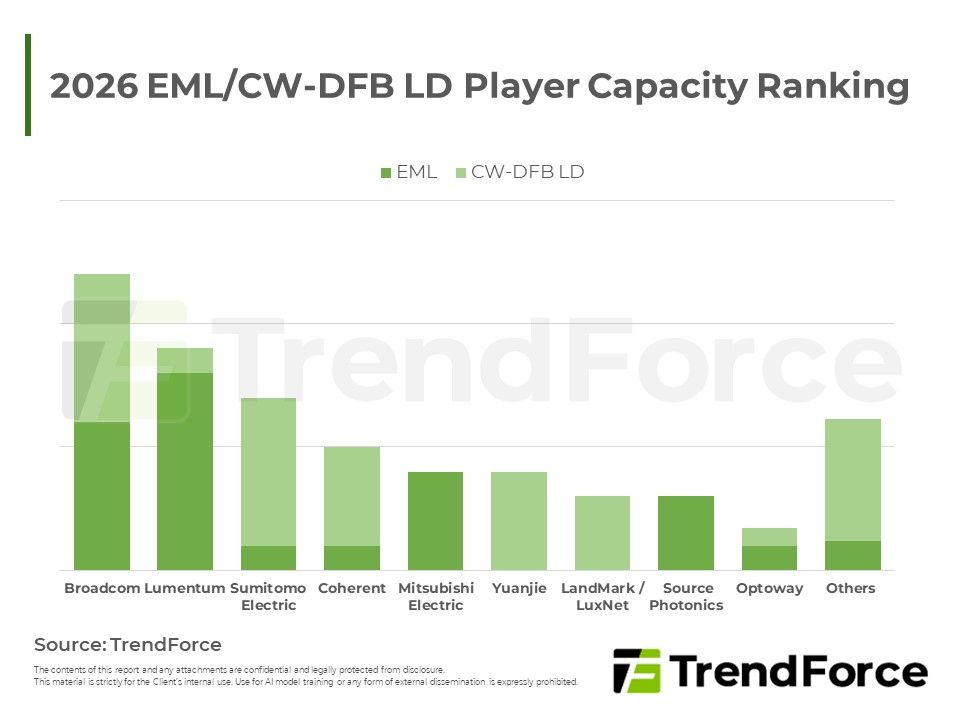
- PIC Industry Chain and Major Players Worldwide
- Mass Production Bottlenecks for CPO - Modulators, Coupling, Packaging, Reliability
- Summary
<Total Pages: 19>

Spotlight Report
-

DRAM Monthly Datasheet Aug. 2026
2026/08/19
Semiconductors
EXCEL
-

NAND Flash Monthly Datasheet Aug. 2026
2026/08/17
Semiconductors
EXCEL
-

3Q26 Memory Price Forecast
2026/06/30
Semiconductors
PDF
-

Global Memory Supply-Demand Divergence: Analyzing 2027 DRAM Structural Tightness and NAND Flash Oversupply
2026/07/28
Semiconductors
PDF
-

DRAM Contract Price Jun. 2026
2026/06/30
Semiconductors
PDF
-

DRAM Contract Price Jul. 2026
2026/07/31
Semiconductors
PDF
AI Infra BulletinRelated Reports




Download Report
8,000

Spotlight Report
-
DRAM Monthly Datasheet Aug. 2026
2026/08/19
Semiconductors
EXCEL
-
NAND Flash Monthly Datasheet Aug. 2026
2026/08/17
Semiconductors
EXCEL
-
3Q26 Memory Price Forecast
2026/06/30
Semiconductors
PDF
-
Global Memory Supply-Demand Divergence: Analyzing 2027 DRAM Structural Tightness and NAND Flash Oversupply
2026/07/28
Semiconductors
PDF
-
DRAM Contract Price Jun. 2026
2026/06/30
Semiconductors
PDF
-
DRAM Contract Price Jul. 2026
2026/07/31
Semiconductors
PDF