

Rising Memory and CPU Prices Could Push Mainstream Notebook Prices Up by Nearly 40%, Says TrendForce
- For a mainstream notebook with an MSRP of US$900, surging memory prices alone could raise retail prices by more than 30%; combined with CPU price increases, the total price hike could approach 40%
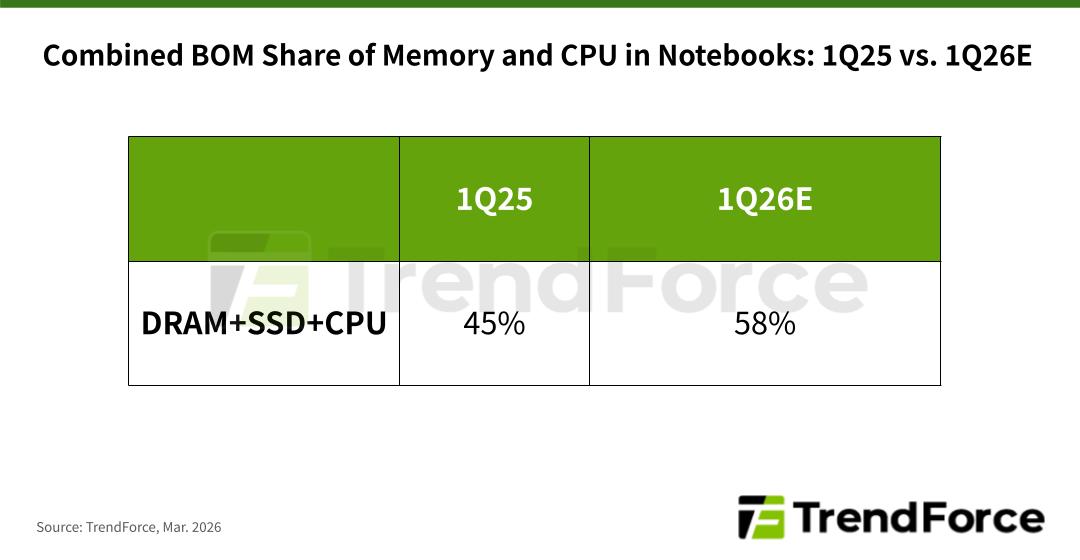
- If memory and CPU prices rise simultaneously, their combined share of notebook BOM costs could climb to 58%
- CPU supply volatility is also emerging, with shortages beginning to affect entry-level platforms across multiple brands
The global notebook market is expected to face dual pressures from weak demand and rising component costs in 2026, according to TrendForce’s latest research on the notebook industry. In addition to rapidly rising memory prices, CPU pricing has also begun to move higher. TrendForce estimates that to preserve existing margin structures for both notebook brands and distribution channels, the retail price of a mainstream notebook with an original MSRP of US$900 could rise by nearly 40%.
TrendForce notes that since the start of 2026, supply for notebook DRAM and NAND Flash has tightened significantly. Prices have surged, and shortages of certain components have become more pronounced, increasing uncertainty for notebook brands as they plan their procurement strategies.
TrendForce modeled a baseline scenario based on a mainstream notebook with a $900 MSRP in 1Q25 to evaluate the potential impact of component price increases on retail pricing.
Under normal conditions, DRAM and SSD account for roughly 15% of a notebook’s BOM cost. However, after several quarters of sharp increases in memory prices, that share is projected to exceed 30% in 1Q26. In this scenario, retail prices for a $900 notebook may need to rise by more 30% just to maintain existing profit margins across the supply chain.
Rising memory costs are not the only challenge: According to TrendForce’s supply chain observations, Intel has already raised prices on certain entry-level and older-generation notebook CPUs by more than 15%, and is planning further price increases for mainstream and mid-to-high-end platforms in 2Q26.
Because CPUs already represent one of the largest cost components in a notebook’s BOM, these increases will further drive up overall system costs. For a $900 notebook, if both memory and CPU prices rise, their combined share of BOM costs could climb from approximately 45% to around 58%. These cost pressures could translate into retail price increases approaching 40% higher if brands and distribution partners maintain their existing margins.
TrendForce also notes that recent developments in the CPU market extend beyond pricing. Supply stability has begun to fluctuate as well. As demand for AI-related computing workloads continues to grow, upstream advanced process and packaging capacity has increasingly been prioritized for high-performance computing products, crowding out supply for some entry-level and lower-end CPUs. This shift has begun to limit supply for certain entry-level and lower-end CPUs, leading to tighter availability for Intel’s entry-level notebook platforms.
The degree of impact will vary depending on the depth of collaboration and procurement scale between notebook brands and Intel. Tier-one brands, benefiting from long-term partnerships and larger purchasing volumes, are more likely to secure stable allocations and favorable pricing. Smaller brands, by contrast, face greater cost pressure and shipment risks as CPU price increases and supply volatility occur simultaneously.
Recently, AMD CPUs have become more competitive as notebook brands increasingly adopt multi-platform strategies, boosting AMD’s market share. Although AMD’s supply had been stable before, recent reports indicate possible shortages in some entry-level AMD platforms, suggesting that tight CPU supply conditions are now affecting a wider range of the market.
TrendForce concludes that memory supply conditions and CPU pricing strategies over the next several quarters will be key factors shaping global notebook shipment trends and competitive dynamics among brands.
For more information on reports and market data from TrendForce’s Department of Display Research, please click here, or email the Sales Department at DR_MI@trendforce.com
For additional insights from TrendForce analysts on the latest tech industry news, trends, and forecasts, please visit https://www.trendforce.com/news/