

TrendForce Roadshow Korea Highlights How Emerging Technologies Are Reshaping Industries Toward an AI-Native Future, Says TrendForce
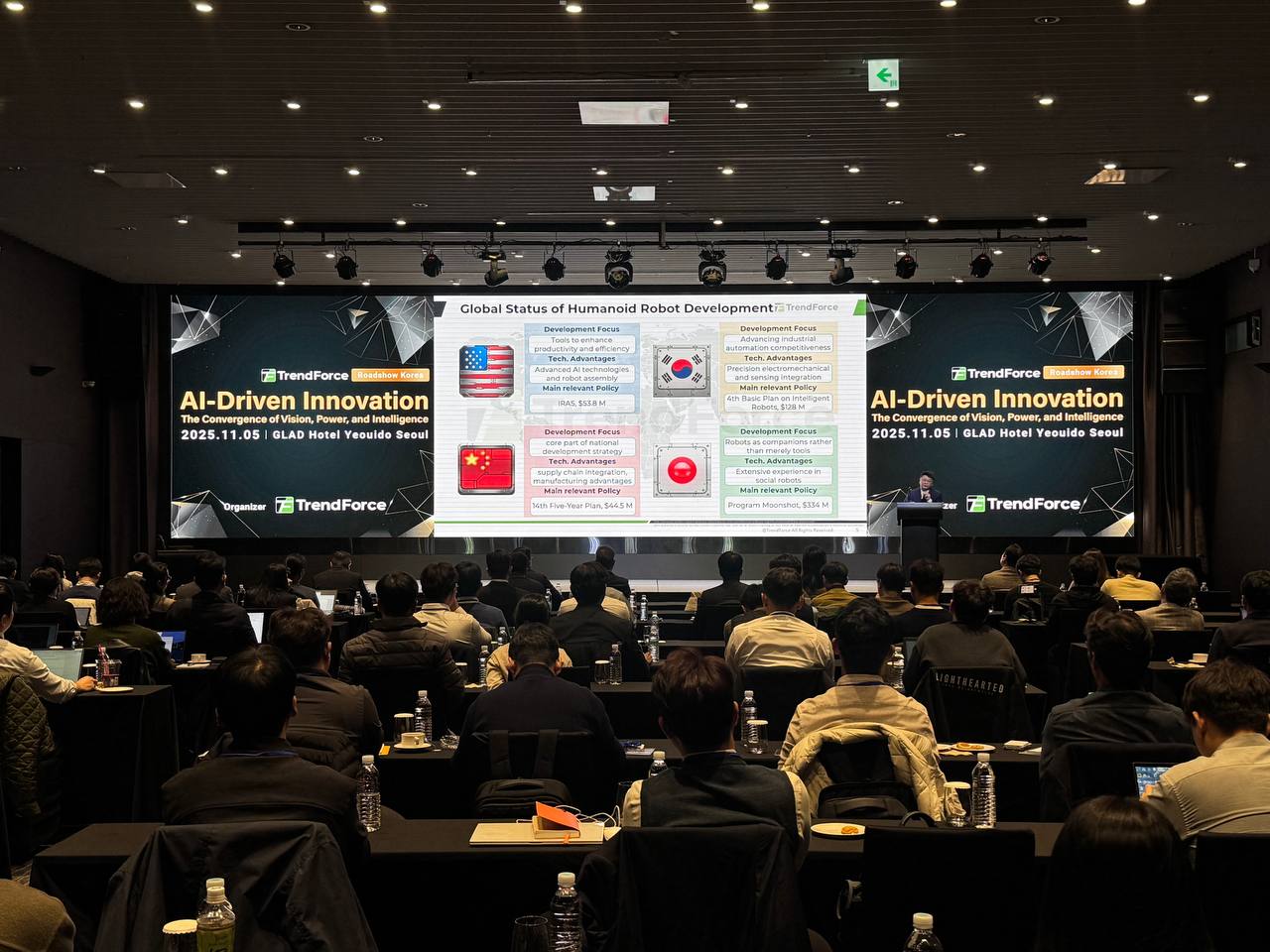
TrendForce hosted the AI-Driven Innovation: The Convergence of Vision, Power, and Intelligence seminar in Seoul on November 5. The leading technology industry analysis firm shared insights into how AI is driving advances spanning near-eye displays and autonomous robotics to HBM memory, advanced MLCCs, and AI-optimized semiconductor manufacturing. Key highlights from the seminar include:
Displaying Technology Diversification and Korean Manufacturers' Strategies
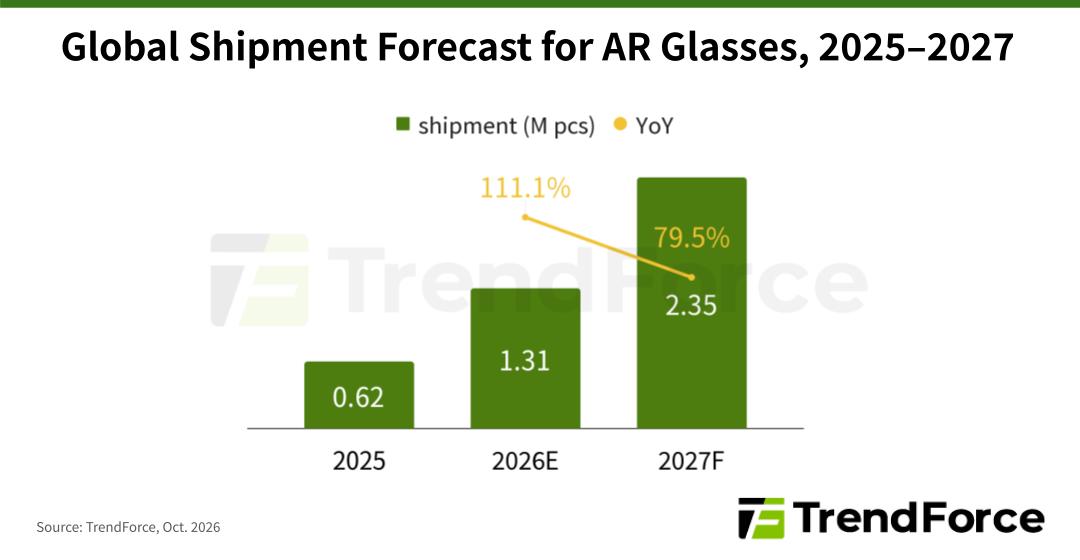
Maintaining a focus on OLED will remain the core strategy for the Korean display industry. Compared with TV applications, WOLED and QD-OLED should focus more on monitor applications. Meanwhile, demand for notebook PC OLEDs is highly anticipated, but aggressive capacity investments by Chinese manufacturers—along with new production processes such as Inkjet and non-FMM—will intensify competition. OLEDoS will primarily serve VR and MR devices, while silicon-based Micro LED (LEDoS) technology could also be a promising path for the Korean industry to explore for AR glasses.
Identifying the Tipping Point: Strategic Outlook for the Global Humanoid Robot Industry to 2026
The humanoid robot market is emerging as a critical non-linear growth sector – not a passing trend. Fueled by irreversible global labor shortages, adoption is accelerating—shifting from industrial applications today to domestic use tomorrow. While movement mechanics currently account for about 55% of total costs, the software layer delivers the core value, enabling learning, adaptability, and scalability. TrendForce projects substantial market expansion after 2032, positioning 2026 as the pivotal investment window for those seeking early strategic advantage. The race is no longer about motion but about generalized autonomy and scalable system integration. Humanoid robotics is entering its decisive decade.
CSPs Accelerate Investments, AI Server Deployment Expands, Supply-Demand Outlook for DDR5 and HBM
The current memory market upcycle is being driven by aggressive procurement from major CSPs, leading to a supply shortage and a sharp increase in contract prices. Looking ahead, CSPs continue to plan substantial capital expenditures and are even considering extending long-term agreements (LTAs) through 2027. As the supply-demand imbalance is expected to persist, contract prices for memory products are likely to maintain their upward momentum into 2026.
MLCC market outlook in 2026
The 2026 MLCC market is being shaped by global economic instability and geopolitical tensions. AI infrastructure has emerged as the primary growth driver, fueling demand for high-end, high-temperature, and high-voltage MLCCs. Japanese and Korean suppliers are continuing capacity expansion, while Taiwanese and Chinese manufacturers have postponed their plans. Demand for consumer electronics remains sluggish, as notebooks and smartphones lack AI-driven upgrades. Meanwhile, escalating U.S.–China tariffs and persistent inflation are constraining ICT industry growth. Overall, the MLCC industry is expected to experience modest growth in 2026.
Navigating 2026 Foundry Market - Dual Realities of Advanced Dominance and Mature Saturation
TrendForce forecasts the global foundry industry to grow by 19% in 2026, driven primarily by advanced process technologies, which are expected to expand by 28% year-over-year on the back of strong HPC demand—creating a stark contrast to the mature process segment.
Both the front-end manufacturing and back-end packaging and testing of advanced technologies are experiencing tight supply due to robust AI demand and the limited number of qualified suppliers, making them short-to-mid-term scarce resources with prices rising each year.
In contrast, demand for mature processes is still expected to grow in 2026 as supply chains continue to rebuild inventories. However, growth momentum remains constrained by the lack of major innovations in consumer applications, increasingly fragmented regional demand, and new capacity coming online from multiple foundries. As a result, pricing continues to trend downward, though the rate of decline has moderated.
For more information on reports and market data from TrendForce’s Department of Semiconductor Research, please click here, or email the Sales Department at SR_MI@trendforce.com
For additional insights from TrendForce analysts on the latest tech industry news, trends, and forecasts, please visit https://www.trendforce.com/news/