

AI to Dominate Demand in 2025, While the Electronics Industry Faces Slow Growth in 2026, Says TrendForce
TrendForce’s latest investigations find that the global electronics market in 2025 will be sharply divided. AI server demand—driven by data center consumption—will stand out as the sole growth engine, while end products such as smartphones, notebooks, wearables, and TVs are expected to stagnate under the combined pressures of high inflation, a lack of breakthrough innovations, and ongoing geopolitical uncertainty. TrendForce projects that overall growth momentum will slow further in 2026, signaling the industry’s entry into a low-growth consolidation phase.
In 2025, to mitigate potential U.S. tariff barriers and geopolitical risks, and benefiting from China’s first-half subsidy policies, many sectors will see significant front-loading of orders. Shipments of servers, tablets, monitors, and automobiles have shifted from the traditional second-half peak season to the first half of the year, resulting in a roughly 50:50 shipment split between the two halves. While this trend will help boost revenue in the first half, it also raises concerns for the second half, as the depletion of early pull-in momentum could lead to shrinking orders and high channel inventories in Q4.
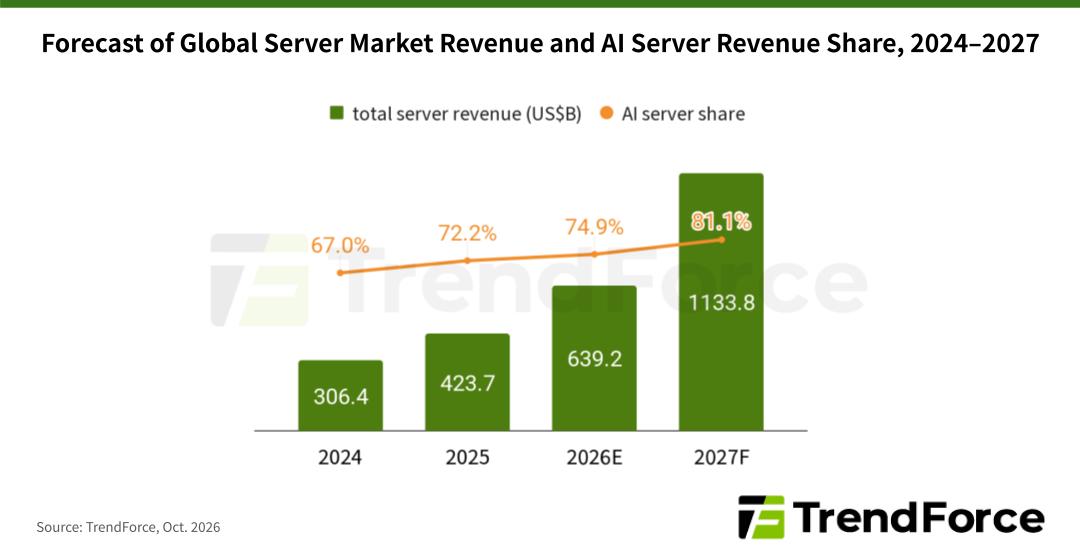
TrendForce forecasts that AI server shipments in 2025 will grow by more than 20% YoY. As CSPs concentrate capital expenditures on NVIDIA’s high-end GPUs and their own custom ASIC chips, procurement budgets for general-purpose servers are being squeezed.
By contrast, the buzz surrounding edge AI for end devices has clearly cooled. Although brands have sought to integrate AI functions into consumer products, most efforts remain at the marketing stage, awaiting the emergence of killer applications. As such, TrendForce projects that smartphone and notebook shipments in 2025 will be flat or grow by only 1–2% YoY, TV shipments will decline by 1.1%, and the wearables market will contract by 2.8%.
Looking ahead to 2026, most consumer product shipments are expected to remain flat or grow only modestly by around 1%, while wearables and automobiles may decline. Even AI servers, which have posted strong gains in recent years, are expected to see slower growth after two years of rapid expansion and a high base effect.
The electronics industry in 2026 will face notable challenges based on current conditions, and the next growth cycle will likely require either a technological breakthrough or a consumer application compelling enough to drive a new wave of demand.
For more information on reports and market data from TrendForce’s Department of Semiconductor Research, please click here, or email the Sales Department at SR_MI@trendforce.com
For additional insights from TrendForce analysts on the latest tech industry news, trends, and forecasts, please visit https://www.trendforce.com/news/