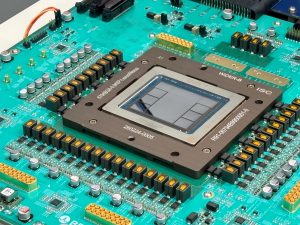
[News] TSMC Reportedly Develops EMIB-like Packaging with Kinsus to Prevent Potential Customer Shift to Intel
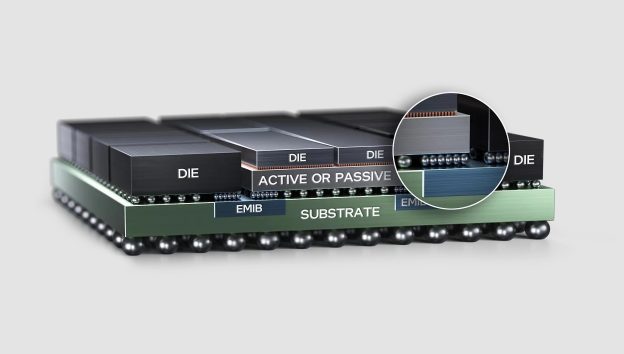
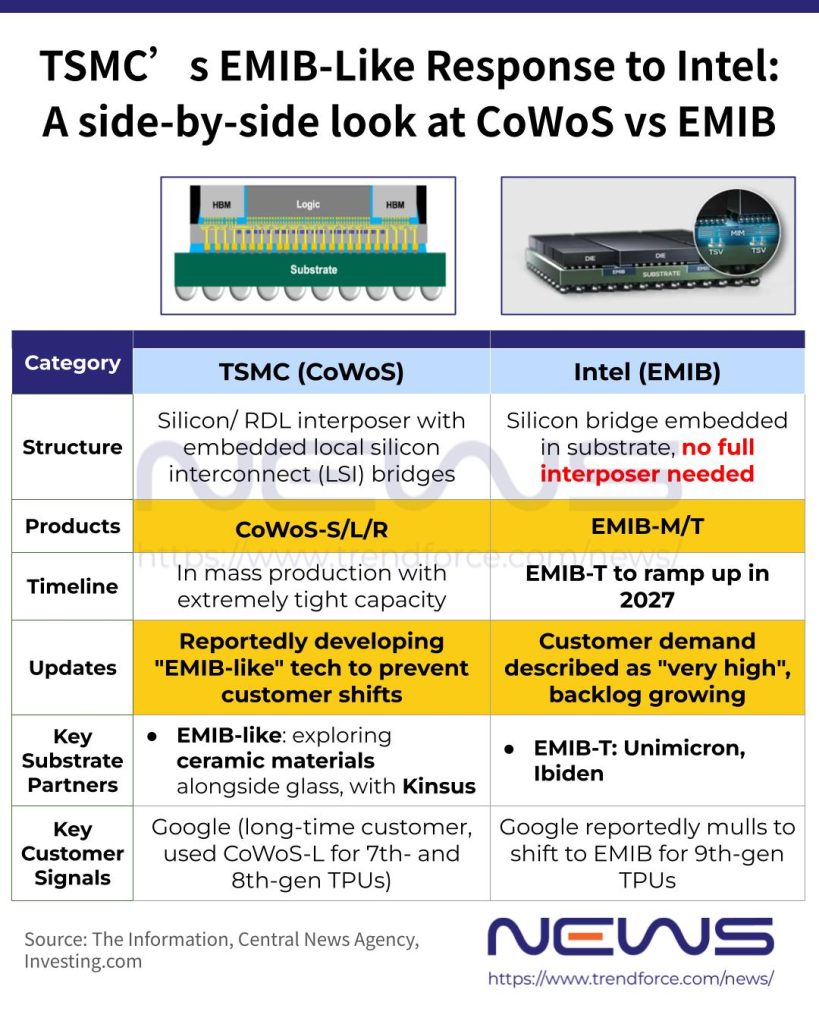
With TSMC’s CoWoS (Chip-on-Wafer-on-Substrate) capacity under pressure, the foundry leader is reportedly developing an advanced packaging solution similar to Intel’s Embedded Multi-die Interconnect Bridge (EMIB). Citing The Information, TechPowerUp reports that the technology, internally dubbed “EMIB-like,” is being developed to prevent potential customer shifts from CoWoS to Intel’s packaging platform.
Taiwan-based IC substrate maker Kinsus is expected to support the effort, helping scale the new architecture from development through volume production, the reports add.
As highlighted by TechPowerUp, Intel’s EMIB embeds a silicon bridge directly into the package substrate to deliver localized, high-density die-to-die interconnects while avoiding the cost and area overhead of a full-size silicon interposer. Available in configurations such as EMIB-M with integrated MIM capacitors and EMIB-T with TSVs, the technology supports efficient, high-bandwidth links for logic-to-logic and logic-to-HBM designs, the report suggests.
On the other hand, TSMC’s CoWoS portfolio currently includes CoWoS-S, CoWoS-L, and CoWoS-R. Investing.com points out that a successful rollout of an EMIB-like solution could help TSMC reinforce its packaging leadership and reduce Intel’s ability to attract customers—including NVIDIA and Google.
According to Tom’s Hardware, Google has been a long-time CoWoS customer, adopting CoWoS-S for earlier TPUs before moving to CoWoS-L for its 7th- and 8th-generation TPU designs, with the technology now scaling packages up to 5.5× the reticle size. However, analysts cited in the report suggest that Google could turn to Intel’s EMIB for its 9th-generation TPUs.
Intel’s EMIB Gaining Customer Traction
Intel is signaling stronger momentum for EMIB as competition in advanced packaging intensifies. At its latest earnings call, CEO Lip-Bu Tan said demand for EMIB-T remains “very high,” while the company continues to build a growing backlog, according to an Investing.com transcript. With yield and reliability targets achieved, Intel, according to Tan, is now focused on scaling EMIB-T into high-volume production and supporting customer ramps in 2027.
Meanwhile, Taiwanese IC substrate maker Unimicron is collaborating with both Intel and TSMC on ABF substrate supply. According to Liberty Times, Unimicron said substrates for Intel’s next-generation EMIB-T are expected to enter mass production next year, with initial yields targeted at 50% before gradually improving. Citing Unimicron, Next Apple noted that EMIB-T remains an emerging technology, with the company working alongside two Japanese partners to further accelerate development.
Read more
- [News] TSMC Welcomes Intel’s EMIB for More Market Flexibility; CEO Jokes About Memory Makers’ Margin Boom
- [News] Intel Says EMIB Customers Back Substrate Prepayments; 4 Taiwan, 2 Japan Suppliers Seek Commitments
(Photo credit: Intel)