[News] Japan’s Rapidus Takes on TSMC With Aggressive 2nm Pricing, Reportedly Targeting up to ¥3.5M per Wafer
The race for advanced nodes among foundries is shifting beyond a battle over technology timelines, with emerging challengers also competing on pricing. According to Nikkei, Rapidus, which is targeting 2nm mass production in 2027, plans to price its foundry services at levels comparable to or lower than those of industry leader TSMC as it seeks to gain a foothold in the market.
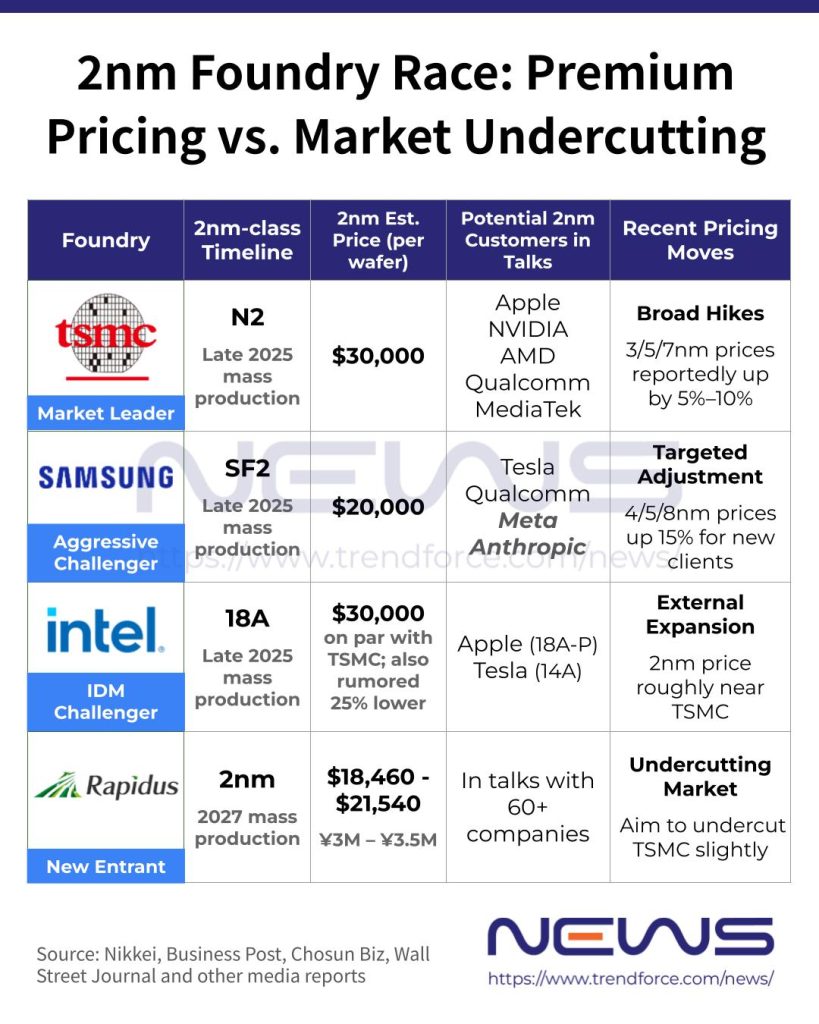
Nikkei, citing Rapidus CEO Atsuyoshi Koike, reports that the company aims to “at least match, or slightly undercut” TSMC’s pricing for its products. Rapidus is targeting a reference price of ¥3 million to ¥3.5 million per wafer, although the final price could fluctuate depending on factors such as exchange rates, the report adds. At current rates, the range translates to approximately US$18,460 to US$21,540 per wafer.
Meanwhile, Rapidus is accelerating customer engagement efforts, holding discussions with more than 60 companies, the majority of which are overseas customers, according to Nikkei. The company is also looking beyond its initial 2nm ramp-up, targeting 1.4nm production in 2029, with its planned second fab in Chitose, Hokkaido, expected to support future capacity expansion, according to the Yomiuri Shimbun.
2nm Pricing Battle Intensifies Among Foundry Giants
Rapidus’ aggressive pricing strategy is putting established foundry leaders under renewed scrutiny. According to Business Post, TSMC’s 2nm process and Intel’s 18A (1.8nm-class) node are reportedly priced at around US$30,000 per wafer. If accurate, the pricing would be significantly above Rapidus’ targeted pricing of up to US$21,000 per wafer.
In comparison, Samsung Electronics’ 2nm process is estimated at approximately US$20,000 per wafer, highlighting its more aggressive pricing stance as it seeks to attract advanced-node customers, Business Post notes.
Nonetheless, both foundry giants are said to be raising prices amid surging demand and tight capacity. Industry sources cited by Chosun Biz noted that TSMC has recently informed major customers, including NVIDIA, Apple, and AMD, of plans to raise wafer prices by 5% to 10% for advanced processes such as 3nm and 5nm, as well as the 7nm node widely used for high-performance semiconductor production.
A similar trend is emerging at Samsung’s foundry business as well. According to Chosun Biz, Samsung is raising supply prices for new customers by around 15%, mainly for high-demand advanced nodes such as 4nm and 5nm, as well as selected 8nm nodes used for automotive semiconductors.
However, unlike TSMC’s broader pricing increase strategy, Samsung’s adjustments are viewed as more targeted price normalization focused on specific processes with strong demand, the report suggests.
Read more
- [News] Rapidus Accelerates 1nm Push, Reportedly Targets Six-Month Gap with TSMC
- [News] TSMC Reportedly Eyes Up to 15% 3nm Price Hike in 2H26, Further 5%–10% Seen in 2027 Amid AI, ASIC Demand
(Photo credit: Rapidus)