[News] Kioxia Adopts Cautious Capex Despite NAND Upcycle: Reportedly 10% Below FY23 Peak, Key Concerns in Focus
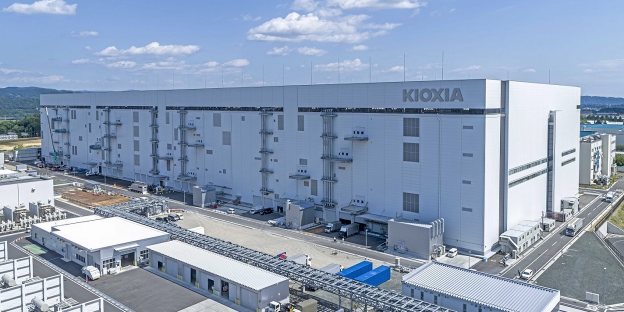
As Kioxia briefly saw its market capitalization exceed ¥50 trillion on June 16—becoming only the second Japanese firm to reach that level—focus has turned to whether the NAND upcycle can sustain its momentum. Notably, Global Economic News, citing Nikkei, reports that the company is taking a more cautious investment stance, with a relatively conservative capex plan over the next three years.
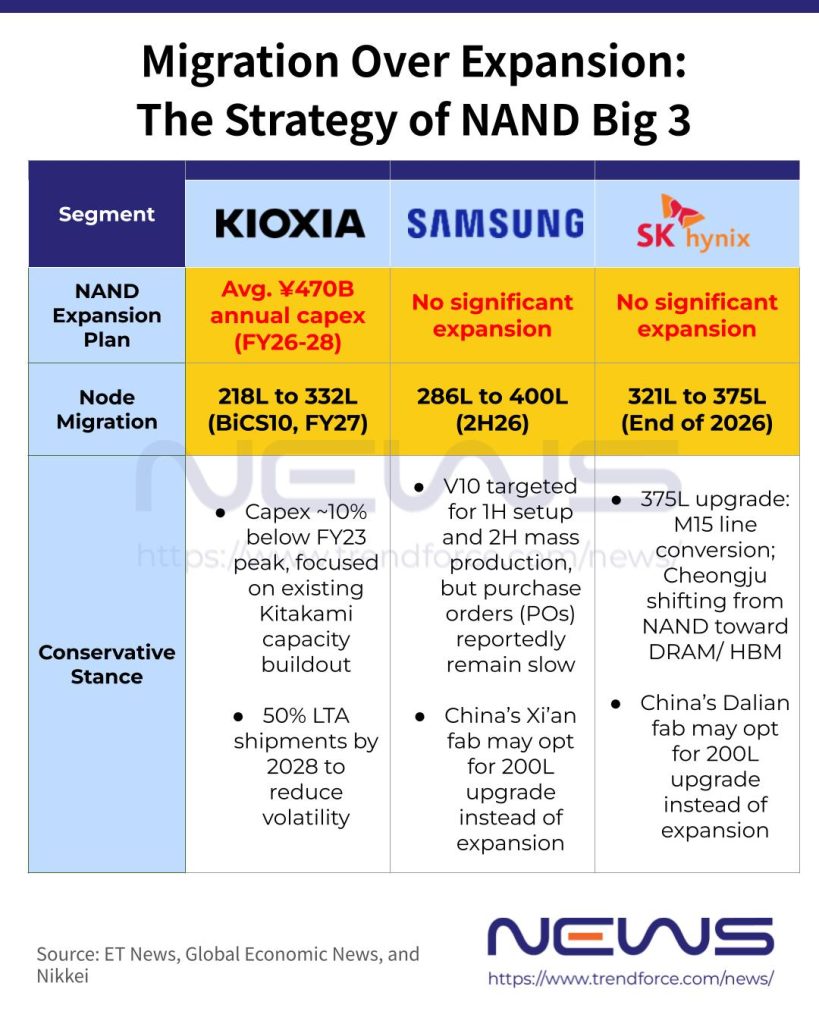
As previously reported by EE Times Japan, Kioxia plans average annual capex of around ¥470 billion for FY2026–FY2028, up 66% from FY2025. Total spending over the period is expected to reach roughly ¥1.4 trillion.
However, Nikkei notes that the average remains about 10% below its previous peak in FY2023 (¥510.4 billion). The move is therefore interpreted as a pre-emptive strategy to avoid memory market oversupply.
Past Expansion Losses Drive Investment Caution
Global Economic News further explains the rationale, noting that Kioxia’s more cautious investment stance is largely rooted in its painful experience in 2022, when it committed ¥1 trillion to expand capacity at its Yokkaichi plant. However, the post-pandemic downturn quickly reversed the cycle, leading to a slump in demand that pushed the company into losses for five consecutive quarters through Q4 2023, the report adds.
Against this backdrop, the report suggests that Kioxia is focusing on cash flow discipline, limiting spending mainly to its Kitakami plant in Iwate Prefecture, where it still has available cleanroom capacity.
Yet Kioxia’s conservative stance comes as the NAND market enters a strong upcycle. According to TrendForce, total NAND Flash contract prices are expected to rise by 70–75% QoQ in 2Q26, while average SLC NAND prices have surged by an estimated 130–150% during the first half of the year. The improving pricing environment could provide Kioxia with an opportunity to strengthen cash flow and profitability while maintaining a disciplined investment strategy.
LTA Implications: A Double-Edged Sword?
As NAND contract prices are on an upward trend, TrendForce also expects a clear NAND Flash shortage in 2026, while significant capacity additions are unlikely before late 2027 or 2028. As cloud service providers move to secure supply, long-term contracts are gaining traction.
In line with this trend, Kioxia President Hiroo Ota has set a goal of placing 50% of shipments under LTAs by 2028 through multi-year agreements with hyperscale cloud providers, according to Global Economic News.
However, the report notes that a surge in LTA signings can also be viewed as a potential late-cycle indicator. During periods of severe supply tightness, customers rush to secure capacity while suppliers seek to lock in favorable pricing, raising concerns that the market may be approaching a cyclical peak, the report adds.
South Korean Players Poised to Benefit
As Kioxia maintains supply discipline, Global Economic News notes that any recovery in NAND profitability could prompt Samsung Electronics or SK hynix to restore output or even pursue unexpected capacity expansions, potentially supporting near-term price strength.
Against this backdrop, Kioxia’s conservative investment stance is further tightening commodity NAND supply, creating opportunities not only for Samsung and SK hynix but also for Korea’s materials, components, and equipment suppliers, including ALD (atomic layer deposition) equipment makers critical to advanced NAND scaling, the report adds.
Nonetheless, the most direct beneficiary of Kioxia’s boom could be SK hynix. According to Financial Times, Bain Capital is set to reap more than $15 billion in gains from its 2018 buyout of Kioxia. Though Bain Capital has reportedly sold out its own stake, the report notes that the Korea–US–Japan consortium fund, which includes SK hynix and other investors, still holds an 18% stake in Kioxia, leaving a substantial portion of potential gains unrealized.
Market expectations cited by the report suggest the consortium’s total returns could exceed $70 billion, driven by the sharp appreciation in Kioxia’s valuation since its listing.
Read more
- [News] The Race to 400-Layer NAND: Roadmaps and Key Technologies Driving Samsung, SK hynix, and Kioxia
- [News] Kioxia Targets ¥470B Yearly Capex in FY26–28, Up 66% from FY25, Reportedly Weighing Third Kitakami Fab and M&A
(Photo credit: Kioxia)