[News] SK hynix Develops 1c LPDDR6 DRAM with 33% Speed Gain, 20% Power Savings; Ships in 2H26
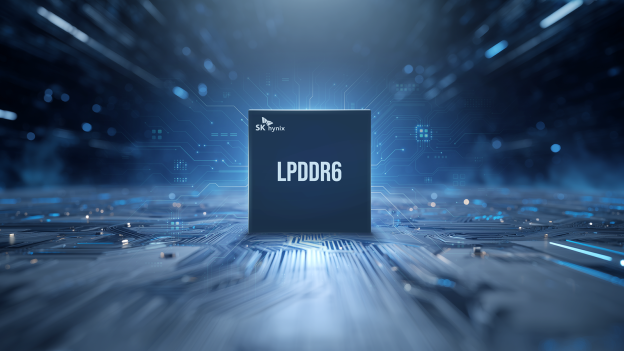
After JEDEC unveiled the LPDDR6 standard last August, SK hynix announced it has successfully developed a 16Gb LPDDR6 DRAM using its 6th-generation 10nm-class (1c) process, aiming to complete mass-production preparations in the first half of the year and start shipments in the second half.
According to its press release, SK hynix first showcased the product at CES 2026 in January and recently completed the world’s first development certification for a 1c-based LPDDR6, designed mainly for smartphones and tablets with on-device AI.
SK hynix highlighted that the chip boosts data processing by 33% over LPDDR5X, thanks to expanded bandwidth that increases the amount of data transmitted per unit time. The chip reportedly operates at a base speed of over 10.7Gbps, exceeding the peak performance of earlier generations, while power consumption has been cut by more than 20% compared with the previous generation.
As previously reported by Business Korea, by introducing an “Efficiency Mode,” SK hynix’s LPDDR6 is capable of cutting power consumption while sustaining a 12.8Gb/s transfer rate. The company said the chip achieves 10.9Gb/s under low-voltage conditions and maintains stable performance even at peak speeds of 14.4Gb/s, according to Business Korea.
The company attributed the lower power consumption to the adoption of a sub-channel architecture and Dynamic Voltage and Frequency Scaling (DVFS) technology. Yonhap News further explains that the sub-channel architecture is designed to activate only the necessary data paths, minimizing unnecessary power consumption. Combined with DVFS, these technologies enhance performance and efficiency, extending battery life and improving multitasking on mobile devices, the report notes.
For instance, Yonhap News suggests that in high-performance scenarios such as gaming, the system raises voltage and frequency to achieve maximum bandwidth, while under normal usage it lowers them to reduce power consumption.
Memory Giants Step up LPDDR6 Race
As the battle for high-performance, low-power memory in on-device AI intensifies, leading memory players are accelerating their innovation. Samsung Electronics and SK hynix both showcased LPDDR6 milestones at the 2026 ISSCC in February, according to Business Korea.
In addition to SK hynix, Business Korea notes that Samsung’s LPDDR6 emphasized power efficiency, with most circuits operating at ultra-low voltages and read power cut by 27% compared with LPDDR5. On the other hand, the chip reached a data transfer rate of 12.8Gb/s at a minimum voltage of 0.97V, and structural optimizations were applied to ensure stable performance in real-world usage scenarios, the report notes.
Business Korea notes that LPDDR, traditionally used in smartphones for its low power consumption, is now attracting attention in AI infrastructure. According to the report, inference AI generates temporary “KV cache” data to maintain conversation context. As the context length grows, KV cache demands can rise sharply, potentially exceeding the HBM capacity in GPUs. Combining HBM’s high bandwidth with LPDDR’s high capacity and low-power design is therefore emerging as a promising solution.
Read more
- [News] SK hynix, Samsung Showcase LPDDR6 at ISSCC as Qualcomm Reportedly Eyes Samsung’s LPDDR6X
- [News] SK hynix Debuts 16-Layer 48GB HBM4 at CES 2026, Alongside SOCAMM2 and LPDDR6
(Photo credit: SK hynix)
Please note that this article cites information from Yonhap News, Business Korea and SK hynix.