[News] Samsung, SK hynix Reportedly Delay Phase-out to 2026 as DDR4 Becomes Unexpected Cash Cow
With DDR4 prices holding strong amid tight supply, memory giants that once planned to phase out the chip are now reversing course. South Korea’s Maeil Business Newspaper reports that Samsung and SK hynix will extend DDR4 production into next year.
Previously, as Commercial Times noted, both companies had aimed to end DDR4 shipments between late 2025 and early 2026. But citing industry sources on September 1, Maeil says Samsung will continue production through 2026, while SK hynix is taking the same approach—informing customers and boosting DDR4 output at its older Wuxi fabs in China.
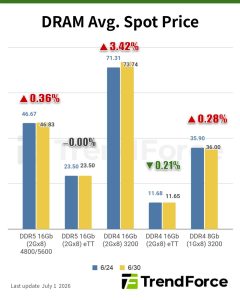
The move, as per Maeil, has been sending DDR4 prices soaring. Commercial Times also points out that tight supply and rapidly dwindling inventories are restricting shipments, driving DDR4 module prices higher. DDR5 modules are also climbing amid constrained supply, highlighting the ongoing demand for legacy products, as Commercial Times suggests.
DDR4 Shortage Sparks Price Surge
Why are memory giants reversing their DDR4 phase-out plans? Maeil reports that as recently as early 2024, Samsung, SK hynix, and Micron had told customers they would wind down DDR4 output. But a surge in HBM demand has changed the dynamics. HBM production typically consumes about three times as many wafers as standard DRAM, leaving fewer resources for conventional DDR4, the report notes.
The squeeze deepened when China’s DRAM leader announced it would halt DDR4 production this year, speeding its shift to DDR5 with government subsidies, as noted by Maeli. The combined pressures have tightened supply so sharply that DDR4 prices have now overtaken DDR5—a rare reversal prompting memory makers to keep older production lines running to lock in higher margins, Maeil adds.
TrendForce’s latest findings reveal the DDR4 market is set to remain in a persistent state of undersupply and strong price growth through 2H25.
Notably, TrendForce reports that DRAM suppliers and PC OEMs are finalizing 3Q25 contract prices. With limited production capacity and resources tilted toward the server segment, most PC-side demand cannot be met. In July, prices for 8GB PC DDR4 modules surpassed those of DDR5 modules of the same capacity in a rare “price inversion.”
Will the Party Last?
However, Micron appears to be sticking to its original plan. According to MoneyDJ, citing Nikkei, Executive VP and Chief Business Officer Sumit Sadana confirmed that the U.S. memory giant issued end-of-life (EOL) notices for DDR4 and LPDDR4 in June, with DDR4 shipments expected to end within 2–3 months.
On the other hand, analysts cited by Maeli caution that the pricing reversal won’t last. When DDR2 gave way to DDR3, a similar four-month flip reportedly occurred before the transition completed and the anomaly disappeared. SK hynix echoed that view on its July 24 earnings call, describing the recent DDR4 spike as “a short-term demand surge driven by supply concerns,” the report adds.
Anyhow, the report notes that Samsung, with its larger share of commodity DRAM production, is seen as the main beneficiary of higher DDR4 prices. But SK hynix could also reap gains if it significantly ramps up DDR4 output at its Wuxi facilities, the report notes.
Read more
- [Insights] Memory Spot Price Update: DDR4 Price Surge Slows Amid Samsung EOL Delay Rumors
- [News] DDR4 Exit Timeline Unfolds for Top Memory Makers: Plans for Samsung, SK hynix and Micron
- [News] DDR4 Spot Prices Reportedly Double as China’s Memory Maker Rumored to Phase out Production by 2026
(Photo credit: Samsung)
Please note that this article cites information from Maeil Business Newspaper, Commercial Times, MoneyDJ and Nikkei.