[News] Decoding Googlebook Chip Partners: Intel Confirms Role, Qualcomm and MediaTek Also Reportedly in Play
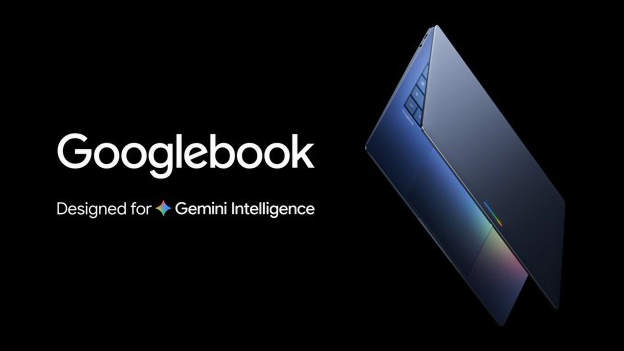
Shortly after Google unveiled its upcoming Googlebook lineup, Intel confirmed on X that its chips will power the new platform, saying it is “thrilled” to partner with the search engine giant and describing the devices as “premium, powerful ones designed for intelligence.” With technical details still under wraps, the announcement has quickly fueled market speculation over which Intel silicon will power the new machines.
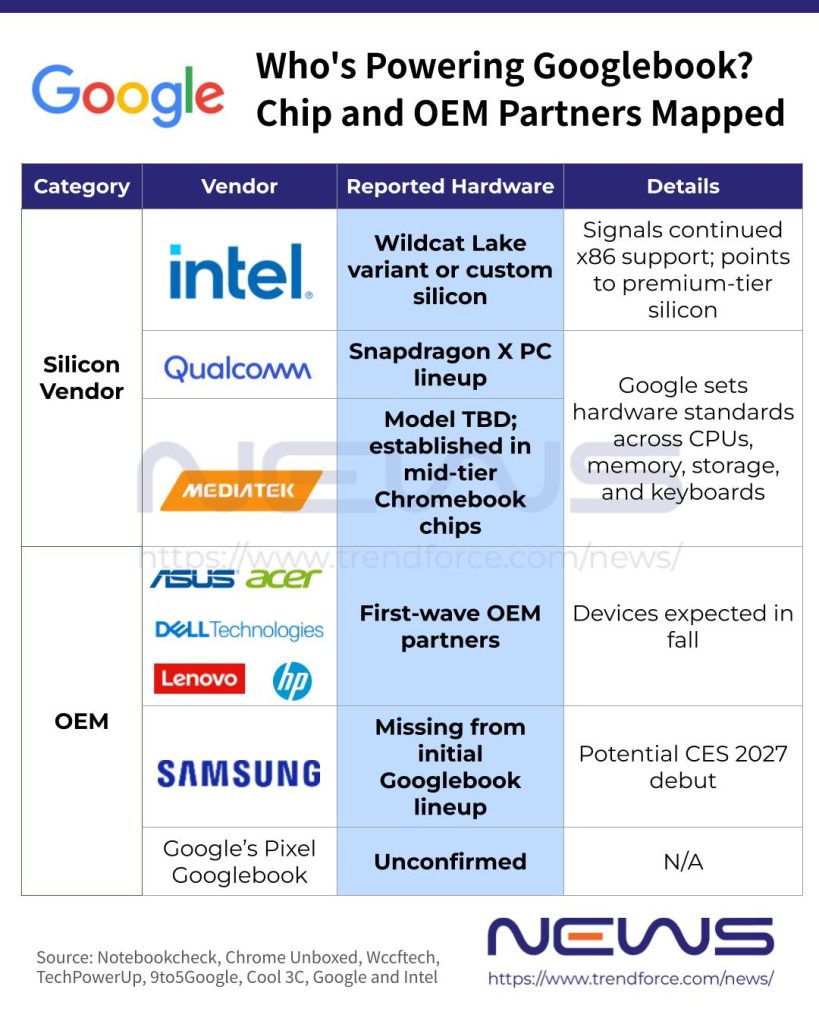
Google says the Googlebook ecosystem will launch with five OEM partners—Acer, ASUS, Dell, HP, and Lenovo—with the first devices slated for this fall. However, Intel may not be the sole silicon provider. According to Notebookcheck, citing Chrome Unboxed’s interview with Google VP John Maletis, Google is setting strict hardware standards across the platform, spanning processors from Intel, Qualcomm, and MediaTek to memory, storage, and even keyboard layouts.
Chip Partners Take Shape for Googlebook
Notably, Wccftech reports that while Google’s Googlebook is not intended to replace Chromebooks for now, Intel’s use of the term “powerful” suggests the platform is aimed above entry-level or low-end silicon.
Given Googlebook’s AI-centric positioning, Intel’s upcoming Core Series 3 “Wildcat Lake” appears to be a plausible fit, the report notes, adding that it could either be custom silicon designed and manufactured by Intel, or a tailored variant of its Wildcat Lake platform optimized for Googlebook.
Interestingly, TechPowerUp reports that one of Intel’s first Wildcat Lake reference laptops surfaced in April, featuring a design closely resembling Apple’s $599 MacBook Neo. The system is said to use a 6-core configuration with two Xe3 cores and a 17 TOPS NPU, housed in an aluminum chassis with a bright, Neo-like finish.
As for potential silicon from Qualcomm and MediaTek powering Googlebook, 9to5Google reports that Qualcomm has been expanding its Apple-competitive push with its Snapdragon X PC lineup, while MediaTek’s role remains less defined beyond its long-standing presence in mid-tier Chromebook chips. The report adds that Intel’s inclusion also points to continued x86 support within the ecosystem.
Ultimately, the success of these partnerships hinges on AI capabilities. Against this backdrop, Cool 3C points out that it is speculated that a TPU at least on par with the Pixel 10’s Tensor G5 would likely be required to power on-device Gemini AI experiences. That said, the focus may not be on the overall chip tier, but rather NPU performance as the key driver, according to the report.
Samsung Missing From Initial Googlebook OEM Lineup
Notably, Samsung was a conspicuous omission from the initial roster of five OEM partners announced by Google. As highlighted by 9to5Google, while previous supply chain leaks suggested Samsung is developing an Android-based “Galaxy Book” powered by One UI 9, the tech giant was notably absent from the fall 2026 launch lineup of Googlebook.
When questioned about this absence, a Google representative cited by the report declined to comment, though industry insiders understand the current list to reflect only the “first-wave” partners. This leaves the door open for a later debut—potentially at CES 2027—allowing Samsung more time to refine its integration of Galaxy AI within the new OS, the report notes.
Similarly, rumors of a first-party “Pixel Googlebook” remain unconfirmed, as per 9to5Google.
Read more
- [News] Google TPU Push Reportedly Meets Cautious Early Adoption from AI Infrastructure Providers
- [News] Intel’s EMIB Reportedly Gains Traction at Google, Meta; Yields Said to Reach ~90% Milestone
(Photo credit: Google)