[News] SK hynix Starts Mass Production of 192GB SOCAMM2, Tapping 1c DRAM and NVIDIA Rubin Optimization
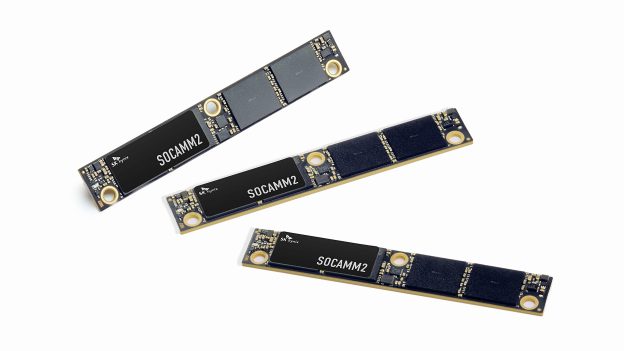
As NVIDIA accelerates adoption of SOCAMM2 (Small Outline Compression Attached Memory Module 2), competition among memory heavyweights is intensifying. Following Micron’s shipment of 256GB SOCAMM2 samples in early March, SK hynix announced on April 20 that it has kicked off mass production of 192GB SOCAMM2 modules, built on its 10nm-class sixth-generation (1c) LPDDR5X low-power DRAM.
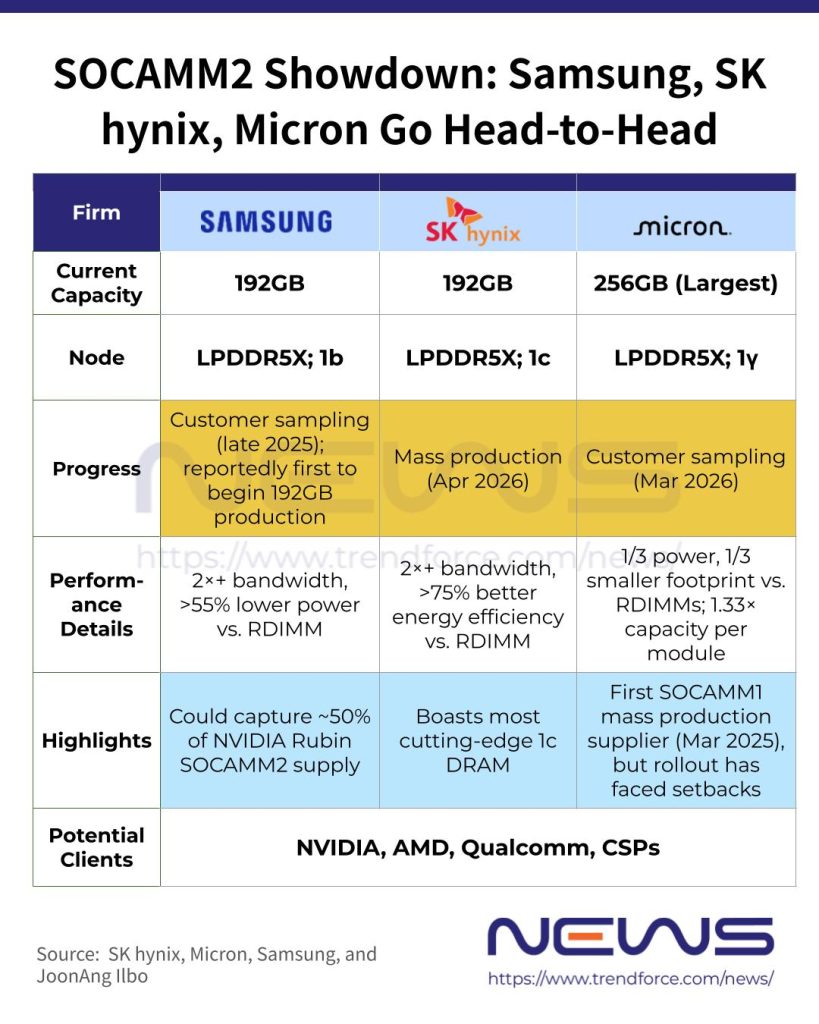
As highlighted by SK hynix, its SOCAMM2, built on 1c DRAM, delivers more than twice the bandwidth and over 75% improved energy efficiency compared with conventional RDIMM (Registered Dual In-line Memory Module). News 1 notes that positioned as the industry’s first module optimized for NVIDIA’s next-generation Vera Rubin platform, the product is expected by SK hynix to ease memory bottlenecks in both training and inference of ultra-large AI models.
SK hynix explains that SOCAMM2 is a server-optimized module derived from low-power memory traditionally used in mobile devices such as smartphones, which leverages a compression-type connector to enhance signal integrity while enabling easier module replacement. The company adds that it has quickly stabilized mass production in line with demand from global cloud service providers (CSPs).
According to News1, as AI data centers increasingly demand a new memory layer to bridge the performance and power gap between ultra-high-bandwidth HBM and high-capacity DDR5 RDIMM, SOCAMM2 is emerging as a key pillar of AI infrastructure—alongside HBM, DDR5, and CXL—by combining LPDDR’s low-power efficiency with a modular, serviceable design. SK hynix adds that it has quickly stabilized mass production in line with demand from global cloud service providers (CSPs).
Samsung, Micron Also Make Strides
Meanwhile, the other two memory giants are also moving fast. Samsung, according to ETNews, has recently overcome the warpage issue, a major hurdle for SOCAMM2, by applying its internally developed next-generation low-temperature solder (LTS) technology.
The report suggests that SOCAMM2 is particularly susceptible to warpage, as it uses a structure in which LPDDR5X chips are assembled into a module and secured through bolt-based compression, increasing the risk of connection failures. To address this, Samsung lowered the soldering process temperature from above 260°C to below 150°C to minimize thermal expansion mismatches, as per ETNews.
A previous JoonAng Ilbo report indicated that Samsung is reinforcing its position as the first in the industry to begin mass production of 192GB SOCAMM2 modules. Analysts cited by the report noted that it shipments to NVIDIA could reach around 10 billion Gb, accounting for roughly half of total SOCAMM2 demand.
On the other hand, in early March, Micron had shipped the world’s first 256GB SOCAMM2 customer samples, marking an approximately 33% increase in capacity compared with the 192GB flagship products from Samsung Electronics and SK hynix, as highlighted by the report.
Read more
- [News] Samsung Reportedly Solves SOCAMM2 Warpage, May Gain Edge Over Micron, SK hynix in Mass Production Timeline
- [News] SOCAMM War Heats up: Micron Ships 256GB SOCAMM2 Samples, Topping Industry Capacity
(Photo credit: SK hynix)