[News] Decoding Impact: Asia Chipmakers Move to Tackle Helium Strain as Intel Gains Relative Buffer

While Iran and the U.S. have agreed to a ceasefire contingent on guaranteed safe passage through the Strait of Hormuz, the helium crisis across the semiconductor supply chain shows temporary signs of easing.
However, as highlighted by Forbes, Qatar’s Ras Laffan Industrial City, which supplies roughly one-third of global output, has remained largely offline since early March following Iranian strikes. The disruption has reportedly removed an estimated 27–30% of global supply, pushing spot prices up 40–100% within weeks.
As a result, amid heightened geopolitical uncertainty, secure gas supply has emerged as a key concern, with ripple effects now visible across leading global semiconductor firms and prompting a series of strategic responses.
South Korea: Samsung, SK hynix Sign LTAs
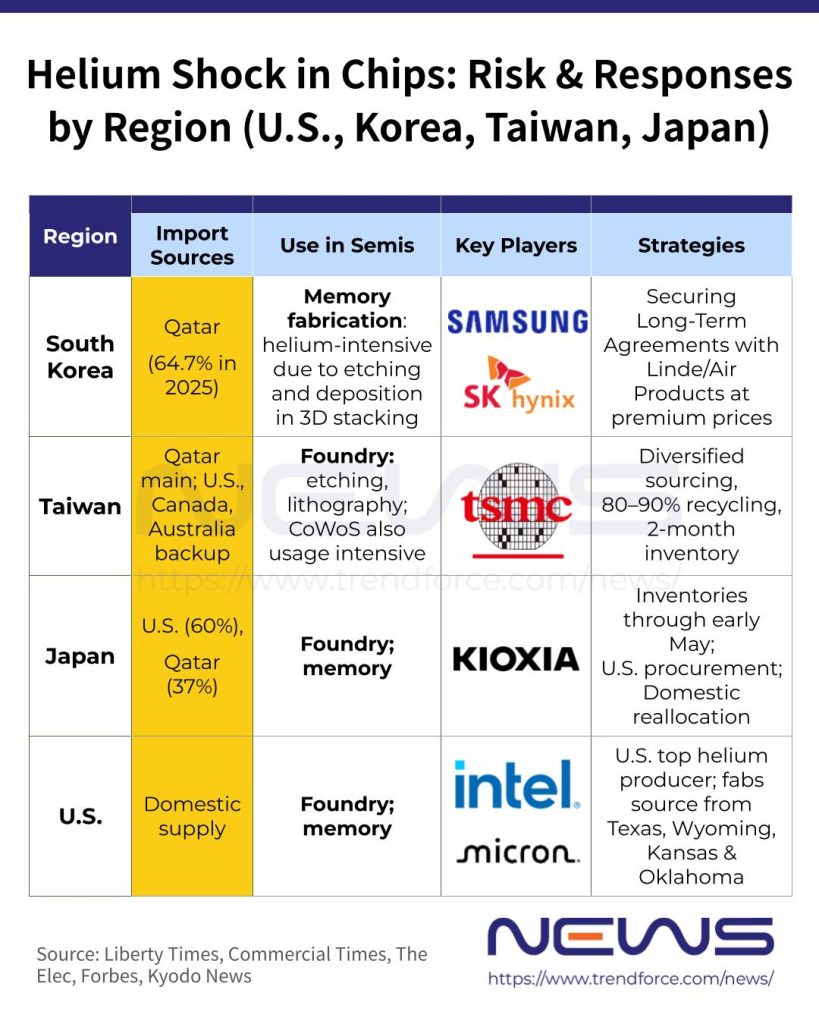
According to Forbes, nowhere is this vulnerability more pronounced than in South Korea, as the country sourced around 64.7% of its helium imports from Qatar in 2025.
Notably, Forbes suggests that memory fabrication is particularly helium-intensive due to repeated high-temperature etching and deposition processes required for advanced 3D stacking architectures. Thus, Samsung and SK hynix are actively diversifying supply sources, expanding recycling efforts, and reallocating procurement volumes to strengthen resilience.
Roughly coinciding with easing U.S.-Iran tensions, The Elec reports that Germany’s Linde and U.S.-based Air Products—both sourcing helium feedstock primarily from the U.S.—have secured additional long-term supply agreements with Samsung Electronics and SK hynix. Both memory giants are said to have accepted higher helium prices as part of efforts to stabilize supply during the crisis.
Yonhap News, citing officials, reports that the South Korean government has secured roughly four months’ worth of semiconductor-grade helium, noting that industry feedback indicates no immediate disruptions.
Taiwan: TSMC Maintains Supply Resilience Despite Helium Risks
As Forbes notes, helium is widely used for wafer backside cooling during lithography and etching, maintaining thermal and vacuum stability in process tools, as well as for leak detection, gas purging, and as a carrier gas in plasma-enhanced chemical vapor deposition (CVD) and extreme ultraviolet (EUV) lithography.
Commercial Times reports that though helium accounts for less than 1% of wafer manufacturing costs, it remains irreplaceable in etching and process cooling stages. Sources cited by the report suggest both semiconductor-grade 6N electronic helium and EUV-grade helium rose by more than 5% on April 2, underscoring mounting cost pressures across the supply chain.
Thus, Forbes suggests TSMC is also exposed to the supply-chain risk. According to Forbes, TSMC’s Chip-on-Wafer-on-Substrate (CoWoS) advanced packaging lines rank among the most helium-sensitive manufacturing processes.
However, the Forbes report notes that TSMC’s diversified logic portfolio and global supply footprint provide greater flexibility. The company also relies on diversified sourcing, high-efficiency on-site recycling—achieving 80–90% recovery at leading fabs—and ample inventory buffers to mitigate risks. According to Liberty Times, TSMC maintains more than two months of helium inventory, reinforcing supply stability.
Japan: Helium Supply Concerns Mount Amid Import Reliance
Another major semiconductor hub in Asia is also facing rising pressure from helium supply uncertainty. According to Kyodo News, Japan is stepping up efforts to secure alternative sources as supply concerns intensify. Trade data cited by the report show that in 2025, about 60% of Japan’s helium imports came from the U.S. and roughly 37% from Qatar.
According to Kyodo News, Japan’s Ministry of Economy, Trade and Industry (METI) said existing inventories can sustain supply through early May, while procurement from the U.S. is underway to replace Middle East volumes. However, some domestic firms have begun restricting sales amid ongoing regional tensions, with Japan Helium Co. redirecting part of its overseas supply to the domestic market, the report adds.
For the semiconductor sector, supply stability remains a concern. A Kioxia representative cited by the report said there has been no immediate impact, but stressed that helium is difficult to substitute and essential for chip production.
Why Intel Could Be a Relative Winner in the Helium Crunch
Notably, Forbes reports that U.S.-based semiconductor manufacturers, particularly those with significant domestic capacity such as Intel, are less exposed to the near-term helium squeeze than their Asian peers. The United States is the world’s largest helium producer, with output of roughly 81 million cubic meters annually, and most domestic fabs source supply from Texas, Wyoming, Kansas, and Oklahoma, supplemented by Algeria, the report adds.
Meanwhile, analysts cited by the report also expect U.S. industrial gas suppliers such as Air Products, Linde and ExxonMobil to benefit from tightening global helium supply, as customers increasingly pivot toward more stable U.S. and North American sources.
Read more
- [News] Iran Conflict Reportedly Drives 50%+ Helium Spot Price Surge; Samsung, SK hynix on High Alert
- [News] Under Qatar’s Shadow: Helium Crunch Hits South Korea Harder, Putting Samsung, SK hynix, TSMC in Spotlight
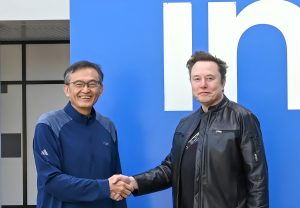
(Photo credit: Intel)