Popular Keywords



About TrendForce News
TrendForce News operates independently from our research team, curating key semiconductor and tech updates to support timely, informed decisions.
[News] Memory Giants’ HBM Cleanroom Race: Samsung & SK hynix Fast-Track, Micron Acquires
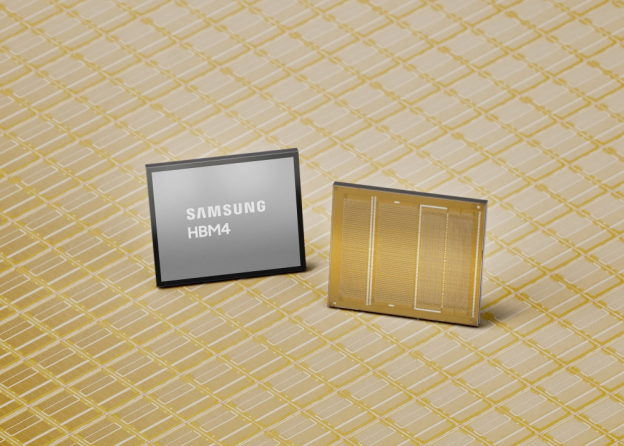
Amid soaring memory demand and aggressive product roadmaps from NVIDIA and other big techs, memory giants are racing not just on chip performance but also on cleanroom capacity, each taking a different approach. Financial News reports that Samsung and SK hynix are fast-tracking cleanroom construction to stay ahead, while Micron is pursuing a brownfield strategy, acquiring existing facilities to overcome constraints.
Samsung Accelerates P4 & P5 Construction at Pyeongtaek
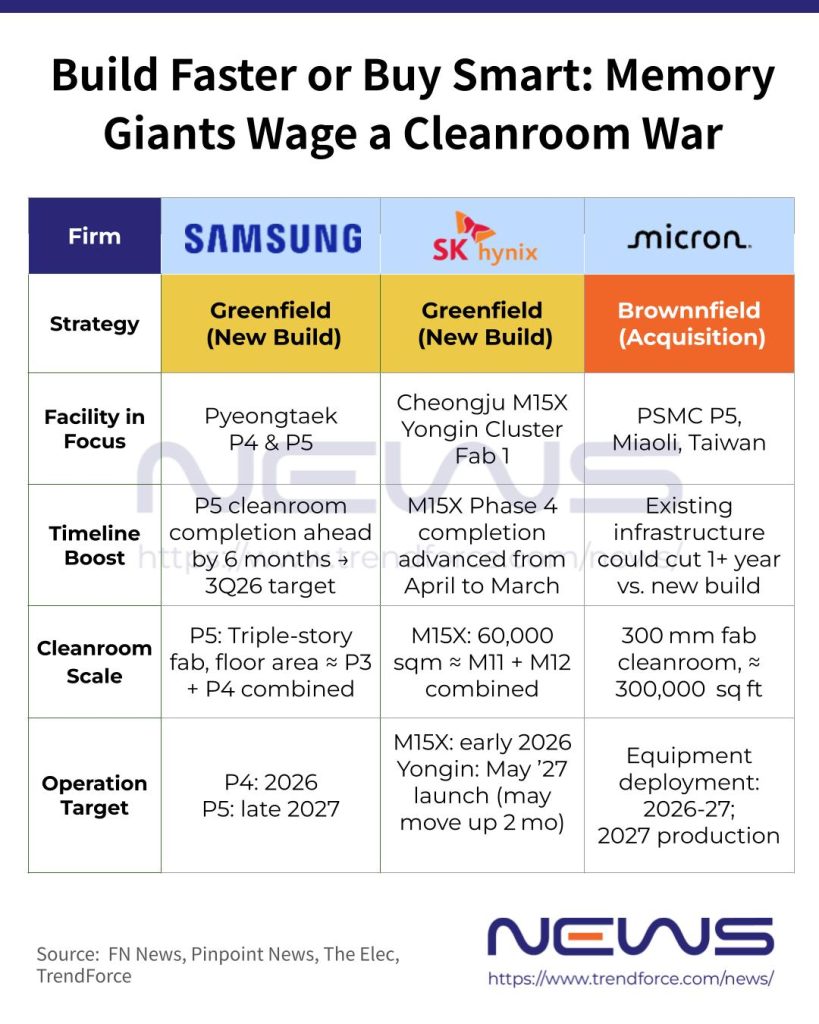
The report suggests that Samsung is said to be bringing forward the construction schedule for the cleanroom at its P5 production line at its Pyeongtaek campus by more than six months, setting completion for the third quarter of 2026. As a result, the facility’s operational target is expected to move up from early 2028 to late 2027, the report adds.
In addition, Samsung is also using a “fast-track” approach, building structures and utilities like gas and chemical systems simultaneously, Financial News notes. An earlier Pinpoint News report indicated that rising memory demand had prompted the company’s directives to shorten construction timelines for the P4 and P5 lines, with night shifts reportedly added to speed up progress.
Notably, Pinpoint News reported that P5 will boast a triple-story fab, giving it a total floor area roughly equal to the combined size of P3 and P4. Meanwhile, the P4 line is expected to come online well ahead of P5, around 2026, according to the report.
SK hynix Fast-Tracks M15X and Yongin Fabs
On the other hand, Financial News reports that SK hynix is fast-tracking construction at its Cheongju M15X fab, as the company has moved Phase 4’s completion from April to March, following an earlier decision to advance the startup of the first cleanroom, Phase 3, to February.
As previously reported by The Elec, the M15X fab is set to mass-produce HBM4 and boasts ample cleanroom space. The report added that the site spans 60,000 square meters—roughly the same size as the combined M11 and M12 plants in Cheongju.
Meanwhile, construction of the first fab at the Yongin semiconductor cluster is also being accelerated, with SK hynix aiming to shorten build timelines to meet its target of launching operations in May 2027, the Financial News report notes.
Micron’s Brownfield Play
Unlike its South Korean peers, Micron, whose new U.S. capacity won’t come online until 2027, is boosting output by acquiring existing facilities. The company recently finalized the roughly $2 billion acquisition of Taiwan’s PSMC P5 fab in Tongluo, Miaoli County.
Notably, Financial News points out that the facility already has fully built cleanroom infrastructure for 300mm wafer production, allowing Micron to accelerate its production timeline by over a year compared with building a new plant from scratch.
According to TrendForce’s projection, Micron plans to deploy both existing and new equipment in phases during 2026–2027, mainly front-end tools for advanced DRAM manufacturing, with mass production expected in 2027. The capacity from Phase 1 at Tongluo in the second half of 2027 is projected to surpass 10% of Micron’s global capacity as of the fourth quarter of 2026, TrendForce adds.
Interestingly, as Financial News notes, the three memory giants’ aggressive push to secure cleanroom capacity reflects the growing process complexity of HBM4: it features higher stacking layers and increasingly segmented manufacturing steps, requiring substantially larger cleanroom space to produce the same output compared with previous generations. As a semiconductor industry source cited by the report points out, the key battleground for memory makers today is no longer just technological capability, but also “supply visibility.”
Read more
- [News] NVIDIA May Relax HBM4 Specs as Samsung and SK hynix Reportedly Face Capacity, Yield Limits
- [News] Samsung Delivers First-Ever Commercial HBM4, Boosting Speeds from 11.7 Gbps to 13 Gbps
(Photo credit: Samsung)
Please note that this article cites information from Financial News, Pinpoint News and The Elec.