





 Download Report
 Contact Us
AI-Native 6G Revolution: Supply-Chain Strategies from 5G-Advanced

Last Modified
2026-01-06

Update Frequency
Not

Format
The arrival of 6G marks a fundamental shift toward fully AI-native network architectures, reshaping both communications technologies and market structures. Compared with 5G-Advanced, 6G design places a much stronger emphasis on energy efficiency—measured as energy per bit—driving a new division of labor between C-RAN and O-RAN, broader adoption of GaN and SiC materials, and deeper integration of photonic and electronic interconnect technologies.
AI is becoming increasingly central to RAN control, beam management, scheduling optimization, and spectrum allocation. At the same time, emerging materials such as AIN, Ga2O3, and diamond are demonstrating significant potential to surpass the performance limits of today’s mainstream semiconductors. Together, technological advances and commercial imperatives are jointly reshaping competitive dynamics in the 6G era, unlocking high-value markets spanning Industry 5.0, autonomous driving, smart healthcare, and AI agents
Key Highlights
- Shift to AI-Native 6G Architecture: 6G emphasizes AI integration in network control, beam management, and spectrum allocation, moving from bandwidth-focused to energy-efficient designs, enabling edge computing and automated optimization for applications like autonomous driving and smart healthcare.
- AI-Driven Challenges and Necessity: Edge-based data generation and AI inference expose bottlenecks in heterogeneity and traffic asymmetry, making architectural redesign essential for scalability.
- Emerging Materials Potential: AlN, Ga2O3, and diamond offer superior thermal conductivity and breakdown fields, promising advancements in RF, power devices, and extreme environments.
Table of Contents
- Communication Bottlenecks in the AI Era and the Inevitability of 6G
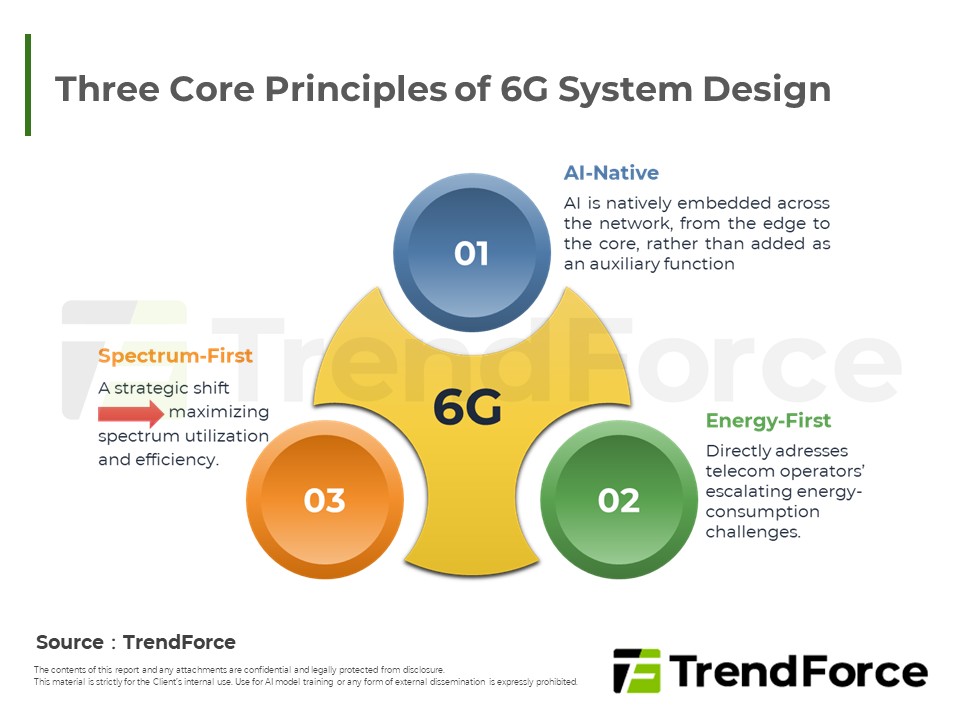
- Figure 1: Three Core Principles of 6G System Design
- The WBG and III-V Materials Revolution: Laying the Physical Foundation for 6G
- Table 1: Energy Efficiency Assessment of Semiconductor Materials Across Cross-Domain Applications
- Figure 2: Technical and Performance Analysis of SiGe and CMOS in Advanced mmWave Transceivers
- Figure 3: Changes in Power Consumption and Antenna Count in Transmitter Architectures Using CMOS, SiGe, and InP
- TRI’s View
<Total Pages: 15>

Spotlight Report
-

AI Wave & DRAM Deficits: 2027 Global DRAM Outlook
2026/07/28
Selected Topics
PDF
-

AI Surge Drives NOR Flash Deficit: 2026 Industry Outlook
2026/09/10
Selected Topics
PDF
-

iPhone 18: Modest Hardware Gains, Pricing and AI Drive Sales
2026/09/02
Selected Topics
PDF
-

AI Server Boom Outpaces U.S. Grid Buildout
2026/09/07
Selected Topics
PDF
-

US Data Center Buildout Faces Midterm Risks
2026/10/07
Selected Topics
PDF
-

AI Server Value Surges on Pricing and Capex Boom
2026/10/08
Selected Topics
PDF
Selected TopicsRelated Reports


Download Report
2,500

Membership
- Selected Topics
- Selected Topics-170_AI-Native Communications Revolution: Technologies, Industry Dynamics, and Supply-Chain Strategies from 5G-Advanced to 6G
Spotlight Report
-
AI Wave & DRAM Deficits: 2027 Global DRAM Outlook
2026/07/28
Selected Topics
PDF
-
AI Surge Drives NOR Flash Deficit: 2026 Industry Outlook
2026/09/10
Selected Topics
PDF
-
iPhone 18: Modest Hardware Gains, Pricing and AI Drive Sales
2026/09/02
Selected Topics
PDF
-
AI Server Boom Outpaces U.S. Grid Buildout
2026/09/07
Selected Topics
PDF
-
US Data Center Buildout Faces Midterm Risks
2026/10/07
Selected Topics
PDF
-
AI Server Value Surges on Pricing and Capex Boom
2026/10/08
Selected Topics
PDF