

NVIDIA and Broadcom Begin Volume Ramp of CPO Switches, with Optical Engine Yield and Advanced Packaging Capacity Emerging as Key Expansion Bottlenecks, Says TrendForce
TrendForce's latest research on the optical communications industry reveals that NVIDIA has begun shipping its next-generation Spectrum-X CPO switch to select partners. Meanwhile, Broadcom is continuing limited shipments of its 51.2T Bailly CPO switch, marking the official transition of co-packaged optics (CPO) into the mass production phase.
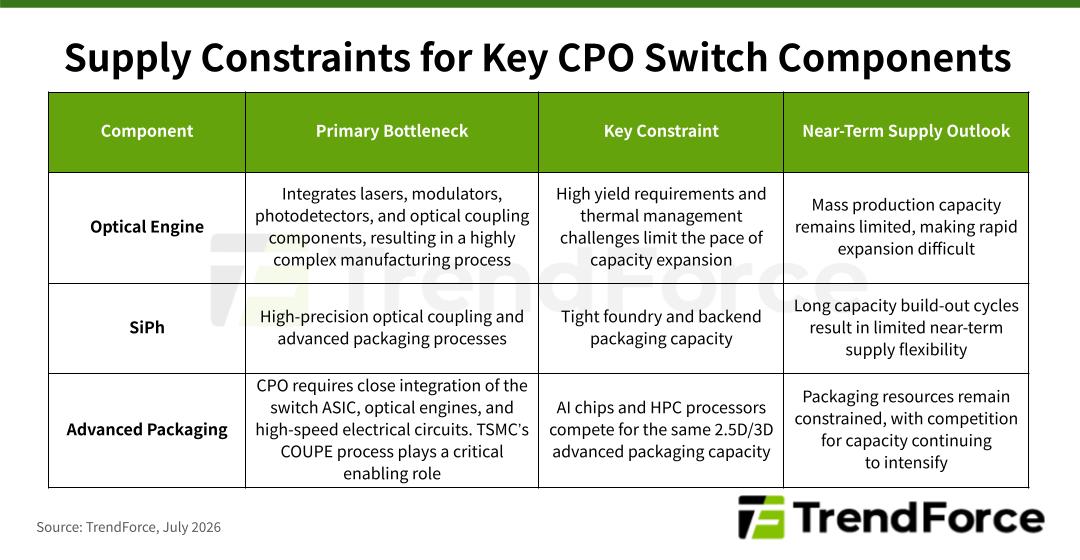
The supply capacity of key components, including optical engines, silicon photonics chips, and advanced packaging, is expected to become the primary factor determining the pace of future production expansion.
TrendForce notes that the Spectrum-X CPO switch—jointly developed by NVIDIA and TSMC—utilizes TSMC's COUPE advanced packaging technology and delivers up to 400 Tb/s of switching capacity. Production capacity is expected to expand further during the second half of 2026.
Broadcom's 51.2T Bailly CPO switch has entered volume manufacturing with support from Delta Electronics and Micas Networks. Compared with conventional pluggable optical transceivers, the solution reduces power consumption by up to 70% and has already completed deployment validation with hyperscale operators such as Meta.
CPO significantly improves power efficiency by integrating optical components directly around the switch ASIC, and has emerged as the leading architecture for next-gen high-bandwidth switches. However, TrendForce identifies three major supply-side bottlenecks that could constrain market expansion.
The first is the optical engine, which integrates lasers, modulators, photodetectors, and optical coupling components into a highly complex module. High manufacturing yields and effective thermal management are essential, limiting mass production to only a small number of suppliers.
The second bottleneck lies in silicon photonics (SiPh), where wafer fabrication and advanced packaging require extremely high levels of precision and reliability. Long capacity build-out cycles leave little flexibility to increase supply in the near term.
The third challenge is advanced packaging. As CPO switches become increasingly dependent on technologies such as COUPE, they must compete directly with AI chips and high-performance computing (HPC) processors for the same 2.5D/3D packaging resources, further tightening supply availability.
Supply chain pressure is driving a clear split in vendor strategy. Some cloud hyperscalers are locking in supply via long-term procurement deals and taking strategic stakes in upstream silicon photonics suppliers. NVIDIA, meanwhile, is deepening its alliance with TSMC, which controls advanced packaging capacity, to push toward vertical integration. Others, like Google, are moving to develop optical components in-house, cutting reliance on outside suppliers altogether.
TrendForce believes vertical integration is becoming the default playbook. Vendors that can control silicon photonics design, optical engine manufacturing, and advanced packaging in-house will be best positioned to lead once the CPO switch market hits its volume ramp in 2027–2028.
For more on the latest technology industry news and trends, please visit News.